
Lunch planners looking for lower-fat options
You’re looking for loose peanuts with demonstrably less fat and want to check a claim on the packaging. A cooking method such as oven-roasting doesn’t, by itself, prove that the fat content is lower.


If you want less fat, compare the nutrition information and the exact claim; unsalted or made without added oil doesn’t automatically mean peanuts contain less fat. For a school lunch, you also need to consider the school’s rules, allergens, your child’s ability to chew and the amount you pack.
You’re looking for loose peanuts with demonstrably less fat and want to check a claim on the packaging. A cooking method such as oven-roasting doesn’t, by itself, prove that the fat content is lower.
You want to know whether peanuts fit with the school’s rules, any allergies and your child’s ability to chew. A nutrition claim doesn’t change any of these considerations. The Netherlands Nutrition Centre warns about choking on whole peanuts; the NVWA provides information about allergens on labels.
You want to pack an appropriate amount in the lunchbox and compare nutritional values on the same basis. A portion size or reference intake for adults isn’t automatically a recommendation for your child.
First check the claim and nutritional values per 100 g; then see whether the variety fits with the school’s rules and the amount you want to pack.
| What to consider | What to look for | Who is this important to? |
|---|---|---|
| Demonstrably lower in fat | Compare fat and energy per 100 g, and check the exact claim and what it is being compared with. | If my main aim is to reduce total fat, I want to be able to check the claim and nutritional values; around 29% of consumers prioritise a demonstrable reduction in fat. |
| School rules and eating safely | Ask about the school’s rules and check the allergen information and form of food that suits your child. | If I’m considering peanuts for my child, I want to know whether they fit with the school rules and can be eaten safely; around 29% of consumers put school safety first. |
| Salt content | Compare salt per 100 g; ‘unsalted’ doesn’t mean a product contains less fat. | If I mainly want to limit salt, I look for a variety with a clearly stated salt content; around 24% of consumers focus primarily on salt. |
| Portion and storage | Check the portion weight and storage instructions; don’t treat an adult reference intake as advice for children. | If I want to pack an amount every day and store the rest properly, I pay attention to the portion and packaging; around 18% of consumers prioritise portion control. |
These words don’t automatically tell you the total fat content. For example, Albert Heijn lists 51 g of fat per 100 g for AH Unsalted Peanuts, so the ‘unsalted’ label doesn’t make this variety low in fat.
Read the nutrition table per 100 g and check exactly what the claim means. Compare portions only after you’ve checked the per-100 g figures.
Choosing based on fat or salt doesn’t change the allergens or the risk posed by whole, hard peanuts. The Netherlands Nutrition Centre warns about choking on whole peanuts, particularly for young children.
Check the school’s rules and the allergen information. Also consider your child’s ability to chew and the circumstances in which they’ll be eating.
Product pages may list different average portion sizes. The Jumbo product page states that its reference intake is based on an average adult.
Compare nutritional values per 100 g and decide separately how much to pack. Don’t treat an adult reference intake as your child’s personal requirement.
Albert Heijn’s warning of 20 May 2026 applies to AH Extra Large Salted Peanuts in a tub with a best-before date of 4 November 2026; the warning does not list other best-before dates as affected.
Check the exact product name, packaging and best-before date. Don’t consume the product with the date listed, and follow Albert Heijn’s instructions.
Duyvis sells plain peanuts as well as Oven Baked Peanuts Original. The manufacturer describes the Original variety as oven-baked without added oil or fat.
AH Unsalted Peanuts are an own-brand example whose salt, fat, portion size and allergen information you can compare on the product page.
Jumbo Unsalted Kingsize Peanuts are an own-brand variety with nutritional values listed per 100 g and per 25 g.
The Dutch product page describes unsalted peanuts in a 285 g pack.
ALDI Netherlands describes Trader Joe’s 250 g peanuts as roasted and unsalted.
PLUS Unsalted Peanuts are an own-brand example with information on ingredients, allergens, nutritional values and storage instructions.
These Joybuy products are standard peanut varieties that you can compare for factors such as preparation, salt and packaging; the information shown doesn’t prove that they have reduced fat content.
 No image available
An unsalted variety to consider if you mainly want to compare salt content; this doesn’t prove a reduction in fat.
The product description lists 50 g of fat and 0.02 g of salt per 100 g.
Contains peanuts and may contain cashew nuts. Check the school’s rules and any allergies.
Whole peanuts can pose a choking risk; consider your child’s ability to chew.
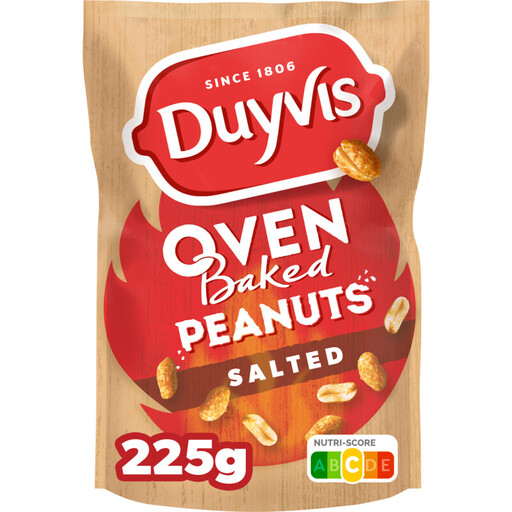 No image available
A roasted variety to compare if you’re considering how the peanuts are prepared; roasting alone doesn’t prove that they have a lower fat content.
The product description lists 50 g of fat and 1.4 g of salt per 100 g.
Contains peanuts and may contain nuts. Check the school’s rules and any allergies.
Whole peanuts can pose a choking risk; consider your child’s ability to chew.
 No image available
A roasted variety to compare with other peanuts if you’re looking at preparation and salt; the product information doesn’t prove a reduction in fat.
The product description lists 50 g of fat and 0.02 g of salt per 100 g.
Contains peanuts. Check the school’s rules and any allergies.
Whole peanuts can pose a choking risk; consider your child’s ability to chew.
 No image available
An option if you’re looking for peanuts in their shells; you’ll need to shell them before eating.
The product description lists 49 g of fat and 0.12 g of salt per 100 g.
Contains peanuts and may contain nuts. Check the school’s rules and any allergies.
Whole peanuts can pose a choking risk; consider your child’s ability to chew.
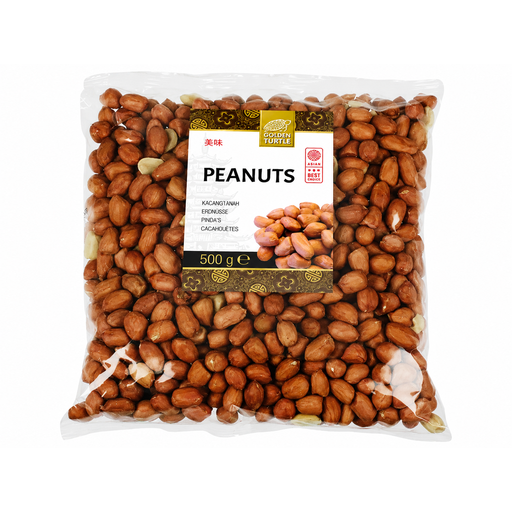 No image available
A raw, unroasted variety to consider if you want to roast peanuts yourself; roasting is mentioned as a way to prepare them.
The product description lists 49 g of fat per 100 g.
Contains peanuts. Check the school’s rules and any allergies.
Whole peanuts can pose a choking risk; consider your child’s ability to chew.
No. ‘No added oil’ describes how a product is prepared; it doesn’t automatically tell you the total fat content. According to the European Commission, the claim ‘low fat’ can be used for solid foods containing no more than 3 g of fat per 100 g. Check the exact claim and the nutrition table.
That depends in part on whether your child can chew safely and the circumstances in which they’re eating. The Netherlands Nutrition Centre warns about choking on whole peanuts and advises children to sit quietly and have someone nearby while they eat. If your child can’t chew safely or won’t have suitable supervision, don’t pack whole peanuts for that mealtime.
Ask the school which products the policy covers, including peanuts, tree nuts and warnings about possible cross-contamination. Peanuts and tree nuts are separate allergens; also read the ingredients list and allergen information on the exact pack.
Not necessarily. Product pages may list different average portion sizes, and reference intakes may be based on an average adult. Don’t use this information as your child’s personal nutritional requirement.
Read the ingredients list and any warnings about possible cross-contamination. The NVWA states that allergens which must be declared have to be included in the ingredients list; a claim about fat or salt doesn’t replace this information.