What should you look for in peanuts for the road?
First decide whether you’re mainly looking for a demonstrably lower fat content, want to limit your portion, avoid salt, or need a snack that’s easy to take with you and store.
| What to consider |
What to look for |
Who is it important to? |
| Fat claim |
Check the exact variety, fat per 100 g and the wording of the claim. |
If I want less fat, I look for a clear comparison, not just a different preparation method. Consumers who put a demonstrable reduction in fat first when choosing make up around 36%. |
| Portion size |
Check the portion size and values per 100 g; weigh out your own portion in advance. |
If I want to know how much fat I’ll eat in one sitting, weighing out a portion in advance helps me work it out. Consumers who prioritise portion control make up around 29%. |
| Salt and ingredients |
Compare salt per 100 g and read the ingredients list for the exact variety. |
If I want to avoid added salt, I also check whether oil is listed in the ingredients. Consumers whose main priority is an unsalted product make up around 21%. |
| Taking it with you and storage |
Read the storage instructions and reseal opened packaging securely. |
When I pack snacks for a journey, I want to know how to take portions with me and store the rest. Consumers who prioritise taking snacks with them and storing them make up around 14%. |
Peanuts at Joybuy
This selection includes unsalted and roasted peanuts, including honey varieties, as well as peanuts in their shells. These options give you a starting point for comparing varieties and weighing out your own portion; they’re not all labelled as reduced-fat.
 Image unavailable
g’woon Unsalted Peanuts – 250 g
An unsalted option to take with you if you want to decide how much to have in each snack portion.
The product information for this variety lists 99% peanuts, sunflower oil, 50 g of fat and 0.02 g of salt per 100 g. The pack contains peanuts and may contain cashew nuts.
View at Joybuy
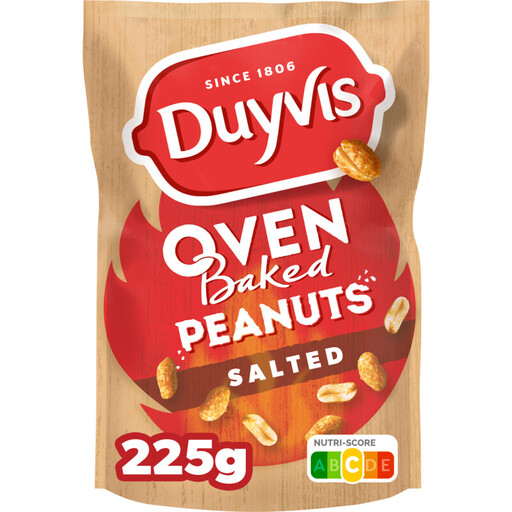 Image unavailable
Duyvis Roasted Peanuts – 225 g
A ready-to-eat roasted snack if you’re looking for a regular peanut variety to take with you.
The pack contains peanuts and may contain nuts. Check the nutrition table and allergen information on the exact pack.
View at Joybuy
 Image unavailable
Duyvis Honey & Lightly Salted Oven-Roasted Peanuts
A roasted variety with honey and salt if you want to consider the flavour as well as the portion size.
The product information lists peanuts, wheat and gluten; the product may contain other nuts. Check the nutritional values on the exact pack.
View at Joybuy
 Image unavailable
g’woon Peanuts in Their Shells – 500 g
An option if you want to take peanuts in their shells with you and portion them out yourself.
The peanuts are in their shells and may contain traces of nuts. Check the nutrition table and allergen information on the pack.
View at Joybuy
 Image unavailable
Verse Extra Large Roasted Peanuts – 210 g
A roasted variety if you’re looking for a snack to take with you and want to weigh out your own portion.
The product name says that these are roasted peanuts. Check the ingredients, nutritional values and allergen information on the pack.
View at Joybuy
Frequently asked questions
Are unsalted peanuts automatically low in fat?
No. The Netherlands Nutrition Centre states that a 25 g handful of unsalted peanuts contains 12.9 g of fat. This is general information about the category, not a label value for every individual variety.
How do I calculate the fat in my portion?
Multiply the weight of your portion in grams by the label value per 100 g, then divide by 100. For AH Unsalted Peanuts, 300 g, a 15 g portion works out at 7.65 g of fat based on 51 g of fat per 100 g. This calculation uses the declared value.
What does ‘low fat’ mean on a pack?
The Netherlands Nutrition Centre explains that ‘low fat’ means no more than 3 g of fat per 100 g for solid foods. Treat ‘less fat’ as a separate comparative claim and check the exact wording and the product being compared with. The ‘low fat’ threshold doesn’t prove a reduction in fat compared with another product.
Can young children take whole peanuts as a car snack?
The Netherlands Nutrition Centre advises against giving whole nuts or peanuts to children under 4 because of the risk of choking. This is nutritional and safety advice, not a legal age limit. A lower fat content doesn’t change that risk.
Which allergen information should I check?
According to the NVWA, peanuts are on the list of allergens consumers must be informed about. Check the label on pre-packed peanuts, and also read any warnings about other nuts or wheat for the specific variety.
How should I store opened peanuts while travelling?
Follow the storage instructions on the pack. For the variety reviewed, Albert Heijn advises storing it in a cool, dark and dry place and closing the pack securely after use. The Netherlands Nutrition Centre lists rancid, chewy or mouldy peanuts as signs that roasted peanuts have gone off; advice to store them in a kitchen cupboard doesn’t automatically apply to a hot car.


