What should you look for when choosing?
First decide whether fat, suitability for those taking part, energy per portion, salt or ease of serving matters most to you. Then check the exact variant and its packaging.
| What to consider |
What should you check? |
Which consumers is this for? |
| Substantiated fat reduction |
Check the claim, the exact variant used for comparison and the fat content per 100 g. ‘Oven-baked’ is not proof of reduced fat. |
If I’m mainly looking for less fat, I want to know what the variant is compared with. This is the top priority for around 26% of consumers. |
| Suitability for those taking part |
Decide who will be eating and read the allergen information on the exact packaging. Don’t give whole peanuts to children under 4. |
If children or people with allergies will be eating, suitability matters more than a claim on the front of the pack. Around 26% of consumers rank this as their top priority. |
| Energy per portion |
Compare kcal per 100 g and weigh the amount you serve. Calculate the energy in a portion using kcal per 100 g × portion weight in grams / 100. |
If I want to keep track of the energy in my snack portion, I look at how much I actually eat. This is the top priority for around 21% of consumers. |
| Salt content |
Check the salt per 100 g and the ingredients list for the exact variant. Unsalted does not mean low fat. |
If I mainly want less salt, I look for an unsalted variant and accept that this does not demonstrate fat reduction. Around 16% of consumers rank salt as their top priority. |
| Portioning and storage |
Check the pack weight, storage instructions and where the exact variant is sold. |
If I’m serving a group, I want to be able to divide up portions in advance and store the packaging properly. This is the top priority for around 11% of consumers. |
Peanuts on Joybuy
This selection of Joybuy products includes unsalted peanuts, roasted peanuts and peanuts in their shells; none is a proven lower-fat choice.
 No image available
g’woon unsalted peanuts, 250 g
A good option if you’re looking for unsalted peanuts, but the stated composition does not demonstrate fat reduction.
Per 100 g: 50 g of fat and 0.02 g of salt.
Contains peanuts and may contain cashew nuts. Don’t give whole peanuts to children under 4.
View on Joybuy
 No image available
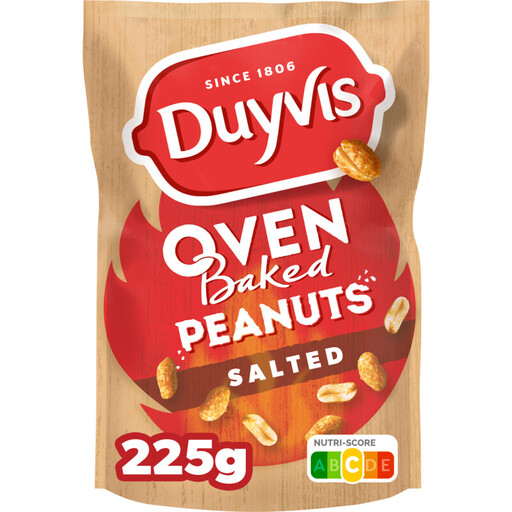
Duyvis roasted peanuts, 225 g
A roasted snack option; roasted does not automatically mean the peanuts contain less fat.
Per 100 g: 50 g of fat and 1.4 g of salt.
Contains peanuts and may contain nuts. Don’t give whole peanuts to children under 4.
View on Joybuy
 No image available
g’woon peanuts in shells, 500 g
The shells set this product apart; when serving, consider who will be eating them and the shape of the peanuts.
Per 100 g: 49 g of fat and 0.12 g of salt.
Contains peanuts and may contain traces of nuts. Don’t give whole peanuts to children under 4.
View on Joybuy
 No image available
Freshly roasted peanuts, 210 g
The product information describes unsalted roasted peanuts; this is an unsalted option, not a proven lower-fat choice.
Ingredients: 100% peanuts. Per 100 g: 50 g of fat and 0.02 g of salt.
Contains peanuts. Don’t give whole peanuts to children under 4.
View on Joybuy
Frequently asked questions
Are oven-baked peanuts automatically low in fat?
No. ‘Oven-baked’ describes the preparation method and does not prove fat reduction. For the ‘low fat’ claim, the European Commission sets a maximum of 3 g of fat per 100 g for solid foods; check the nutritional values for the exact variant.
Does Duyvis smoked paprika’s 30% less fat claim mean it has less fat than plain peanuts?
No. The AH page names regular Duyvis Borrelnootjes/Crac a Nut and Tijgernootjes/Tigernuts as the comparison products. The claim therefore does not compare it with plain peanuts; the same page says that the variant has been discontinued.
Can I hand out whole peanuts to young children during the egg hunt?
The Netherlands Nutrition Centre advises against giving whole peanuts or nuts to children under 4. Older children can also choke on them: make sure they eat calmly while sitting down, and stay with them. This is dietary and safety advice, not a legal age limit.
Does a Dutch pack have to list peanuts as an allergen?
Yes. According to the Netherlands Food and Consumer Product Safety Authority (NVWA), allergen information must appear on the label of prepacked products. Check the information for the exact flavour variant and packaging, too.
How should I store an opened bag of peanuts?
Follow the instructions on the exact packaging. AH Ongezouten pinda’s says to store the product in a cool, dark, dry place and to close the pack properly after use. For an opened bag of Duyvis Original, Jumbo recommends a light- and airtight tin.
What should I do with the recalled tub of AH Pinda’s extra groot gezouten?
Albert Heijn’s warning of 20 May 2026 applies only to AH Pinda’s extra groot gezouten in a tub with a best-before date of 04-11-2026. Do not eat this product and follow Albert Heijn’s instructions for returning it. According to the warning, packs with other best-before dates are not affected by this recall.


