What should you look for when choosing?
First decide whether you want less fat per 100 g or simply fewer peanuts to take with you. Preparation method, portion size and salt answer different questions.
| What to consider |
What to look for |
Who is this important for? |
| Fat in the same amount |
Compare the fat per 100 g and check the claim for the exact product. According to the European Commission, the ‘low fat’ claim applies to solid foods containing no more than 3 g of fat per 100 g. |
If I want less fat in the same amount, I check the nutritional information rather than looking only at the preparation method. Around 31% of consumers give nutritional composition top priority when making this choice. |
| Amount in your lunchbox |
Weigh your portion, then multiply the nutritional value per 100 g by the portion weight and divide by 100. The 25 g portion shown on a label applies to that product; it isn’t automatically right for everyone. |
If I mainly want to take fewer peanuts with me, weighing out a portion helps; the peanuts themselves keep the same nutritional composition. Around 25% of consumers prioritise the amount in their packed lunch. |
| Salt and ingredients |
Check both the ingredients list and the salt content; ‘unsalted’ doesn’t automatically mean low in fat. |
If I’m looking for unsalted peanuts, I check the salt separately from the fat and portion size. Around 19% of consumers make unsalted composition their main consideration. |
| Taking them with you and storage |
Use a tightly sealed container and store peanuts somewhere cool, dark and dry, as advised by the Netherlands Nutrition Centre. |
For my packed-lunch routine, it matters that peanuts are easy to take with me and stay tightly sealed. Around 13% of consumers prioritise convenience on the go. |
| Pack size |
Check the net weight and consider whether you can seal and store the remaining peanuts properly after portioning them out. |
If I use a bag over several packed lunches, I want to divide up the contents without leaving the rest open. This is the top priority for around 12% of consumers. |
Peanuts at Joybuy
This Joybuy selection is roasted peanuts as a ready-to-eat snack for a packed lunch, not a proven reduced-fat variety.
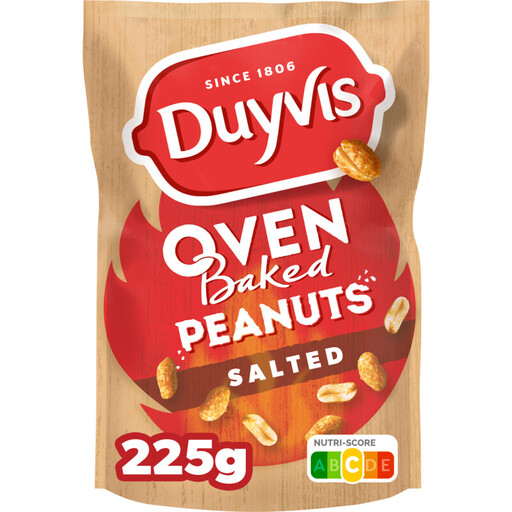 Image unavailable
Duyvis Roasted Peanuts, 225 g
If you’re looking for roasted peanuts as a ready-to-eat lunchbox snack, this product fits the bill; its stated nutritional values mean it isn’t a low-fat choice.
The product information lists 50 g of fat and 1.4 g of salt per 100 g. This fat content is above the European Commission’s maximum of 3 g per 100 g for the ‘low fat’ claim on solid foods.
The pack contains 225 g; the product information lists 7–8 portions per pack.
View at Joybuy
Frequently asked questions
What does ‘low fat’ mean on a peanut label?
For solid foods, the European Commission sets a maximum of 3 g of fat per 100 g for the ‘low fat’ claim. This is a condition for using that specific claim; a smaller portion is not the same as a low-fat composition.
How do I calculate the nutritional value of my packed-lunch portion?
Multiply the nutritional value per 100 g by the weight of your weighed portion, then divide by 100. For AH Unsalted Peanuts, 500 g, a 25 g portion works out at 155 kcal and 12.75 g of fat according to the stated values. This applies to that product variety and its label values.
How should I store peanuts for my packed lunch?
Store peanuts in a tightly sealed container somewhere cool, dark and dry, as advised by the Netherlands Nutrition Centre. Peanuts readily absorb odours, so you may want to keep them separate from strongly scented or moist lunch items. For an unopened pack, follow the storage instructions and best-before date on the packaging.
Which allergen information should I check?
Peanuts are an allergen that must be declared on the label of prepacked foods. The Netherlands Food and Consumer Product Safety Authority also lists, among other things, nuts and cereals containing gluten as allergens. Check the ingredients and any warnings on the pack of the variety you buy.
Does the recall warning apply to all AH peanuts?
No. On 20 May 2026, Albert Heijn issued a warning about AH Extra Large Salted Peanuts in a tub with a best-before date of 04-11-2026 because of possible metal fragments. Do not eat the product in that specific pack. Return it to an AH store for a full refund. The warning does not apply to all AH peanuts.


