
Snackers keeping an eye on portions
You want to enjoy peanuts over New Year’s Eve and decide for yourself how much energy is in your bowl. So compare the same weight in grams, rather than different serving sizes shown on the packaging.


If you want to eat fewer calories over New Year’s Eve, compare peanuts by weight and weigh your portion: regular peanuts aren’t automatically low in calories. Unsalted, plain peanuts are a good choice if you prefer less salt, while sweet or savoury varieties call for a separate check of flavour, sugar, salt and allergens.
You want to enjoy peanuts over New Year’s Eve and decide for yourself how much energy is in your bowl. So compare the same weight in grams, rather than different serving sizes shown on the packaging.
You’re looking for peanuts without a sweet or salty coating and don’t want to mistake unsalted for low-calorie.
You want a savoury or sweet option to serve and weigh up its flavour alongside factors such as sugar, salt and allergens.
First, check the nutritional information per 100 g, then decide how many grams you want to serve. This lets you compare portions on the same basis and treat flavour and ingredients as separate choices.
| Factor | What to look for | Who is this most relevant to? |
|---|---|---|
| Calories per serving | Compare kcal per 100 g and weigh your portion; use the same serving weight for each product. | If I want to know how much energy is in my own bowl, I’d rather weigh my portion than guess by the handful. Around 36% of consumers put the calories in their own portion first. |
| Plain and unsalted | Check the ingredients and salt content of the specific variety. | I’d rather choose plain, unsalted peanuts, even if another flavour has fewer kcal per 100 g. Around 28% of consumers prioritise plain, low-salt options. |
| Flavour and ingredients | For sweet or savoury coatings, check the sugar and salt content as well as the allergen information. | If I want a sweet or savoury flavour for a party, I want to know what else is in that variety. This is the priority for around 22% of consumers. |
| Packaging and storage | Choose a pack size that suits the number of servings you want to offer, and follow the storage instructions on the packaging. | I want to buy enough peanuts for the party, but not open more than I can store properly. Around 14% of consumers focus mainly on portion planning and pack size. |
A plain product may suit you if you prefer less salt, while still being high in energy per 100 g.
Check the kcal per 100 g and weigh your portion. Consider salt as a separate factor.
A 25 g serving and a 30 g serving aren’t the same amount, so their calories per serving aren’t directly comparable.
Convert the values on the label to the same weight in grams before comparing the servings.
A sweet variety may list fewer kcal per 100 g than the other varieties reviewed, but sugar, salt and allergens may also affect your choice.
First decide whether portion size, plain peanuts or flavour matters most to you. Then check the nutritional information, ingredients and allergens for the specific variety.
The product ranges reviewed include unsalted peanuts and Oven Baked Original and Honey varieties.
AH Unsalted Peanuts are a plain variety with the serving size shown on the packaging.
Jumbo Unsalted Peanuts are a supermarket own-brand option with nutritional information per 100 g and per serving.
Lidl describes roasted unsalted peanuts in a 200 g pack; the brand also sells peanuts with a dough coating.
ALDI lists TRADER JOE’S roasted unsalted peanuts in a 250 g pack.
PLUS Unsalted Peanuts are a supermarket own-brand option without a sweet coating.
The nutritional values shown are product information from manufacturers or retailers, not independent laboratory measurements. They apply to the varieties named and not necessarily to a brand’s entire range.
This selection of Joybuy products caters for portion-conscious snacking and preferences for plain peanuts, in-shell peanuts or a bold party flavour.
 No image available
A good choice if you prefer a plain peanut snack without added salt.
May contain cashew nuts; check the allergen information if this is relevant to you.
 No image available
An option if you’re looking for in-shell peanuts to serve at a party.
The product information states that it may contain traces of nuts.
 No image available
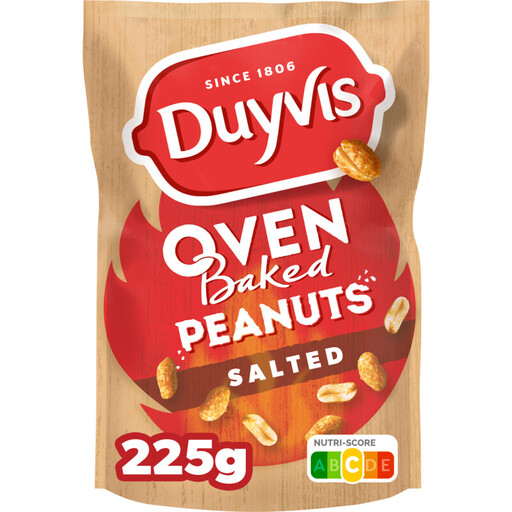
A good choice if you’re looking for a savoury roasted peanut snack to serve at a party.
The product information lists salt and states that it may contain other nuts; check the allergens on the packaging.
 No image available
A good choice if you’re looking for a sweet, lightly salted flavour to serve at a party.
Contains peanuts and wheat; may contain other nuts. The product information warns that it poses a choking hazard for young children.
 No image available
An option if you’re looking for roasted peanuts to snack on.
As stated in the product information, close the pack securely after opening.
According to the European Commission, the claim ‘low energy’ is only permitted for solid foods containing no more than 40 kcal (170 kJ) per 100 g. The varieties discussed here, for which energy values are listed, are above that limit. So describe a smaller portion as a way to limit the calories in your serving, not as proof that peanuts are low in calories.
The Netherlands Nutrition Centre uses an average of 157 kcal per 25 g handful of unsalted peanuts. For the exact variety you’re buying, multiply the kcal per 100 g by the weight of your portion in grams, then divide by 100. This average isn’t an exact value for every brand.
Read the up-to-date allergen information on the packaging and take each guest’s needs into account. Peanuts are an allergen, and a coating may contain other allergens; the honey variety discussed here contains wheat and may contain other nuts. The Netherlands Food and Consumer Product Safety Authority explains that allergens must be clearly shown on the label of pre-packed foods.
Follow the storage advice on the packaging of the variety you buy. Albert Heijn recommends storing its unsalted peanuts in a cool, dark, dry place and closing the pack securely after use; Jumbo recommends storing them in a cool, dry place.
Whole peanuts can pose a choking hazard. Amsterdam UMC recommends nut butter instead of whole nuts for children under 4; this is safety advice, not a legal age limit. Bear the risk in mind around young children, and make sure they eat calmly at the table under supervision.