
Snackers keeping an eye on fat and portion size
You want to buy peanuts as a snack and distinguish between a product that meets the ‘low-fat’ claim and a smaller portion of regular peanuts.


If you want to consume less total fat, compare the nutritional values per 100 g and don’t mistake a portion for a low-fat product. ‘Unsalted’ and ‘no added oil or fat’ describe the salt content and preparation method respectively; neither automatically means the product is lower in total fat. The European Commission sets a maximum of 3 g of fat per 100 g for a ‘low-fat’ claim on solid foods.
You want to buy peanuts as a snack and distinguish between a product that meets the ‘low-fat’ claim and a smaller portion of regular peanuts.
You’re looking for unsalted peanuts, but don’t want to confuse ‘unsalted’ with lower fat.
You’re comparing regular and oven-baked peanuts and want to know what ‘no added oil or fat’ does and doesn’t tell you about the product.
Start by comparing the nutritional values per 100 g, then decide which portion suits the way you’ll eat them. Consider the salt content and preparation method separately from the total fat content.
| What to consider | What should you check? | Who is this important for? |
|---|---|---|
| Total fat | Compare the fat content per 100 g for the exact variety. For solid foods, the ‘low-fat’ claim means a maximum of 3 g per 100 g, according to the European Commission. | If I mainly want to consume less total fat, I check the nutrition table rather than relying on a preparation claim. Around 37% of consumers prioritise total fat. |
| Portion and energy | Check the kcal per 100 g and weigh your own portion if you want to compare it accurately. The Netherlands Nutrition Centre uses 25 g as an example portion for unsalted peanuts. | If I want to manage how much I snack on, I look at the weight of my portion and its energy content. Around 27% of consumers prioritise portion size and energy. |
| Salt | Check the salt value and ingredients for the specific variety. ‘Unsalted’ does not mean a lower total fat content. | If I want to avoid added salt, I look for a suitable unsalted variety and check the fat content separately. Around 18% of consumers prioritise salt. |
| Packaging and storage | Check the pack weight and follow the storage instructions on the packaging. A larger pack is not the same as a recommended portion. | If I’m buying peanuts for home, I want an amount that’s practical for how I’ll use them and can be stored according to the pack instructions. Around 18% of consumers prioritise convenience and packaging. |
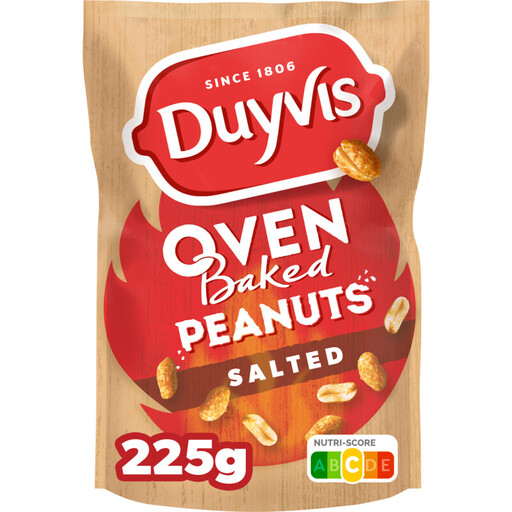
A claim about how a product is prepared doesn’t mean it contains no naturally occurring fat. Duyvis describes Oven Baked Peanuts Original as roasted without adding oil or fat; the Jumbo product page lists 50 g of fat per 100 g for this variety.
Assess the preparation description and nutrition table separately.
AH Unsalted Peanuts contain 51 g of fat, 620 kcal and 0 g of salt per 100 g. So the salt content doesn’t tell you how much total fat the variety contains.
Use ‘unsalted’ as a way to choose by salt content, and check the separate nutritional value for fat.
Nutritional values for portions of different weights can’t be compared directly. The Netherlands Nutrition Centre uses an example portion of 25 g; the Jumbo product page for unsalted peanuts also lists values per 30 g.
Compare values per 100 g first, then calculate them for portions of the same weight.
Worth considering if you want to assess a preparation description stating that no oil or fat has been added to Oven Baked Peanuts Original.
AH Unsalted Peanuts are a specific variety to consider if added salt is your main concern.
Jumbo Unsalted Peanuts 250 g has published nutritional values you can compare on a like-for-like basis.
The Dutch product page lists unsalted peanuts, which may be relevant if you want to avoid added salt.
TRADER JOE’S Roasted and Unsalted Peanuts are a specific option if you’re considering the preparation method and salt content.
PLUS Unsalted Peanuts 250 g is a supermarket own-brand variety with published nutritional values.
The Joybuy products below are snack peanuts in unsalted, roasted and in-shell varieties. The product information provided doesn’t support describing them as low-fat choices.
 No image available
A good fit if you’re looking for unsalted snack peanuts, but the label alone isn’t enough to assess them as low-fat.
The listed ingredients are 99% peanuts and sunflower oil; cashew nuts may also be present.
 No image available
A good fit if you’re looking for roasted peanuts as a snack; roasting alone doesn’t mean they have a lower total fat content.
The product description lists 1.4 g of salt, but doesn’t specify the basis for this value.
 No image available
A good fit if you’re specifically looking for peanuts in shells as a snack; their form doesn’t indicate a lower fat content.
The title lists a 500 g pack.
 No image available
A good fit if you’re looking for roasted peanuts with no added salt, but not if you’re choosing based on a low-fat claim.
The listed nutritional values are 50 g of fat and 626 kcal per 100 g. For solid foods, the European Commission sets a maximum of 3 g of fat per 100 g for a ‘low-fat’ claim.
For solid foods, the limit is a maximum of 3 g of fat per 100 g. The European Commission sets this condition for a ‘low-fat’ claim; the NVWA refers to European rules for nutrition claims.
No, compare the same quantity first. The European Union explains that nutritional values are listed per 100 g or 100 ml; additional values per portion use a different basis. So convert portions to the same weight before comparing them.
Ask about allergen information before buying if it isn’t clearly displayed. According to the NVWA, information about allergens must also be available before purchase for unpackaged products; if the information is given verbally, it must be clear that you can ask for it.
A fat or preparation claim says nothing about allergies or choking risks. The AH product page for AH Unsalted Peanuts lists peanuts as an ingredient and says that other nuts may be present; the page also warns that young children may choke on peanuts. Consider this information separately from the fat content.
Follow the instructions on the packaging for the variety you buy. For mixed salted nuts, the Netherlands Nutrition Centre recommends a cool, dark and dry place and a well-sealed container; don’t automatically apply its storage period to every type of peanut.
Albert Heijn’s warning applies to AH Extra Large Salted Peanuts in a tub with a best-before date of 04-11-2026, due to possible metal fragments. Don’t eat this specific pack; return it to the store. Albert Heijn says you’ll receive a full refund. The warning doesn’t mention other best-before dates.