
Snackers keeping an eye on total fat
You want a lighter snack and to understand the difference between the fat naturally found in peanuts and fat added during preparation.


If you want to eat less fat, compare the total fat content on the nutrition declaration and keep an eye on your portion size. The fact that peanuts are prepared without added fat does not, in itself, prove that they have a lower total fat content: Duyvis describes its Oven Baked variety as made without adding oil or fat, while the Netherlands Nutrition Centre gives 12.9 g of fat per 25 g as a general reference for unsalted peanuts.
You want a lighter snack and to understand the difference between the fat naturally found in peanuts and fat added during preparation.
You’re buying snacks for several occasions and want to choose an amount that suits how you’ll use them and the storage instructions.
You’re looking for an unsalted option in your usual supermarket range, without assuming that unsalted automatically means lower in fat.
First decide whether you mainly want to compare total fat, find an unsalted option or plan your stock and portions. Treat the preparation method, nutritional values and pack size as separate criteria.
| What to consider | What should you check? | Who is this important for? |
|---|---|---|
| Total fat or preparation method | Read the nutrition declaration on the exact pack and consider it separately from claims about the preparation method. | If I want less total fat, I look at the nutritional values rather than just how the peanuts are prepared. Around 37% of consumers consider total fat first. |
| Weekly stock and portions | Compare the net weight with your planned use and follow the storage instructions on the pack. | If I’m buying peanuts for several snack occasions, I want an amount that suits my needs and lets me decide how much to have each time. Around 27% of consumers prioritise weekly stock and portions. |
| Unsalted option | Check that the exact variety is unsalted, then look at the nutritional values and ingredients too. | If I’m looking for an unsalted snack, I want to be able to identify that variety without assuming it has less fat. Around 18% of consumers choose unsalted as their first criterion. |
| Shop and way of buying | Check how the specific retailer offers the variety and whether it fits your usual shopping routine. | If I’m planning my regular shop, I want to know whether I can pick up the variety in store or order it through my usual route. Around 18% of consumers prioritise convenience when choosing how to buy. |
Duyvis describes its Oven Baked variety as made without adding oil or fat. Peanuts naturally contain fat; the Netherlands Nutrition Centre gives 12.9 g of fat per 25 g of unsalted peanuts as a general reference.
Assess the preparation method and total fat separately, and check the nutrition declaration on the pack you’re buying.
Unsalted describes the salt variety, not a lower total fat content. The Netherlands Nutrition Centre’s general reference for unsalted peanuts is 12.9 g of fat per 25 g.
Choose unsalted if that’s what you prefer, and assess any total fat target separately using the information on the pack.
A 250 g or 500 g bag indicates the amount in the pack, not how much to have in one sitting. An opened pack may also lose quality if you don’t follow the storage instructions.
Choose a pack size that suits your planned use and follow the instructions on the packaging. For its Dry Roasted variety, Jumbo recommends storing it in a cool, dry place away from light.
The range includes an oven-baked line and regular salted peanuts.
Albert Heijn has a product page for AH Unsalted Peanuts.
Jumbo lists a 200 g Dry Roasted variety.
The Dutch product page describes unsalted peanuts in a 285 g pack.
A product page describes Trader Joe’s roasted and salted peanuts in a 500 g pack.
PLUS describes a 250 g unsalted own-brand variety.
This selection includes unsalted and roasted peanuts in different pack types and sizes. The product information does not show that these are low-fat options; check the total fat content on the nutrition declaration.
 No image available
An option if you’re looking for an unsalted peanut snack and want to choose a pack size that suits your needs.
The product description lists 99% peanuts and sunflower oil.
The product information lists peanuts and possible traces of cashew nuts.
 No image available
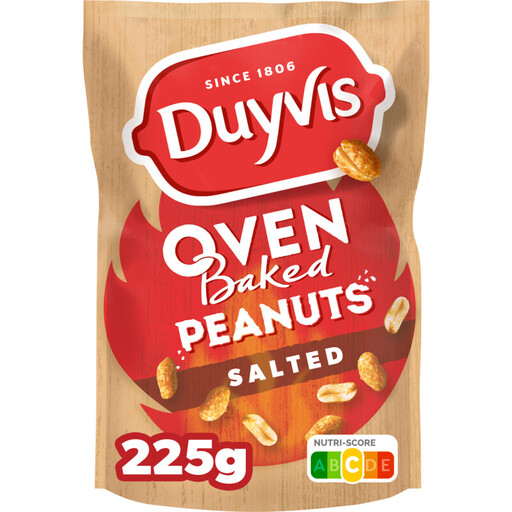
A roasted snack option if you’re looking for a 225 g pack to add to your weekly shop.
The product description lists salt in the ingredients and states that the pack contains 7–8 servings.
The product information lists peanuts and possible traces of other nuts.
 No image available
An oven-roasted variety with honey and a lightly salted flavour, for anyone looking for that particular combination.
The product description states that the pack contains 175 g and 5–6 servings, and lists honey, salt and sunflower oil among the ingredients.
The product information lists peanuts, wheat and gluten, and possible traces of other nuts. It also warns of a choking hazard for young children.
 No image available
An option if you’re looking for peanuts in their shells and want to plan a 500 g pack for several snack occasions.
The product information lists peanuts and possible traces of other nuts.
 No image available
An option if you’re looking for an unsalted roasted peanut snack in a 210 g pack.
The product description lists peanuts as an ingredient.
Yes. The Netherlands Food and Consumer Product Safety Authority says that nutrition claims must comply with European rules. A description of the preparation method does not replace an assessment of the nutrition claim and the product’s nutrition information.
No. According to the European Union, declared nutritional values are averages based on analysis or permitted calculations. They relate to the product as sold.
Check the allergen information on the label of the exact pack. The Netherlands Food and Consumer Product Safety Authority says this information must appear on the label of prepacked products.
Follow the storage instructions for your exact product. For its Dry Roasted variety, Jumbo recommends storing it in a cool, dry place away from light. As a general guide, the Netherlands Nutrition Centre says salted peanuts keep for six months in a kitchen cupboard and one year in the freezer; their quality may deteriorate after that. This guidance is not a guarantee for every product variety.
On 20 May 2026, Albert Heijn announced a recall of AH Extra Large Salted Peanuts in a tub with a best-before date of 04-11-2026 because they may contain metal particles. Albert Heijn asks customers not to eat the product and says they can return it for a full refund. The warning applies to this specific best-before date.