
Label-conscious shoppers
You’re looking for snack peanuts with demonstrably less fat for the same quantity, and want to distinguish a nutrition claim from a preparation method.


Assess a lower-fat claim by checking the fat content per 100 g and the basis for comparison; unsalted or dry-roasted does not automatically mean lower in fat. The Joybuy peanuts below list 49–50 g of fat per 100 g. Under European Commission rules, the claim ‘low fat’ can only be used for solid foods containing no more than 3 g of fat per 100 g; this is not the same as a comparative ‘lower fat’ claim. If your main aim is to eat less, weigh your portion. Choose unsalted if reducing salt is your top priority.
You’re looking for snack peanuts with demonstrably less fat for the same quantity, and want to distinguish a nutrition claim from a preparation method.
You want to keep eating peanuts, but would rather decide in advance how much to have and compare the nutritional information with that portion.
Reducing salt is your main priority, so you don’t automatically assume that unsalted means low in fat.
First compare the nutritional information per 100 g, then decide how much you want to eat and consider salt as a separate factor.
| What to consider | What should you check? | Who is this important for? |
|---|---|---|
| Demonstrably less fat | Compare fat per 100 g and check the exact claim and basis for comparison. Preparing a product without added oil does not, by itself, prove that it contains less fat. | If you want less fat for the same quantity, a verifiable comparison matters more than the preparation method; around 36% of consumers prioritise demonstrable fat reduction. |
| Calories per portion | Weigh your portion and convert the value per 100 g to the weight you actually eat. | If your main aim is to limit how much you snack, the value for your own portion is what matters; around 29% of consumers prioritise portion size and calories. |
| Less salt | Check the salt per 100 g and look at fat and energy separately; unsalted does not automatically mean lower in fat. | If you mainly want to avoid salt, look for an unsalted variety without mistaking it for a low-fat one; around 21% of consumers prioritise reducing salt. |
| Flavour and use | Check the ingredients, pack size and storage instructions. Check the packaging for allergen information. | If flavour, packaging or storage is your main consideration, you’ll want to know what the variety contains and how to store it; around 14% of consumers prioritise these practical factors. |
A preparation method doesn’t automatically tell you how much fat the finished product contains. AH Dry roast lists 47 g of fat per 100 g; the European Commission sets a maximum of 3 g per 100 g for the ‘low fat’ claim on solid foods.
Read the nutrition table and the exact claim separately from the preparation method. Don’t treat a comparative ‘lower fat’ claim as a synonym for ‘low fat’.
Unsalted Jumbo and PLUS varieties list 51.3 g of fat and 623 kcal per 100 g. So, being lower in salt doesn’t, by itself, tell you anything about fat or energy content.
Choose unsalted if reducing salt is your goal, and use the nutritional information per 100 g to work out the calories in your own portion.
A pack may contain several servings as listed on the label: AH lists six 25 g servings in a 150 g bag; Jumbo lists fourteen servings in a 350 g pack.
Decide how much you want to have in advance, weigh that amount and close the pack after use, following the label instructions.
If you treat the whole bag as one portion, you may eat more peanuts than you planned for that snack.
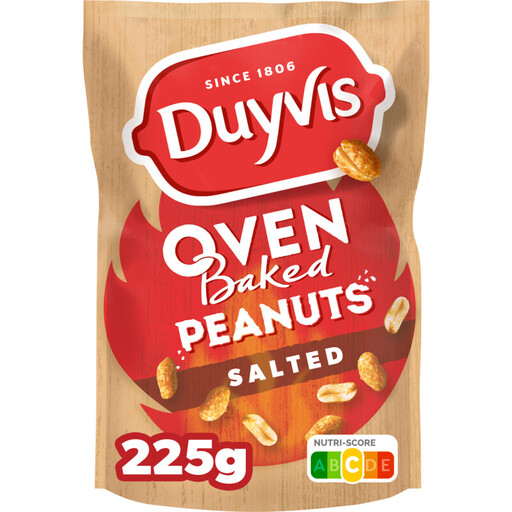
Relevant product ranges include unsalted peanuts and Oven Baked Original.
AH Dry roast salted peanuts come with a labelled serving size that you can compare with the amount you usually snack on.
Jumbo Unsalted Kingsize Peanuts are an option if you’re mainly looking for an unsalted variety.
Lidl lists both unsalted peanuts and Alesto peanuts in a seasoned coating.
ALDI lists Trader Joe’s roasted, unsalted peanuts in a 250 g pack.
PLUS Unsalted Peanuts 300 g is a separate own-brand option for shoppers looking to avoid salt.
These Joybuy products are snack peanuts in unsalted, roasted or in-shell varieties. The listed fat content ranges from 49 to 50 g per 100 g; under European Commission rules, solid foods must contain no more than 3 g per 100 g to qualify for the ‘low fat’ claim.
 No image available
Suitable for a snack when reducing salt matters more to you than reducing fat.
Per 100 g: 50 g of fat and 0.02 g of salt. Ingredients: 99% peanuts and sunflower oil. Contains peanuts and may contain cashew nuts; check the packaging if you have allergies.
 No image available
A roasted snack variety; the preparation method doesn’t automatically mean the product contains less fat.
Per 100 g: 50 g of fat, 606 kcal and 1.4 g of salt. Contains peanuts and may contain traces of nuts.
 No image available
The resealable pack may be handy if you want to save some of the bag for later.
Per 100 g: 49 g of fat, 590 kcal and 1.5 g of salt. The pack is described as resealable. Contains peanuts and may contain traces of nuts.
 No image available
An option if you’re looking for peanuts in shells as a snack and the larger pack suits how you use them.
Per 100 g: 49 g of fat, 2,515 kJ and 0.12 g of salt. Contains peanuts; check the packaging if you have a relevant allergy.
 No image available
The product description says these are roasted, unsalted peanuts for snacking.
Per 100 g: 50 g of fat, 626 kcal and 0.02 g of salt. The ingredients list states 100% peanuts.
Under European Commission rules, the ‘low fat’ claim can only be used for solid foods if the product contains no more than 3 g of fat per 100 g. This is a different claim from a comparative description such as ‘lower fat’. For example, AH Dry roast lists 47 g of fat per 100 g, so it does not meet the low-fat limit.
No. The preparation method alone does not demonstrate a lower fat content. Duyvis says that Oven Baked Original is made without added oil or fat, while AH Dry roast lists 47 g of fat per 100 g. So compare the nutrition table and any claim separately.
Weigh the amount you want to eat and convert the values per 100 g to that weight. Albert Heijn lists six 25 g servings of AH Dry roast in a 150 g bag; this labelled serving size is not personal dietary advice.
Snack peanuts contain peanuts and aren’t suitable if you need to avoid them. The NVWA lists peanuts as an allergen that must be declared on prepacked products. Other allergens that may be present vary by variety, so always check the ingredients and allergen information on the packaging.
Follow the instructions for the specific pack. Albert Heijn recommends storing AH Dry roast in a cool, dark and dry place, and sealing the bag securely after use. For salted peanuts, the Voedingscentrum lists rancidity, toughness and mould as signs of spoilage; don’t assume this information applies as a storage period for every variety.