
Label-conscious shoppers
You’re looking for peanuts with less fat and want to know what unsalted, oven-roasted and low-fat really mean. Compare product values on the same basis, and treat a preparation claim separately from a nutrition claim.


If you want to consume less fat and energy, weighing out a smaller portion in advance can help; also compare different peanuts per 100 g. Unsalted doesn’t mean low-fat, and roasting peanuts without adding oil doesn’t prove that they contain less fat. The European Commission sets a maximum of 3 g of fat per 100 g for a ‘low fat’ claim on solid foods. If you’re sharing snacks, bear allergens and young children in mind too.
You’re looking for peanuts with less fat and want to know what unsalted, oven-roasted and low-fat really mean. Compare product values on the same basis, and treat a preparation claim separately from a nutrition claim.
You want to keep eating peanuts during days at home or on days out, without accidentally snacking on a large amount. Measuring out a portion in advance makes the amount clear; the size of the bag doesn’t determine your portion. The Netherlands Nutrition Centre gives 25 g as a general portion of unsalted peanuts for nutrition information.
You’re buying for several people and thinking about allergens, young children and how to store an opened bag. The Netherlands Nutrition Centre warns against giving whole peanuts to young children; the NVWA emphasises that allergen information must be available before purchase.
First decide whether you mainly want to change the total amount you eat, or are looking for a product feature such as salt content or preparation method. The nutrition table per 100 g helps you compare products; weighing your own portion helps you work out how much you actually eat.
| What to consider | What to look for | Who is this most relevant to? |
|---|---|---|
| Genuinely less fat | Compare fat per 100 g and check the ingredients on the exact pack. For a ‘low fat’ claim on solid foods, the European Commission sets a maximum of 3 g of fat per 100 g. | If I choose peanuts because they have less fat, I want to see the nutrition information on the label, not just a word about how they’re prepared. Around 31% of consumers say demonstrably lower total fat is their top priority when choosing. |
| Portion and intake | Compare products per 100 g first, then weigh your own portion. The 25 g portion shown on the AH page is product information, not a set portion for everyone. | If I want to snack less without looking for a different variety, weighing out an amount in advance helps. Around 25% of consumers put portion size and total snack intake first. |
| Salt | Check salt per 100 g and the ingredients list; don’t rely only on a shelf category. AH lists 0 g of salt and Jumbo 0.01 g per 100 g for the unsalted varieties mentioned. | If I want to avoid added salt, I check the label rather than relying on the name or category. Around 19% of consumers make avoiding salt their main consideration when choosing. |
| Sharing snacks safely | Check the latest allergen information and whether whole peanuts are suitable for those eating them. The Netherlands Nutrition Centre advises supervising young children and paying attention to the shape of their food. | If I’m sharing peanuts with others, I want to consider allergies and young children before putting out a bowl. Around 13% of consumers put suitability for those eating the snack first. |
| Packaging and storage | Choose a pack size that suits the amount you want to share out. Store opened peanuts in a cool, dark, dry place in an airtight container, as recommended by the Netherlands Nutrition Centre. | If I buy snacks for several occasions, I want to be able to divide up the pack and store it properly once opened. Around 12% of consumers put a suitable pack size and practical storage first. |
Preparation method and salt content don’t automatically tell you anything about total fat. The unsalted varieties examined from AH, Jumbo and PLUS list 48 to 51.3 g of fat per 100 g; for a ‘low fat’ claim on solid foods, the European Commission sets a maximum of 3 g per 100 g.
Compare the fat content per 100 g and only rely on a claim that matches the nutrition information for the exact variety.
PLUS places Duyvis Oven roasted Original with unsalted nuts, while the product information lists salt in the ingredients and 1.4 g of salt per 100 g.
Check the ingredients and nutrition information on the pack you’re buying; a shop category isn’t a product specification.
Peanut allergens and the risk of choking for young children may be more important than taste or nutrition information. The NVWA explains that allergen information must be available before purchase; the Netherlands Nutrition Centre warns against giving whole peanuts to young children.
Before sharing, check the allergen information and consider who’s eating the snack and its shape.
Albert Heijn’s warning of 20 May 2026 concerned AH Extra Large Salted Peanuts in a tub with a best-before date of 4 November 2026, due to possible metal fragments. According to the warning, other best-before dates for this product were not part of the recall; the warning doesn’t automatically apply to all AH peanuts.
Check the product variety, packaging and best-before date against the warning. Don’t eat a pack covered by the warning, and follow Albert Heijn’s instructions.
Duyvis describes Oven Baked Peanuts Original as roasted without added oil or fat. This is a preparation feature, not proof of lower total fat.
AH Unsalted Peanuts is an own-brand example in a 500 g bag, suitable if you want to divide it into several portions.
Jumbo Unsalted Peanuts 250 g is an own-brand example in a smaller bag than the AH pack mentioned above.
The Dutch product page describes 200 g of roasted unsalted peanuts.
The Dutch page describes 250 g of Trader Joe’s roasted unsalted peanuts.
PLUS offers, among other products, unsalted roasted peanuts in a 300 g stand-up pouch.
These Joybuy products are for anyone looking to compare unsalted, roasted or flavoured varieties and measure out their own portions. Their stated fat contents are above the limit for a ‘low fat’ claim, so don’t consider this a selection of low-fat peanuts.
 Image unavailable
An option if you want to measure out unsalted peanuts for a snack; the product name specifies a 250 g pack.
The product information lists 50 g of fat and 0.02 g of salt per 100 g. This is above the maximum of 3 g of fat per 100 g for a ‘low fat’ claim on solid foods, as set by the European Commission.
The ingredients information lists 99% peanuts and sunflower oil. Check the latest allergen information on the pack.
 Image unavailable
The product name describes roasted peanuts in a 210 g pack; compare the exact variety if you’re looking for a snack to enjoy over several occasions.
The product information lists 50 g of fat and 0.02 g of salt per 100 g. This fat content is above the European maximum of 3 g per 100 g for a ‘low fat’ claim on solid foods.
Before sharing, check the latest ingredients and allergen information on the pack.
 Image unavailable
An option if you want peanuts in their shells; the product name specifies a 500 g pack. Peanuts in their shells take an extra step to eat.
The product information lists 49 g of fat per 100 g, above the European maximum of 3 g per 100 g for a ‘low fat’ claim on solid foods.
Consider the shape of the snack if young children will be eating too, and check the latest allergen information.
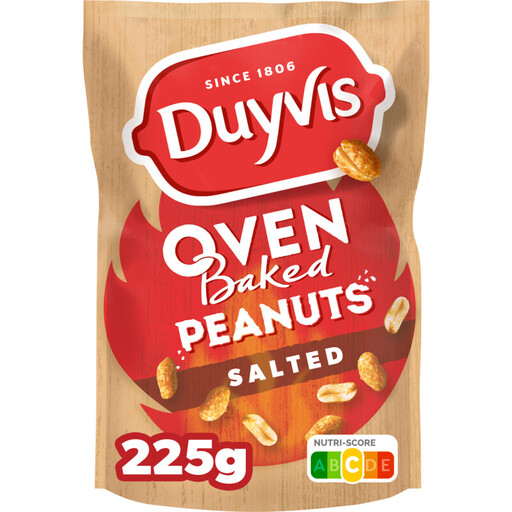 Image unavailable
A roasted Duyvis variety in a 225 g pack, for anyone looking for this type of product and wanting to divide it into portions.
The product information lists 50 g of fat and 1.4 g of salt per 100 g. The fat content is above the European maximum of 3 g per 100 g for a ‘low fat’ claim on solid foods.
If you’re sharing these peanuts, check the latest ingredients and allergen information for this variety.
 Image unavailable
A honey and lightly salted variety for anyone looking for this particular flavour; compare the ingredients if you want a simple peanut variety.
The product information lists 40 g of fat and 1.4 g of salt per 100 g. The fat content is above the European maximum of 3 g per 100 g for a ‘low fat’ claim on solid foods.
The ingredients information lists honey, sugar and wheat; peanuts and wheat are included in the allergen information. Check the label on the current pack.
For a solid food, the European Commission sets a maximum of 3 g of fat per 100 g for a ‘low fat’ claim. The unsalted varieties from AH, Jumbo and PLUS mentioned here list 48 to 51.3 g of fat per 100 g, so they don’t meet this limit.
First compare the nutrition information per 100 g, then weigh your own portion. AH Unsalted lists a 25 g portion; this product information isn’t a set portion for every person or nutritional need.
Whole peanuts can cause young children to choke. The Netherlands Nutrition Centre advises supervising them, making sure they sit calmly while eating and choosing an appropriate form of food. So don’t assume a bowl of whole peanuts is a suitable snack for children.
Yes. The NVWA says consumers must have access to allergen information before purchase. Check the ingredients and allergen information for the exact pack, even if you’re planning to share the peanuts with others.
Don’t eat this specific recalled product. On 20 May 2026, Albert Heijn warned of possible metal fragments; according to the warning, other best-before dates for this product were not affected. The warning doesn’t automatically apply to all AH peanuts.