Who is this relevant to?

You’re looking for genuinely lower-fat peanuts

You’re comparing the fat content of the same quantity of snack peanuts and don’t want to confuse low fat, a relative reduction in fat and no added oil. For solid foods, the European Commission sets the maximum for a ‘low fat’ claim at 3 g of fat per 100 g.

You want a smaller peanut snack

You want to keep eating ordinary peanuts while controlling how much you have per snack by weighing out a portion. The figures per 100 g on the label give you a basis for calculating the amount in your portion.

You’re also keeping an eye on salt and type of fat

As well as total fat, you want to check saturated fat and salt. The nutrition table and ingredients list provide this information separately; ‘unsalted’ doesn’t mean ‘low fat’.

What should you look for when buying?

Snack peanuts with a reduced fat content

Choose this if: you want less fat in the same quantity of peanuts.

Bear in mind: a relative reduction isn’t the same as the absolute ‘low fat’ claim. The Netherlands Bakery Centre describes ‘reduced’ as at least 30% less than comparable products; check which product is used for comparison.

A weighed portion of ordinary peanuts

Choose this if: you want to keep eating ordinary peanuts and mainly want to control how much you have per snack.

Bear in mind: weighing your portion limits how much you eat, but doesn’t change the fat content per 100 g.

Peanuts without added oil

Choose this if: avoiding added oil is your main priority.

Bear in mind: peanuts retain their natural fat. The preparation method alone doesn’t prove they’re low in fat.

What to consider What should you check? Who is this important to?
Actual fat reduction Fat in grams per 100 g, the exact claim and the product used for comparison. If I want less fat in the same quantity, I check both the value per 100 g and the comparison on the label. Around 36% of consumers rank fat reduction as their top priority.
Fat and energy per portion Portion weight in grams, and fat and energy per 100 g. If my main aim is to control how much I have per snack, I weigh out my portion and calculate using the value on the label. Around 29% of consumers prioritise portion size and energy.
Salt and type of fat Saturated fat and salt, each listed separately per 100 g. If I want to consider salt and type of fat as well as total fat, I check those separate entries on the label. Around 21% of consumers rank these nutritional characteristics as their top priority.
Preparation method The preparation description, ingredients and nutritional values for the exact variant. If I want peanuts without added oil, I check both the ingredients and the fat content. Around 14% of consumers prioritise the preparation method.

Common mistakes

  • Assuming no added oil means low fat

    Peanuts naturally contain fat, even when they’re roasted in the oven. The preparation description alone doesn’t tell you how much fat the finished product contains.

    First check the total fat per 100 g, then look at the ingredients and preparation method.

  • Confusing unsalted with lower fat

    The product pages for Jumbo, PLUS and Albert Heijn list 48, 50 and 51 g of fat per 100 g respectively for the unsalted peanuts mentioned. Salt and fat are separate characteristics on the label.

    Compare the fat and salt entries separately; don’t infer the fat content from the term ‘unsalted’.

  • Comparing portions of different sizes

    A lower amount of fat per portion may simply be because one portion is smaller than another. Albert Heijn gives a 25 g portion for the pack mentioned; Jumbo also lists values per 30 g.

    Compare the values per 100 g first, then calculate them for portions of the same size.

Brands for reference

Duyvis

The manufacturer describes Oven Baked Peanuts Original as oven-roasted without added oil or fat.

  • Duyvis’s description is relevant if you’re specifically looking for a variant with no added oil.
  • Duyvis lists 47 g of fat per 100 g, while the Jumbo product listing gives 50 g. These figures don’t make the variant low in fat. Check the nutrition table on the pack you buy.

Albert Heijn

AH Unsalted Peanuts 300 g is an example of ordinary unsalted peanuts you can weigh out into a portion.

  • Albert Heijn lists 51 g of fat per 100 g and a portion size of 25 g.
  • The ingredients are 96% peanuts and sunflower oil; here, ‘unsalted’ doesn’t mean low fat or no added oil.

Jumbo

Jumbo Unsalted Peanuts 250 g provides label values for anyone who wants to work out the nutritional information per portion.

  • Jumbo lists 48 g of fat, 602 kcal and 0.01 g of salt per 100 g.
  • The ingredients include sunflower oil; based on these nutritional values, the unsalted variant isn’t a low-fat choice.

PLUS

PLUS Unsalted Peanuts 250 g is worth considering if you want to compare saturated fat and salt as well as total fat.

  • PLUS lists 50 g of fat, 6.6 g of saturated fat and 0.02 g of salt per 100 g.
  • The ingredients are peanuts and sunflower oil; this variant isn’t low in fat.

Lidl

Lidl Netherlands lists 285 g packs of unsalted peanuts as a supermarket product.

  • The range listing identifies this variant as unsalted peanuts.
  • ‘Unsalted’ doesn’t tell you anything about fat reduction on its own; check the nutrition table on the pack.

ALDI

ALDI lists 250 g packs of Trader Joe’s roasted and unsalted peanuts.

  • The product description says the peanuts are roasted and unsalted.
  • These characteristics don’t prove a reduced fat content; assess the exact variant using the nutrition table.

Joybuy peanuts for a weighed portion

These Joybuy products are ordinary snack peanuts, including roasted, unsalted and in-shell varieties. The fat values listed don’t make them low-fat products, but you can use them to calculate the amount in a portion you weigh out yourself.
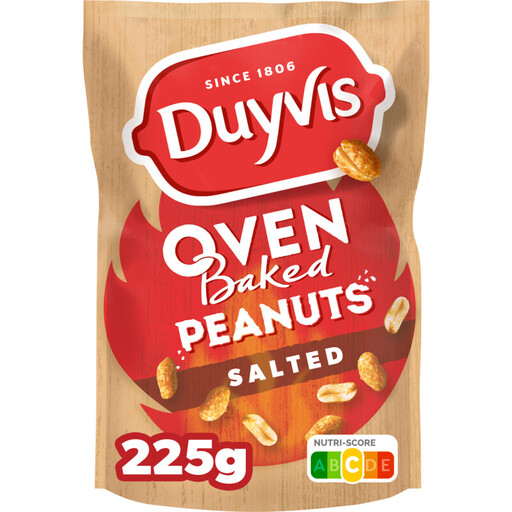
Duyvis Roasted Peanuts, 225 g

Duyvis Roasted Peanuts, 225 g

An option if you want to weigh out a portion of roasted snack peanuts; this isn’t a low-fat product.

Fat: 50 g per 100 g. Salt: 1.4 g per 100 g.

View at Joybuy
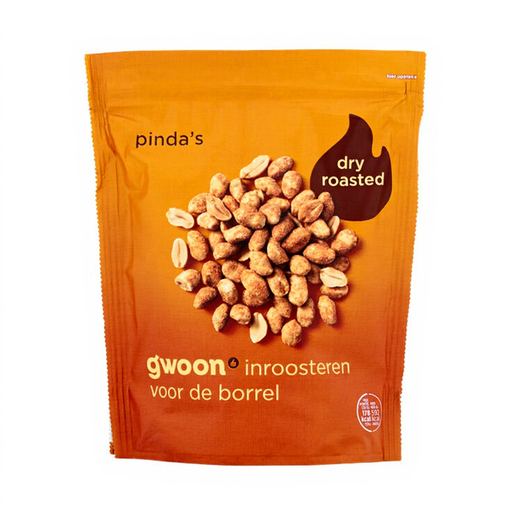
g’woon Dry Roasted Peanuts, 200 g

g’woon Dry Roasted Peanuts, 200 g

Suitable for a snack portion of dry-roasted peanuts, but this isn’t a low-fat product.

Fat: 49 g per 100 g. The ingredients list includes sunflower oil and herbs.

View at Joybuy

g’woon Peanuts in Shell, 500 g

g’woon Peanuts in Shell, 500 g

An option if you want to weigh out a portion of in-shell peanuts for a snack; the shells don’t turn the listed fat value per 100 g into a low-fat claim.

Fat: 49 g per 100 g.

View at Joybuy

g’woon Unsalted Peanuts, 250 g

g’woon Unsalted Peanuts, 250 g

Suitable for a weighed portion of ordinary unsalted peanuts; ‘unsalted’ doesn’t mean low fat.

Fat: 50 g per 100 g. The ingredients list includes sunflower oil.

View at Joybuy

Verse Extra Large Roasted Peanuts, 210 g

Verse Extra Large Roasted Peanuts, 210 g

An option if you want to weigh out a portion of roasted, unsalted peanuts; the listed fat value isn’t low.

Fat: 50 g per 100 g. The product information lists peanuts as the only ingredient.

View at Joybuy

Frequently asked questions

Is a smaller portion the same as low fat?

No. For solid foods, the European Commission sets the maximum for a ‘low fat’ claim at 3 g of fat per 100 g. A smaller portion reduces the amount of fat you eat, but doesn’t change the composition per 100 g.

How do I calculate the fat in my snack portion?

Multiply the fat per 100 g by the weight of your portion, then divide by 100. For Jumbo Unsalted Peanuts 250 g, the label lists 48 g of fat per 100 g: a 15 g portion contains 48 × 15/100 = 7.2 g of fat. This is a calculation based on the label, not personal dietary advice.

Does ‘no added oil’ mean peanuts are low in fat?

No. Peanuts naturally contain fat, even when no oil is added during preparation. Duyvis describes Oven Baked Peanuts Original as made without added oil or fat; assess whether they’re low in fat using the nutritional values per 100 g.

Are roasted peanuts suitable for someone with a peanut allergy?

Don’t assume that roasting or a nutritional claim makes peanuts suitable for someone with a peanut allergy. Stichting Voedselallergie states that the peanut allergen remains stable when heated; check the ingredients and allergen information on the exact pack.

Can you give whole peanuts to young children without taking any precautions?

No. The Albert Heijn and PLUS product pages warn that young children can choke on peanuts. Choosing an unsalted or low-fat variety doesn’t remove this risk.
