What should you look for when buying?
First, decide whether you want the product itself to contain less fat, or simply want to eat less during the match. Then consider salt, portion size and packaging separately.
| What to consider |
What to look for |
Who is this important to? |
| Fat content |
Compare fat per 100 g and check whether a claim specifically refers to fat and which reference product is used. |
If I want the peanuts themselves to contain less fat, I look beyond the preparation method or wording on the pack. Around 36% of consumers prioritise a demonstrable reduction in fat. |
| Quantity |
Decide on your portion in advance and compare the nutritional values for that amount. |
If I don’t want to keep reaching into a large bag during the match, it helps to set aside a portion beforehand. Around 29% of consumers prioritise portion control. |
| Salt |
Check the salt content and ingredients of the exact product; unsalted doesn’t automatically mean it contains no added oil. |
If I’m looking for unsalted peanuts to serve in a bowl, I don’t want to confuse salt content with fat content. Around 21% of consumers prioritise an unsalted product. |
| Packaging and storage |
Choose a pack size to suit the number of people eating and check how to store the pack after opening. |
If I’m sharing peanuts and want to keep any leftovers, I check the quantity and storage advice on the pack. Around 14% of consumers prioritise pack size and storage. |
Peanuts at Joybuy
These peanuts are worth comparing for their preparation method, portion size and nutritional information. If you’re specifically looking for less fat, check the nutrition table for the variety you choose.
 No image available
g’woon unsalted peanuts, 250 g
An option for an unsalted snack; if you’re looking for reduced fat, check the fat per 100 g on the pack.
Contains peanuts and may contain cashew nuts; check the allergen information if relevant.
View at Joybuy
 No image available
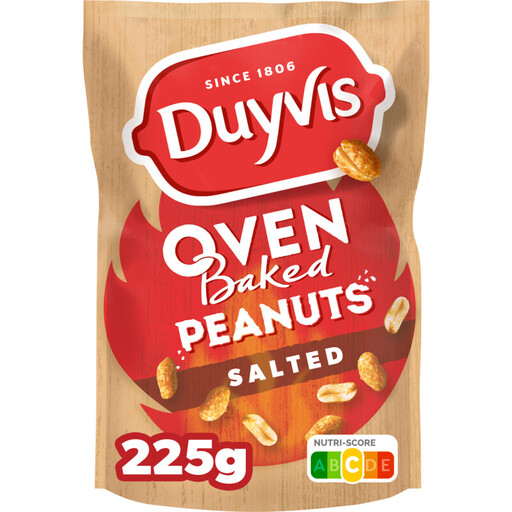
Duyvis roasted peanuts, 225 g
A ready-to-eat roasted snack; roasted doesn’t automatically mean lower in fat, so compare the nutritional values on the exact pack.
The product information states that each pack contains 7–8 servings; decide for yourself how much you want to serve during the match.
View at Joybuy
 No image available
Duyvis honey and lightly salted oven-roasted peanuts
The honey variety is oven-roasted and lightly salted; it’s not the right choice if you’re specifically looking for unsalted peanuts.
The product information lists peanuts and wheat/gluten, and says the product may contain other nuts. Also bear in mind the stated choking hazard for young children.
View at Joybuy
 No image available
Verse extra-large roasted peanuts, 210 g
An option for a roasted, unsalted snack; assess the fat content separately using the nutrition table.
Peanuts are listed in the ingredients; not suitable for anyone with a peanut allergy.
View at Joybuy
 No image available
g’woon peanuts in shells, 500 g
The peanuts are in their shells, so they take a little more effort to eat; bear this in mind if you’re sharing them as a snack.
Contains peanuts and may contain traces of nuts; check the allergen information if relevant.
View at Joybuy
Frequently asked questions
Do ‘reduced fat’ and ‘low fat’ mean the same thing?
No. According to the Netherlands Nutrition Centre, ‘light’ or ‘reduced’ means at least 30% less energy, fat or sugar than the standard product; the packaging must state what has been reduced. For solid foods, the European Commission defines ‘low fat’ as no more than 3 g of fat per 100 g. If you’re comparing products, check whether a relative claim specifically refers to fat.
How do I calculate the nutritional value of my portion?
Multiply the value per 100 g by the weight of your portion, then divide by 100. For example, 25 g of AH Unsalted Peanuts, 300 g, provides 155 kcal and 12.75 g of fat, based on the product values of 620 kcal and 51 g of fat per 100 g. This is a calculation example, not a recommended portion for everyone.
What should I check if guests have allergies?
Check the ingredients and allergen information on the exact pack. The NVWA lists peanuts as an allergen that must be declared. AH Unsalted Peanuts may contain various nuts; for Oven Original, Duyvis states that wheat and various nuts may be present. If a guest has a peanut allergy, follow any specific arrangements they have made.
How should I store any peanuts left over after the football?
Follow the storage advice on the specific pack. Albert Heijn recommends storing the peanuts in a cool, dark and dry place, and closing the pack securely after use. For Duyvis Oven Original, PLUS recommends storing the product in a light- and airtight container after opening.
Which product recall applies to existing stock?
On 20 May 2026, Albert Heijn announced a recall of AH Extra Large Salted Peanuts in a tub with a best-before date of 04-11-2026 due to possible metal fragments. Do not eat this specific pack; Albert Heijn says you can return it to the shop for a full refund. According to the notice, products with other best-before dates are not affected. This does not apply to AH Unsalted Peanuts, 300 g.


