If you want to reduce your total fat intake, compare the nutritional values per 100 g and assess any reduced-fat claim separately; unsalted or made without added fat does not automatically mean low-fat. Duyvis describes its Oven Baked Original as made without added oil or fat, while PLUS lists 51.3 g of fat per 100 g for its unsalted peanuts. For solid foods, the European Commission sets a maximum of 3 g of fat per 100 g for a ‘low fat’ claim. Also choose a pack size and portion that suit your family.
Who is this guide for?
Families looking to understand fat claims
If you want to buy products with less fat, it helps to distinguish nutritional values from descriptions of how a product is made. Duyvis describes its Oven Baked Original as made without added oil or fat; on its own, this does not tell you how much total fat the product contains.
Families planning their supplies and portions
A 500 g pack may suit a larger stock-up, but it does not tell you how much to serve at each snack time. The Voedingscentrum uses 25 g as a reference portion for generic unsalted peanuts; this is not a set portion for every family member.
Families considering age or allergens
If you have young children or food allergies to consider, check the form of the peanuts and the information on the packaging. CJG Zeist advises against giving whole peanuts or nuts to children under 4; the NVWA explains that allergens must be clearly identifiable in the ingredients list.
What should you look for when buying?
First compare the total fat per 100 g and the meaning of any claim; then consider portion size, pack size and information for family members separately.
| What to consider |
What should you check? |
Who is this important for? |
| Total fat and claims |
Compare the total fat per 100 g. For solid foods, the European Commission sets a maximum of 3 g of fat per 100 g for a ‘low fat’ claim; assess a reduced-fat claim using the specific product information. |
If I want to reduce my total fat intake, I look beyond whether peanuts are unsalted or oven-baked. Around 36% of consumers prioritise demonstrable fat reduction. |
| Amount per portion |
Use the nutritional values for the product you buy and calculate them based on the amount you actually serve. The Voedingscentrum uses 25 g as a reference portion for generic unsalted peanuts. |
If I want to keep track of how much I serve at each snack time, I need product information that matches my portion. Around 29% of consumers prioritise portion control. |
| Pack size |
Check the net weight and storage instructions on the packaging. Jumbo lists a 500 g pack of unsalted peanuts; PLUS lists a 300 g stand-up pouch. |
If I’m stocking up for several family members, I want a pack size that suits our consumption and is easy to store. Around 21% of consumers prioritise a practical family stock-up. |
| Age and allergens |
Check the form, ingredients and allergen warnings. CJG Zeist advises against giving whole peanuts to children under 4; the NVWA says allergens must be clearly identifiable in the ingredients list. |
If age or a food allergy affects the choice, I check this separately from the fat content. Around 14% of consumers prioritise family safety. |
Common buying mistakes
-
Assuming unsalted or oven-baked means low-fat
These descriptions refer to different product characteristics. PLUS lists 51.3 g of fat per 100 g for its unsalted peanuts, so ‘unsalted’ does not mean the total fat is low. Duyvis’s description of its product as made without added oil or fat refers to how it is prepared.
Check the total fat per 100 g and the preparation description separately. For solid foods, the European Commission sets a maximum of 3 g of fat per 100 g for a ‘low fat’ claim.
-
Treating a large pack as portion advice
A large pack, such as Jumbo’s 500 g pack, does not determine how much you serve at each snack time. The Voedingscentrum uses 25 g as a reference portion for generic unsalted peanuts.
Choose a serving amount that suits your needs, and follow the storage instructions on the packaging.
-
Choosing the same type of peanuts for everyone
Age and allergens can affect whether a product is suitable, regardless of its fat content. CJG Zeist advises against giving whole peanuts or nuts to children under 4.
For any family members who need you to, check the product’s form, ingredients and allergen information on the packaging.
Brands to consider
Duyvis
Duyvis describes its Oven Baked Peanuts Original as made without added oil or fat.
- The preparation description makes clear which addition the manufacturer says it leaves out.
- On its own, this description does not prove that the product has a lower total fat content or qualifies as ‘low fat’.
Albert Heijn
AH lists an unsalted peanut option for anyone looking to avoid added salt.
- The product listing makes it easy to identify the unsalted option.
- Unsalted does not automatically mean lower in total fat; check the nutritional values on the specific pack.
Jumbo
Jumbo lists unsalted peanuts in a 500 g pack, a specific stock-up size.
- The net weight is useful if you’re looking for a larger pack.
- The pack size does not prove that the product is low-fat or that it suits every family.
Lidl
Lidl’s product listing features unsalted peanuts in a 285 g pack.
- The product listing gives a specific pack size and identifies the unsalted option.
- Unsalted does not indicate a lower total fat content.
Aldi
Aldi’s product page lists Trader Joe’s roasted, unsalted peanuts in a 250 g pack.
- The product listing gives both the preparation method and the pack size.
- Roasted and unsalted does not prove a lower total fat content.
PLUS
PLUS lists unsalted peanuts in a 300 g stand-up pouch. For this option, PLUS states that each 100 g contains 51.3 g of fat and 0 g of salt.
- The product information gives specific values, so you can assess fat and salt separately.
- These values apply to the option listed and do not prove that the product is low-fat or represent the entire PLUS range.
Peanuts at Joybuy
This selection includes unsalted peanuts, roasted peanuts and peanuts in shells for anyone who wants to choose their own portion size. The product information does not support describing these products as low-fat or reduced-fat.
 No image available
g'woon Unsalted Peanuts 250 g
The product name identifies these as unsalted peanuts; this is a choice based on salt, not on a lower total fat content.
Pack size: 250 g.
The product information lists peanuts and possible traces of cashew nuts; check the packaging if allergens are relevant to your family.
View at Joybuy
 No image available
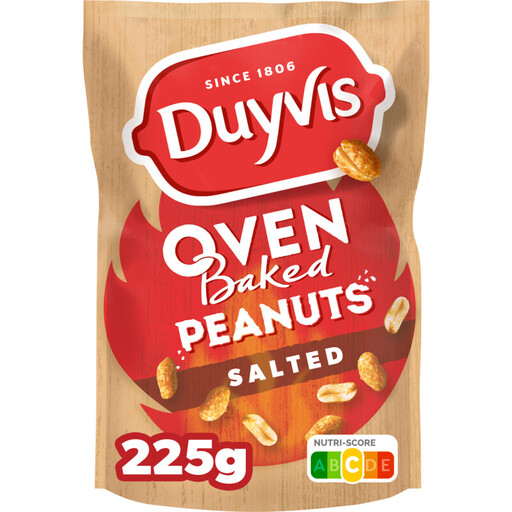
Duyvis Roasted Peanuts 225 g
The product information states that there are 7–8 servings per pack; use the nutritional values for this option to calculate the values for your own portion.
Pack size: 225 g.
The product information lists peanuts and possible traces of other nuts. Seal the pack securely after opening, as advised in the product information.
View at Joybuy
 No image available
g'woon Peanuts in Shells 500 g
At 500 g, this pack may suit anyone looking for a larger supply; the pack size does not tell you how much to serve at each snack time.
The product information lists peanuts and possible traces of nuts.
CJG Zeist advises against giving whole peanuts or nuts to children under 4.
View at Joybuy
 No image available
Verse Extra Large Roasted Peanuts 210 g
The product description calls these roasted peanuts unsalted; that does not automatically make them low-fat.
Pack size: 210 g. The product information includes storage advice for after opening.
The product information lists peanuts; check the packaging for allergen information.
View at Joybuy
Frequently asked questions
Does ‘low fat’ mean the same as ‘made without added fat’?
No. ‘Made without added fat’ describes how a product is prepared; Duyvis uses this description for Oven Baked Original. For solid foods, the European Commission sets a maximum of 3 g of fat per 100 g for a ‘low fat’ claim.
How should I use a portion size listed for peanuts?
Use a listed portion size as a guide for your calculations, not as a set amount for every family member. The Voedingscentrum uses 25 g for generic unsalted peanuts; use the nutritional values for the product you buy to calculate your own portion.
Can children under 4 eat whole peanuts?
CJG Zeist advises against giving whole peanuts or nuts to children under 4 because of the risk of choking. This advice applies to this age group and the form of the product.
What should I look for in the allergen information on the packaging?
Read the ingredients list and any allergen warnings before choosing a product. The NVWA says allergens must be clearly identifiable in the ingredients list and notes that new rules on information about unintended presence due to cross-contamination apply from 1 January 2026.
What should I do with the recalled AH tub of peanuts?
Do not eat AH Pinda’s extra groot gezouten in a tub with a best-before date of 04-11-2026. Albert Heijn says this specific option is being recalled and can be returned for a refund; the warning does not automatically apply to other options or best-before dates.


