
Less fat is your top priority
You’re specifically looking for a peanut snack with demonstrably less fat and want to know what the claim is being compared with. A preparation method that uses no added oil isn’t enough to establish this.


If your main priority is less fat, look for a specific claim with a clear basis for comparison. If you want a smaller snack with your coffee, focus on how much you actually eat. The European Commission sets a maximum of 3 g of fat per 100 g for a ‘low-fat’ claim on solid foods. A claim that a product has a reduced fat content is different: the Dutch Bakery Centre describes this as at least 30% less than comparable products. Unsalted or made without added oil does not, by itself, mean that peanuts are low in fat.
You’re specifically looking for a peanut snack with demonstrably less fat and want to know what the claim is being compared with. A preparation method that uses no added oil isn’t enough to establish this.
You want to have a small amount with your afternoon coffee, so you check the portion size and the nutritional value of what you actually serve yourself. The Netherlands Nutrition Centre gives 157 kcal for 25 g of unsalted peanuts as an example for this category; check the nutritional information for the exact variant on the pack.
You’re looking for a simple unsalted snack that you can portion out yourself. Ingredients, fat content and storage instructions are all separate things to check.
Choose this option: if your main priority is a lower fat content than in similar coated snacks. A historical Albert Heijn product listing for Duyvis Oven baked sundried tomato and herbs stated 30% less fat than regular Duyvis Borrelnootjes and Tijgernootjes.
Please note: that claim did not apply to all regular peanuts. The listing also stated 26 g of fat and 508 kcal per 100 g, and included wheat as an ingredient; the product therefore does not meet the threshold for ‘low fat’. Always check the claim and the label on the variant you’re buying.
Choose this option: if you’re mainly looking for a product that Duyvis says is made without added oil or fat.
Please note: this preparation method does not prove that the product is lower in fat or low in fat. Also check the seasoning, salt content and portion size.
Choose this option: if by a lighter snack you mainly mean keeping the amount you have with your coffee in check. Weighing out a portion in advance makes it clear how much you’re eating.
Please note: a smaller portion does not change the nutritional composition per 100 g. AH Unsalted Peanuts list 51 g of fat, 620 kcal and 0 g of salt per 100 g.
| What to consider | What to check when buying | Who is this most relevant to? |
|---|---|---|
| Spotting a genuine reduced-fat claim | Check the claim, what it is being compared with and the fat content per 100 g. The Dutch Bakery Centre describes ‘reduced content’ as at least 30% less than comparable products. | If I mainly want demonstrably less fat, the comparison needs to be relevant to the product I eat. Around 36% of consumers prioritise this need. |
| Energy per portion eaten | Compare nutritional values on the same weight basis, then decide how much to weigh out yourself; a suggested portion is not a required snack quantity. | If I want to keep my coffee-time snack small, how much I serve myself matters more than just the wording on the front of the pack. Around 29% of consumers prioritise portion size and energy. |
| Unsalted ingredients | Read the ingredients and salt content for the exact variant. Unsalted does not automatically mean made without added oil. | If I want to eat unsalted peanuts regularly, I want to be able to check the salt and ingredients on my own pack. Around 21% of consumers prioritise this choice. |
| Packaging and storage | Check the pack size, confirm current availability with the retailer and follow the storage instructions. The Netherlands Nutrition Centre recommends keeping nuts dry and in a tightly sealed container. | If I’m buying peanuts for several coffee breaks, I want packaging that suits how I use them and can be sealed properly. Around 14% of consumers mainly consider practical shopping and storage. |
A description of how a product is made doesn’t tell you how much fat the finished product contains. For solid foods, the European Commission sets a maximum of 3 g of fat per 100 g for a ‘low-fat’ claim.
Check the fat content per 100 g separately, and treat ‘no added oil’ only as a description of how the product is made.
A lower fat content than in a comparison product doesn’t tell you how much you’ll eat during your coffee break. The amount on your plate also determines the nutritional value of your snack.
Compare products on the same weight basis, then weigh out a portion that suits your coffee break.
The Netherlands Nutrition Centre recommends keeping nuts dry and in a tightly sealed container, as they are susceptible to mould.
Choose an amount that suits how you use them, and seal the pack carefully after your snack.
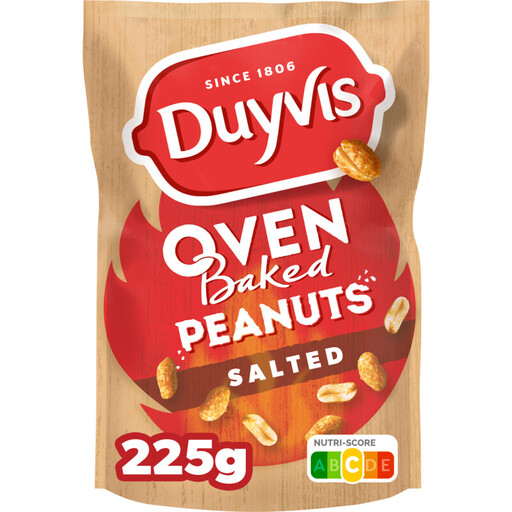
Useful for comparing regular peanuts, oven-roasted peanuts and snacks with a crunchy coating.
The own-brand AH Unsalted Peanuts are a specific option that you can portion out yourself.
The range includes unsalted and dry-roasted peanuts, among other options.
A retailer option for comparing unsalted peanuts.
The Trader Joe’s variant described is an option if you’re looking for roasted, unsalted peanuts.
PLUS Unsalted Peanuts are a specific variant with product information per 100 g.
This selection includes unsalted and roasted peanuts for a coffee break; check the nutritional values and portion size for the exact variant. The products listed are not automatically lower in fat or low in fat.
 No image available
A good fit if you want to portion out unsalted peanuts to have with your coffee.
Lists 50 g of fat and 0.02 g of salt per 100 g. The ingredients include peanuts and sunflower oil; the product may contain cashew nuts.
 No image available
A good fit if you’re looking for roasted peanuts as a savoury snack to have with your coffee.
Lists 50 g of fat and 1.4 g of salt per 100 g. Contains peanuts and may contain other nuts.
 No image available
A good fit if you’re looking for a roasted snack with honey and salt to have with your coffee.
Lists 40 g of fat and 1.4 g of salt per 100 g, with 5–6 portions per pack. Contains peanuts, wheat and cereals containing gluten, and may contain other nuts. The product information warns of a choking hazard for young children.
 No image available
A good fit if you want to shell your own peanuts during your coffee break.
Lists 49 g of fat and 0.12 g of salt per 100 g. Store in a cool, dry place and reseal the pack after opening; the product may contain traces of nuts.
 No image available
A good fit if you’re looking for roasted peanuts to enjoy as a snack.
Lists 50 g of fat and 0.02 g of salt per 100 g.
No, not automatically. For solid foods, the European Commission sets a maximum of 3 g of fat per 100 g as the condition for a ‘low-fat’ claim. A relative claim about having less fat is different from meeting that threshold.
No. A portion size is additional nutritional information, not a prescribed amount to eat. Use the values for the exact variant and consider how much you actually have.
Not by itself. It describes how the product is made; also check the fat content per 100 g and any claim on the exact pack.
Read the ingredients and allergen information for the exact variant. The Netherlands Food and Consumer Product Safety Authority states that allergen information must appear on the label of prepacked products. A reduced-fat claim says nothing about whether a product is suitable for someone with an allergy.
Keep them dry and in a tightly sealed container, preferably somewhere cool, and follow the instructions on the pack. The Netherlands Nutrition Centre recommends storing nuts in a tightly sealed container in a dry place.