If you have coeliac disease, first check the gluten information for the exact product variant, then consider how convenient the packaging is. The product page for AH Unsalted Peanuts 300 g states that they are gluten-free; Duyvis describes salted peanuts in 60 g bags and lists peanuts, sunflower oil and salt as ingredients. Always check the pack you buy, and avoid gluten contact when preparing your own portions.
Who are these options relevant to?
Label-conscious snackers with coeliac disease
You want to assess a snack to take with you based on information about the specific product variant, rather than the brand name or reputation. The Dutch Coeliac Society distinguishes between checking ingredients and looking for information about possible cross-contamination risks.
Snackers short on preparation time
You’re looking for a sealed bag that’s ready to take with you. Duyvis describes salted peanuts in a 60 g single-serve pack; the weight of the bag doesn’t automatically determine how much you want to eat.
Snackers who portion their own
You want to take a smaller amount of unsalted peanuts with you and can weigh it out in advance. Larger packs make this possible, but you’ll need to handle them hygienically when portioning.
What should you consider when choosing?
An individual snack pack
A good fit if: you want a sealed pack to take with you without weighing out a portion in advance.
Bear in mind: the pack may contain more than you want to eat; also check the latest gluten and allergen information.
Portioning from a larger bag yourself
A good fit if: you want to weigh out a smaller amount in advance or prefer to choose unsalted peanuts.
Bear in mind: portioning takes preparation and requires a clean, resealable container.
A larger own-brand bag
A good fit if: you want to check the ingredients and warnings on the pack yourself and prepare portions in advance.
Bear in mind: a simple ingredients list is not a gluten-free claim or proof of a measured gluten content.
If you have coeliac disease and are choosing peanuts to take with you, the main consideration is whether product-specific gluten information, convenience on the go, portion control, or stocking up and preparing in advance matters most to you.
| What to consider |
What to look for |
Who is this important to? |
| Gluten information for the product variant |
Check the gluten-free statement, ingredients and warnings on the pack. |
I want to assess the exact product variant rather than rely on the brand name alone. Consumers who put gluten information first account for around 36% of shoppers in this decision-making context. |
| Individual pack to take with you |
Check the weight of each bag and how many bags are in the pack. |
I want to take a sealed snack with me without any preparation. This is the top priority for around 29% of consumers. |
| Portion size and salt preference |
Consider how much you want to eat, the salt information and whether the bag is intended for one or several eating occasions. |
I want to decide for myself how much to take and prefer unsalted peanuts. Portion control and salt preference are the main priorities for around 21% of consumers. |
| Stocking up and preparation |
Consider the total quantity in the pack and how much you want to portion out in advance. |
I want to avoid buying more than I need, or choosing a pack that requires extra preparation. Stocking up and preparation are the main considerations for around 14% of consumers. |
Common pitfalls
-
Assuming gluten-free information for one product applies to the whole brand
Plain salted peanuts, marinated peanuts and peanuts with a batter coating are different products. Information about plain salted peanuts doesn’t automatically apply to other varieties.
Check the exact product variant and the pack you’re buying. The Dutch Coeliac Society recommends checking the ingredients and relevant warnings separately.
-
Confusing a serving size with individual bags
AH gives a serving size of 25 g for its 300 g pack. This doesn’t mean it contains individual 25 g bags.
Check the weight of each bag and the number of individual packs. Only take a larger bag with you if you’re happy to weigh out your own portion.
Weighing and packing your own portions takes preparation.
-
Assuming a sealed bag is the portion you want to eat
The Duyvis bag contains 60 g. That’s the amount in the pack, not a recommendation that this is the right portion for you.
Decide in advance how much you want to eat, and seal any leftovers properly. The Netherlands Nutrition Centre recommends storing nuts in a dry place in a well-sealed container.
-
Focusing on one bag and forgetting the total quantity
Supplier information for Duyvis describes a box of twenty 60 g bags, totalling 1.20 kg.
Check both the number of individual bags and the total quantity, so the pack suits how much you want to keep in stock.
A box containing several bags may give you more than you need for a few trips.
Brands to consider
Duyvis
The manufacturer describes plain salted peanuts in several pack sizes, including a 60 g option to take with you.
- The manufacturer lists peanuts, sunflower oil and salt as ingredients in its plain salted peanuts.
- Information about plain salted peanuts does not automatically apply to Borrelnootjes, Tijgernootjes or marinated varieties. The manufacturer gives a warning about other nuts.
Albert Heijn
AH Unsalted Peanuts 300 g is a larger pack for consumers who want to prepare their own portions.
- The product page states that this variant is gluten-free and gives a serving size of 25 g.
- A stated serving size does not mean the pack contains individual bags. The gluten-free statement applies to this variant, not automatically to the whole range.
Jumbo
Jumbo Unsalted Peanuts 250 g is an own-brand bag for portioning yourself.
- The product information lists 99.5% peanuts and sunflower oil.
- The ingredients information is not an explicit gluten-free claim; the product information states that the peanuts may contain other nuts.
PLUS
PLUS Unsalted Peanuts 250 g is a larger own-brand pack for preparing portions to take with you.
- The product information lists 99% peanuts and sunflower oil.
- The product information states that the product may contain cashew nuts; also check the latest gluten information on the pack.
Lidl
Lidl has a product page for unsalted peanuts.
- The product information describes the peanuts as unsalted.
- Being unsalted says nothing about whether a product is suitable for a gluten-free diet. Check the ingredients and warnings on the current pack.
ALDI
ALDI describes Trader Joe’s roasted, unsalted peanuts in a 250 g pack.
- The product description gives the pack size and describes the peanuts as roasted and unsalted.
- Being unsalted and having the stated Nutri-Score are not proof that the product is gluten-free; check the current ingredients and warnings.
Peanuts at Joybuy
The Joybuy products shown are packs of 210 g or more and are best suited to portioning yourself, rather than as individual small snack packs. If you have coeliac disease, always check the gluten information on the current pack.
 No image available
g’woon unsalted peanuts 250 g
A larger bag of unsalted peanuts for consumers who want to prepare their own portions; the product description says to store them in a tightly sealed pack after opening.
Bag weight: 250 g.
Ingredients: 99% peanuts and sunflower oil.
Joybuy
 No image available
Verse Extra Large roasted peanuts 210 g
A larger pack for anyone who wants to portion out their own roasted, unsalted peanuts; check the latest gluten information on the pack.
Bag weight: 210 g.
The product description lists 100% peanuts as the ingredient.
Joybuy
 No image available
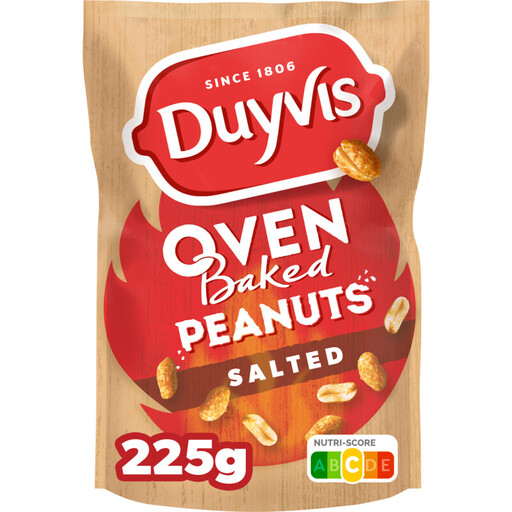
Duyvis roasted peanuts 225 g
This larger pack is for consumers who want to portion out a ready-to-eat peanut snack themselves; it isn’t a small individual snack pack.
Bag weight: 225 g.
The product information lists peanuts, flavourings and salt. Check the current ingredients and gluten warnings on the pack.
Joybuy
 No image available
g’woon peanuts in shells 500 g
A larger quantity for consumers who want to decide how much to take with them; bear in mind that you’ll need to shell the peanuts first.
Pack weight: 500 g.
The ingredients list states peanuts.
Joybuy
Frequently asked questions
Do the peanuts I choose always need to have a gluten-free logo?
No. The Dutch Coeliac Society also explains how to check ingredients in products without a gluten-free logo or statement. Assess the ingredients and information about possible cross-contamination risks separately; an ingredients list is not a certificate.
Does gluten-free mean that a product contains no gluten at all?
No. The European Commission defines the ‘gluten-free’ claim under Regulation (EU) No 828/2014 as a maximum of 20 mg of gluten per kg of product (20 ppm), not as proof that every gluten molecule is absent. A Crossed Grain licence is a separate scheme.
Can I ignore a warning about cereals containing gluten on peanuts?
No. Don’t assume there’s an exception just because peanuts are not cereals. The Dutch Coeliac Society also recommends taking information about possible cross-contamination risks into account when assessing the exact pack.
How can I take my own weighed-out portions of peanuts with me without gluten contact?
Portion them using clean equipment, away from bread crumbs, and use a well-sealed container. Store peanuts in a dry place and follow the storage instructions on the product packaging too.
Do older ‘may contain traces’ warnings automatically no longer apply?
No. From 1 January 2026, the Netherlands Food and Consumer Product Safety Authority will enforce the new rules for cross-contamination warnings. According to the official guidance on the transition, stock packaged earlier may still be sold after that date if the food is not unsafe; therefore, check the pack you actually buy.


