
Comparing fat content
You’re looking for peanuts that demonstrably contain less fat and want to distinguish nutritional values from terms such as ‘unsalted’ or ‘oven-baked’. Compare the same quantity of the exact variety.


Compare the fat content per 100 g of the exact peanuts you’re considering, then decide how much you actually want to eat. Unsalted or made without added oil doesn’t automatically mean low fat: according to the European Commission, a solid food can contain no more than 3 g of fat per 100 g to carry the ‘low fat’ claim.
You’re looking for peanuts that demonstrably contain less fat and want to distinguish nutritional values from terms such as ‘unsalted’ or ‘oven-baked’. Compare the same quantity of the exact variety.
You want to have a small amount of peanuts with your chips and are more concerned with the portion you actually eat than the whole bag. Albert Heijn lists a 25 g portion for the variety we checked.
Your main priority is avoiding added salt. Check the fat content separately in the nutritional information on the packaging.
First decide whether you’re mainly looking for lower fat content, a smaller portion, less added salt or suitable packaging. These are different shopping priorities, so each calls for different checks.
| What to consider | What should you check? | Who is this important to? |
|---|---|---|
| Genuinely less fat | Check the fat content in grams per 100 g and verify any claims on the exact packaging. For solid foods, the European Commission sets a maximum of 3 g of fat per 100 g for the ‘low fat’ claim. | Do you want the peanuts themselves to demonstrably contain less fat, rather than simply being prepared differently? Around 36% of consumers prioritise the product’s fat content. |
| Fat and energy per portion | Weigh the amount you plan to eat and use the nutritional values per 100 g for that variety to work it out. | Would you like a small amount with your chips and to save the rest for later? Around 29% of consumers prioritise portion size. |
| No added salt | Check both the ingredients and the amount of salt per 100 g; ‘unsalted’ doesn’t mean low fat. | Is avoiding added salt your main priority, with fat as a separate consideration? Around 21% of consumers start by checking the salt content. |
| Suitable packaging | Compare the net weight with how much you use and follow the storage instructions on the packaging. | Are you looking for packaging that suits the amount you eat and can store? Around 14% of consumers look at this first. |
The percentages give an indication of the different priorities people may have when making this choice; they are not measured market shares. The unsalted varieties we checked from Jumbo, PLUS and Albert Heijn list 48, 50 and 51 g of fat per 100 g respectively. These values apply only to the varieties mentioned. Oven-baking or leaving out added oil does not in itself prove that a product has a lower fat content.
The unsalted varieties we checked from Jumbo, PLUS and Albert Heijn contain 48 to 51 g of fat per 100 g. Salt content is a separate characteristic; this doesn’t mean the peanuts are low in fat.
Check the salt and fat content separately using the nutritional information for the exact product.
Duyvis uses this description for the way Oven Baked Peanuts Original is made. It doesn’t mean the product contains no fat; the manufacturer also lists salt and herbs.
Use the preparation method to decide whether it suits your preferences, and check the nutritional values for the fat content.
The AH pack we checked contains 300 g and lists twelve 25 g portions. The entire contents are therefore not the same as one portion.
Put the amount you want to eat in a small bowl first, then close the rest of the pack.
If you keep eating straight from the bag, you may have more than you intended.
Duyvis describes Oven Baked Peanuts Original as a variety made without added oil.
The product information for 300 g of AH Unsalted Peanuts lists nutritional values and a portion size.
Jumbo Unsalted Peanuts 250 g provides nutritional values per 100 g and per portion.
PLUS Unsalted Peanuts 250 g is an unsalted own-brand variety with product information for the exact pack.
The Dutch product page describes 285 g of unsalted peanuts.
The Dutch product page lists 250 g of Trader Joe’s peanuts, roasted and unsalted.
These are snack peanuts for anyone looking for, for example, shell-on, unsalted or roasted peanuts. If you’re watching your fat or salt intake, check the nutritional information and ingredients for the pack you choose.
 Image unavailable
An option if you’d like shell-on peanuts and want to decide how much to eat.
Pack size: 500 g. Contains peanuts; not suitable for anyone with a peanut allergy.
 Image unavailable
Suited to your preference for peanuts with no added salt; you can portion them out yourself.
Per 100 g: 50 g of fat and 0.02 g of salt. This fat content does not meet the threshold for the ‘low fat’ claim. May contain traces of cashew nuts.
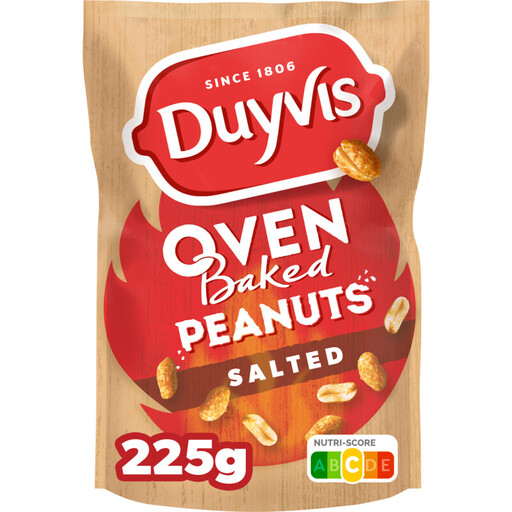 Image unavailable
A roasted snack option if you want to weigh out the amount yourself.
Per 100 g: 50 g of fat and 1.4 g of salt. This fat content does not meet the threshold for the ‘low fat’ claim. May contain other nuts.
 Image unavailable
An unsalted roasted variety that you can divide into a portion yourself.
Pack size: 210 g. The product information lists 50 g of fat per 100 g; this does not meet the threshold for the ‘low fat’ claim. Ingredient: peanuts.
Multiply the value per 100 g by the weight of your portion, then divide by 100. According to the product information, 25 g of AH Unsalted Peanuts contains 155 kcal and 12.75 g of fat; don’t use this result for a different variety.
Ask for allergen information about the peanuts before buying them. According to the Netherlands Food and Consumer Product Safety Authority, this information must be available. For non-prepacked food in catering establishments, it may be provided verbally under certain conditions, with a visible notice telling you that you can ask for it.
Follow the instructions on the packaging for your variety. For the unsalted peanuts we checked, Albert Heijn recommends storing them in a cool, dark and dry place and sealing the pack properly. The Netherlands Nutrition Centre also advises storing nuts in a dry place in a well-sealed container.
The product pages from Albert Heijn, Jumbo and PLUS warn that young children could choke on peanuts. This snack should therefore not be treated as a recommendation for young children.
On 20 May 2026, Albert Heijn issued a warning about AH Extra Large Salted Peanuts in a tub with a best-before date of 04-11-2026, due to the possible presence of metal fragments. Do not eat the affected product. The warning applies to that specific variety and date, and does not automatically apply to AH Unsalted Peanuts.