What should you look out for when choosing?
First, decide whether whole peanuts are suitable for the children and the occasion. Then choose between pre-packed individual portions and portioning them yourself.
Pre-packed individual portions
Choose this when: you want to hand out individual packs to children who can safely eat whole peanuts.
Bear in mind: according to Bidfood, the 60 g pack in the Duyvis box examined here contains two servings according to the label.
A larger unsalted pack
Choose this when: you want to decide how much goes in each pack yourself.
Bear in mind: you’ll need to pack the portions yourself and keep the original product information available.
Don’t hand out whole peanuts
Choose this when: a child is under 4, has a peanut allergy, or the party schedule doesn’t allow time for calm, supervised eating.
Bear in mind: choose a different treat to suit the children’s ages and any allergies their parents tell you about.
| What to consider |
What should you check? |
Who is this important for? |
| Age and allergies |
Ask parents about allergies and follow the advice on whole peanuts. Plan a calm time for eating, with supervision. |
If I’m not sure whole peanuts are suitable for all the guests, I want to check their ages and allergies first. Around 36% of consumers put suitability and safety first. |
| Individual packaging |
Check the number of packs, the weight per pack and the number of servings stated on the label. |
If I want to hand out snacks without filling the bags myself, I look for products that are already individually packed. Around 29% of consumers prioritise convenience when handing out treats. |
| Salt and ingredients |
Compare nutritional values per 100 g and read the ingredients and allergen information for the exact variant. |
If I’m looking for an unsalted option, I want to check the product information for the exact variant. Around 21% of consumers put ingredients first. |
| How much you’ll need for the party |
Add up the contents of the packs and decide in advance how much you want to give each child. |
If I want to avoid having too much or too little for my plans, I check the total quantity and consider whether there’ll be any left over. Around 14% of consumers want to choose an amount that suits their needs. |
Peanuts at Joybuy
These are roasted peanuts for anyone looking for a snack to share; the variants described differ in their ingredients.
 No image available
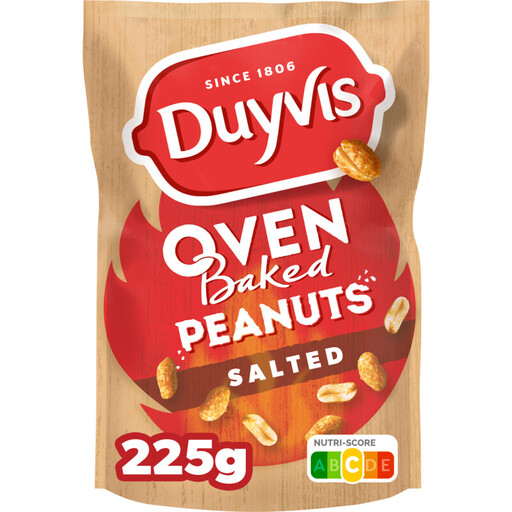
Duyvis Roasted Peanuts 225 g
A roasted snack to share, suitable only for guests who can safely eat whole peanuts and don’t have a peanut allergy.
The product information lists 97% peanuts, flavourings and salt.
Stated salt content: 1.4 g per 100 g.
Joybuy
 No image available
Verse Extra Large Roasted Peanuts 210 g
An unsalted roasted option to share, suitable only for guests who can safely eat whole peanuts and don’t have a peanut allergy.
The product information lists 100% peanuts and no added salt.
Joybuy
Frequently asked questions
Can a child under 4 eat whole peanuts from a small pack?
The Netherlands Nutrition Centre advises against giving whole peanuts or nuts to children under 4 because of the risk of choking. A smaller pack doesn’t change the way the peanuts are eaten. This is nutritional and safety advice, not a fixed legal age limit.
Are unsalted or roasted peanuts suitable for someone with a peanut allergy?
No. According to the Jeroen Bosch Hospital, a child with a peanut allergy must not eat food containing peanuts. Whether the peanuts are unsalted or roasted makes no difference; agree on an alternative with the parents.
Can children eat a pack of peanuts while walking or playing?
Plan a calm time for eating whole peanuts, with supervision. The Netherlands Nutrition Centre points out that older children can choke too; a pack to take along doesn’t make eating during an activity suitable by default.
What should you do with AH Extra Large Salted Peanuts with a best-before date of 04-11-2026?
Albert Heijn’s warning concerns AH Extra Large Salted Peanuts in a tub with that best-before date. Don’t eat the product: Albert Heijn warns that it may contain metal fragments and asks customers to return it. As of 13 October 2026, the best-before date is still in the future.
How should you store opened peanuts?
Follow the instructions on the packaging for the exact variant. For the Duyvis packs examined here, Bidfood advises storing them in a cool, dry place and, once opened, preferably keeping the pack in a light- and airtight container. The AH pack examined here says to store it in a cool, dark, dry place and seal it well after use.


