Who is this choice for?

Portion-conscious snackers

You want peanuts with your canteen lunch and to keep track of how much you eat. Compare the nutritional information on the label and weigh your portion rather than treating a whole bag as one snack. The Netherlands Nutrition Centre provides general information about the energy content of a portion.

People looking for unsalted snacks

You’re looking for peanuts with no added salt. The Netherlands Nutrition Centre includes unsalted nuts in its Wheel of Five guidelines; choosing unsalted doesn’t tell you how much energy your portion contains.

Lunch planners

You’re buying peanuts for several lunches and portioning them out yourself. Net weight and storage instructions help you decide how to use the pack; Jumbo and PLUS offer unsalted varieties in 250-gram packs.

What should you look for when buying?

What to consider What should you check? Who should factor this in?
Energy in your portion Compare kcal per 100 grams, then work out the energy in the amount you’re taking with you: kcal per 100 grams × portion weight in grams / 100. Use the nutritional information on the specific pack. If you mainly want to know how much energy you’re actually consuming, weigh your portion and calculate it using the label; around 50% of consumers prioritise portion control.
Salt and preparation method Check the exact variety and its ingredients. Don’t assume that unsalted or oven-baked means lower in calories. If you’re choosing mainly based on added salt or preparation method, check both the product description and the nutritional information; around 30% of consumers prioritise this product feature.
Portioning and storage Check the net weight and storage instructions. Weigh out the amount you want for lunch separately. If you’re splitting peanuts across several lunches, weighing them out yourself and storing the rest properly are practical considerations; around 20% of consumers prioritise lunch preparation.

Common pitfalls

  • Assuming unsalted means low in calories

    According to the Netherlands Nutrition Centre, unsalted peanuts can fit within its Wheel of Five guidelines, but they still provide energy: the general reference is 157 kcal per 25 grams.

    Consider salt content and the energy in your portion separately. To assess a specific variety, compare the nutritional information on the same basis.

  • Treating a multi-portion pack as one lunch serving

    The Jumbo and PLUS packs mentioned contain 250 grams, while the Netherlands Nutrition Centre uses 25 grams as a general reference portion for unsalted peanuts.

    Weigh out how much you want to take with you in advance, then calculate the energy using the nutritional information on the pack.

  • Assuming oven-baked means fewer calories

    Duyvis describes Oven Baked Peanuts Original as roasted in the oven without added oil or fat. This description of the preparation method does not compare its calorie content with that of other peanuts.

    Choose a preparation method that suits you, and use the nutritional information to compare energy content.

Brands to consider

Duyvis

For this choice, Pinda’s Ongezouten and Oven Baked Peanuts Original are separate product lines.

  • Duyvis describes the first variety as having no added salt and the second as oven-roasted without added oil or fat.
  • The preparation description doesn’t demonstrate a calorie benefit. Compare the nutritional information on the specific pack.

Albert Heijn

AH Ongezouten pinda’s is a own-brand option for anyone looking for peanuts with no added salt.

  • The product description clearly identifies this as the unsalted variety.
  • Albert Heijn advises checking the packaging, as ingredients, nutritional information and allergen details can change. No calorie benefit compared with other brands has been established.

Jumbo

Jumbo Pinda’s Ongezouten is listed in a 250-gram pack, which you can portion out across lunches.

  • The net weight gives you a clear starting point for portioning out the contents.
  • The pack weight is not a recommended lunch portion and doesn’t prove a calorie benefit.

Lidl

Lidl lists a product line called Ongezouten pinda’s.

  • The product description identifies this as an unsalted variety.
  • Use the information on the specific pack to assess its nutritional value and portion size.

ALDI

ALDI lists Trader Joe’s peanuts in a 250-gram pack as roasted and unsalted.

  • The preparation method and net weight stated are product features of this particular variety.
  • This description applies to the product mentioned and not automatically to other peanuts from ALDI.

PLUS

PLUS Pinda’s ongezouten is listed as a 250-gram own-brand pack.

  • The net weight is useful if you’re portioning out the contents across lunches yourself.
  • PLUS advises checking the packaging because product information can change; no lower calorie content than other brands has been established.

Peanuts at Joybuy

This selection includes peanuts for lunch portions you weigh out yourself, including unsalted and roasted varieties, as well as peanuts in their shells. Use the label on the specific pack to calculate the energy in your portion.

Fresh Extra Large roasted peanuts, 210 g

Fresh Extra Large roasted peanuts – 210 g

For anyone who wants to weigh out their own lunch portion; the pack is listed as 210 g.

Roasted peanuts.

Joybuy

g’woon peanuts in their shells, 500 g

g’woon peanuts in their shells – 500 g

An option if you want to portion them out yourself; the pack is listed as 500 g.

Peanuts in their shells. Follow the storage instructions on the pack.

Joybuy

g’woon unsalted peanuts, 250 g

g’woon unsalted peanuts – 250 g

For anyone looking for an unsalted variety and wanting to weigh out their own lunch portion.

Pack weight: 250 g. Unsalted on its own tells you nothing about the energy in your portion; check the nutritional information.

Joybuy
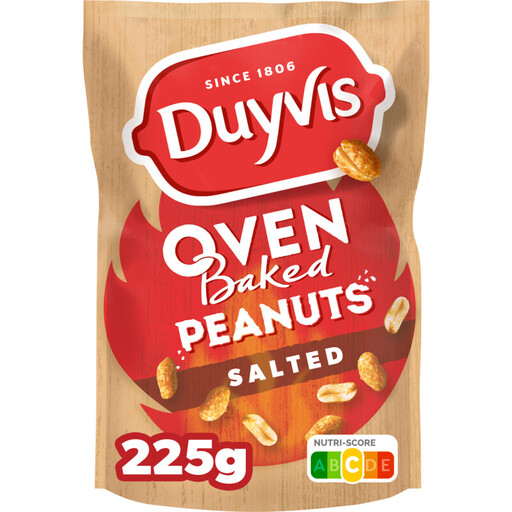
Duyvis roasted peanuts, 225 g

Duyvis roasted peanuts – 225 g

For anyone who wants to take roasted peanuts with them and decide on their own portion size.

Pack weight: 225 g. Check the nutritional information on this pack to calculate your portion.

Joybuy

Frequently asked questions

How do you calculate the energy in your lunch portion of peanuts?

Multiply the kcal per 100 grams shown on the label by the number of grams you’ve eaten, then divide by 100. The Netherlands Nutrition Centre gives 157 kcal per 25 grams of unsalted peanuts as a general reference; for a specific variety, use its own nutritional information.

Can an online shop automatically call unsalted peanuts ‘low-calorie’?

No, not automatically: unsalted peanuts or choosing a smaller portion doesn’t prove that a product meets the requirements for a nutrition claim. According to the European Commission, nutrition claims may only be used if they are authorised and meet the applicable conditions.

What allergen information can you ask for in the canteen?

Ask for information about the specific product before buying it. The Netherlands Food and Consumer Product Safety Authority (NVWA) requires allergen information to be available. Peanuts are an allergen, and a variety may also list other allergens.

Does roasting make peanuts safe for people with a peanut allergy?

No, roasting doesn’t make peanuts safe for people with an allergy. The Dutch Food Allergy Foundation says the allergen remains stable when heated, so don’t treat a roasted variety as an allergy-safe alternative.

How should you store the rest if you make your own lunch portions?

First, follow the storage instructions on the pack. The Netherlands Nutrition Centre’s general storage guide recommends keeping opened unsalted peanuts for six months in a kitchen cupboard or nine months in the fridge. This is general product guidance, not a guarantee for every pack or storage condition.
