
The mindful snacker
You want to enjoy peanuts at a garden party while keeping track of the calories in your portion. Compare the same quantity and weigh it out in advance. The Voedingscentrum lists 157 kcal for a 25 g handful of unsalted peanuts.


If you want to eat fewer calories at a garden party, weighing out your portion in advance is the most useful step; unsalted peanuts are not automatically low in calories. The plain peanuts examined list 602–623 kcal per 100 g, while the cocktail variety with a crispy coating has a different nutritional profile and is not a low-calorie snack either. So compare the same quantity, and also check the salt, ingredients and allergen information.
You want to enjoy peanuts at a garden party while keeping track of the calories in your portion. Compare the same quantity and weigh it out in advance. The Voedingscentrum lists 157 kcal for a 25 g handful of unsalted peanuts.
You’re looking for plain peanuts with no added salt and want to compare the ingredients and nutritional values too. Unsalted doesn’t automatically mean low in calories; for example, the Jumbo variety examined contains sunflower oil.
You’re looking for a snack to serve with drinks and want to get the quantity right, while also taking allergies and young children into account. Plain peanuts and peanuts with a crispy coating can differ in their ingredients and allergens.
| What to consider | What should you check? | Who is this for? |
|---|---|---|
| Calories per serving | Compare kcal per 100 g, then work out the values for each variety using the same serving weight. The Jumbo peanuts examined list 602 kcal per 100 g, Duyvis Unsalted 614, AH Unsalted 620 and PLUS Unsalted 300 g 623; these values apply to the packs specified. | If I want to keep snacking at a garden party without losing track of my portion, I weigh it out in advance. Around 36% of consumers prioritise the calories in the portion they eat. |
| Salt and ingredients | Check the ingredients and nutritional information on the exact pack. Unsalted doesn’t mean that no oil has been added. | If you’re mainly looking for simple, unsalted peanuts, check the ingredients and nutritional information too. This is a priority for around 22% of consumers. |
| Flavour and texture | Choose between plain peanuts, oven-roasted peanuts or a crispy coating. The cooking method or flavour description alone does not prove that a product has fewer calories. | If I’m mainly after a particular flavour or crunch to enjoy with drinks, I also compare the calories and ingredients. Around 14% of consumers start with flavour and texture. |
| Suitability for guests | Read the ingredients and allergen information for the exact variety. The Duyvis cocktail variety examined also contains wheat and milk. According to the MDL Fonds, whole nuts are not safe for children under four because of the risk of choking. | If there are guests with allergies or young children at the table, I first make sure the option is suitable for them. Guest safety is the top priority for around 14% of consumers. |
| Packaging and leftovers | Choose an amount that suits the number of guests and the servings you plan to offer. Follow the storage instructions on the pack for any leftovers. | If I’m shopping for a group, I want to choose the right amount and know how to store any leftovers. Around 14% of consumers make this their priority. |
These terms describe the salt content or how a product is prepared, not whether it meets the criteria for a low-calorie claim. For solid foods, the European Commission sets a limit of no more than 40 kcal (170 kJ) per 100 g.
Compare the nutritional information on the exact pack, then work out the calories in the portion you plan to eat. A smaller portion doesn’t make a product low in calories per 100 g.
The calories per serving may look lower simply because the stated serving is smaller. AH uses a 25 g serving for the peanuts examined; Jumbo also gives values for 30 g.
First compare the values per 100 g, or work out the figures for each product using the same weight.
The cocktail variety examined lists fewer kcal per 100 g than the four plain unsalted varieties examined, but it also has a different nutritional profile. It contains salt, among other ingredients, and lists less protein and fibre than the PLUS Unsalted 300 g examined.
Assess calories and ingredients separately, and check the allergen information for the coating too.
The net weight of a pack isn’t the same as the amount one person eats. Products from the same brand can also differ in their ingredients.
Plan the amount in grams, serve weighed portions and seal any leftovers according to the storage instructions.
The varieties examined include plain unsalted peanuts, oven-roasted peanuts and Borrelnootjes cocktail.
The AH Ongezouten peanuts 250 g examined are plain peanuts for serving with drinks, with a stated serving size of 25 g.
The Jumbo Pinda’s Ongezouten 250 g examined has a nutritional table showing values per 100 g and per serving.
Lidl describes a 200 g pack of roasted, unsalted peanuts for cooking or snacking.
The Dutch product description examined names Trader Joe’s peanuts, 250 g, roasted and unsalted.
The PLUS unsalted peanuts examined are available in, among other options, a 300 g stand-up pouch and a separate 500 g pack.
These products offer a range of peanut options for snacking, from unsalted to seasoned or raw. Check the packaging and ingredients of the variety you choose.
 No image available
An unsalted option for anyone looking for plain peanuts to snack on.
Pack size: 250 g. May contain cashew nuts.
 No image available
A seasoned option for anyone looking for peanuts with a hint of honey and a lightly salted flavour.
The product information lists peanuts, wheat and gluten. Bear the warning for young children in mind.
 No image available
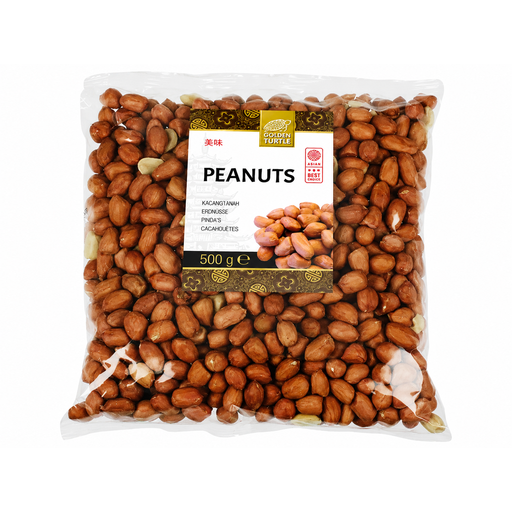
An unroasted variety with skins, described as suitable for cooking as well as snacking.
Pack size: 500 g. May contain traces of nuts.
 No image available
A roasted variety for anyone looking for peanuts to snack on.
Pack size: 210 g.
Not just because the serving is small. For solid foods, the low-calorie claim applies to products containing no more than 40 kcal (170 kJ) per 100 g. For a reduced energy claim, the European Commission requires an energy reduction of at least 30%, and the characteristic responsible for the reduction must be stated.
Multiply the number of guests who want peanuts by the serving size you plan to offer. For example, ten 25 g servings add up to 250 g; the AH 250 g pack examined lists ten 25 g servings. This is a calculation example, not a recommended serving size.
The AH pack examined recommends storing the peanuts in a cool, dark and dry place and resealing the pack after use; it does not say that they must be refrigerated. Follow the label on the pack you buy.
Check the ingredients and allergen information for the exact variety. The NVWA lists peanuts as one of the 14 specified allergens and requires allergens to be clearly indicated. For example, the Duyvis cocktail variety examined also contains wheat and milk.
The MDL Fonds advises against giving whole nuts to children under four because of the risk of choking. Bear this in mind if young children will be eating with you.
On 20 May 2026, Albert Heijn announced a recall of AH Pinda’s extra groot gezouten in a tub with a best-before date of 04-11-2026 because of possible metal fragments. Do not eat the product in question; return it to the shop. The notice does not apply to the AH Ongezouten peanuts 250 g examined, or to all AH peanuts.