What should you look for when choosing?
Start with the portion you want to serve, then compare the nutritional values, salt content and product information that matter to your guests.
| What to consider |
What should you check? |
Who is this important to? |
| Energy per portion |
Compare kcal per 100 g, then weigh out the same portion for each option. |
If I want to limit the energy in each snack portion, I’d rather weigh mine than rely on different handfuls. Around 39% of consumers prioritise calories per portion. |
| Salt and preparation |
Read the ingredients list and check the salt content and kcal per 100 g. |
If I want to avoid added salt, I check the ingredients rather than just how the peanuts are prepared. Around 23% of consumers give avoiding added salt top priority. |
| Allergens and serving |
Check the allergen information on the specific pack and keep it next to the bowl. |
When there are guests with food allergies or young children, I want to know what’s in the bowl and how to serve the peanuts safely. Around 23% of consumers say safe serving is their main concern. |
| Pack size and leftovers |
Check the net weight, work out your own portions and follow the storage instructions. |
If I’m buying for several guests, I want to match the quantity to the buffet and store any leftovers properly. Around 15% of consumers prioritise portion planning and leftovers. |
Peanuts on Joybuy
This selection includes unsalted and roasted peanuts, as well as peanuts in their shells and raw peanuts. Compare the nutritional values listed per 100 g, and always refer to the information on the specific pack for allergens and ingredients.
 No image available
g’woon unsalted peanuts, 250 g
Suitable if you’re looking for an unsalted variety and want to weigh out your own portion.
The description lists 99% peanuts, sunflower oil and 2690 kJ per 100 g. Contains peanuts and may contain cashews.
Joybuy
 No image available
Duyvis honey and lightly salted oven-roasted peanuts
Suitable if you’re looking for a sweet and savoury oven-roasted peanut snack and don’t need to avoid salt.
The description lists 561 kcal per 100 g and 1.4 g salt per 100 g. The pack contains 175 g; the ingredients include honey and wheat starch. Contains wheat and gluten and may contain other nuts. The description warns that the product poses a choking risk for young children.
Joybuy
 No image available
g’woon peanuts in shell, 500 g
Suitable if you want to serve peanuts in their shells and plan portions by weight.
The description lists 2515 kJ and 0.12 g salt per 100 g. Contains peanuts; whole peanuts can pose a choking risk for young children.
Joybuy
 No image available
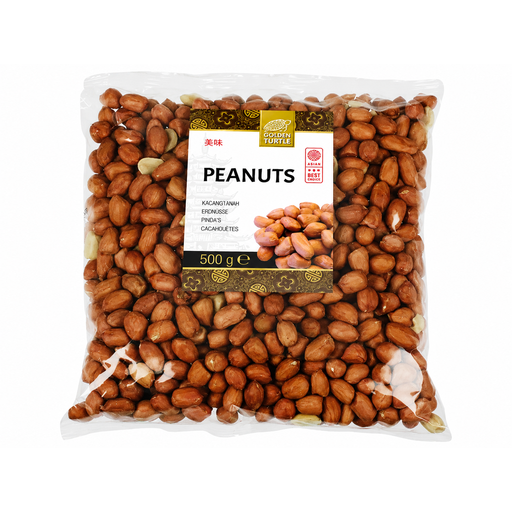
Golden Turtle Premium raw peanuts with skin, 500 g
Suitable if you’d rather choose how to prepare the peanuts than serve them ready-roasted.
The description lists raw peanuts with skin and 567 kcal per 100 g. The pack contains 500 g; roast or cook the peanuts first if you want to serve them roasted.
Joybuy
 No image available
Verse Extra Large roasted peanuts, 210 g
Suitable if you’re looking for a roasted, unsalted peanut snack and want to weigh out your own portion.
The description lists 100% peanuts, dry-roasted, and 626 kcal per 100 g. The pack contains 210 g.
Joybuy
Frequently asked questions
Can you describe regular peanuts as low-calorie?
Not if they exceed the permitted limit for that claim. For solid foods, the European Commission allows a maximum of 40 kcal (170 kJ) per 100 g for the ‘low energy’ claim; the Netherlands Food and Consumer Product Safety Authority refers to the applicable European rules. The peanut varieties discussed here are well above that limit. You could describe a smaller portion, but don’t call the peanuts themselves low-calorie.
Is 25 g the required portion for every buffet guest?
No. Here, 25 g is a standard amount for comparison, not a required portion size or personal dietary recommendation. The product pages reviewed list 25 g as a portion for Albert Heijn and 30 g for Jumbo. For a fair comparison, weigh out the same amount for every product.
What allergen information must a professional food provider give?
A professional food provider selling unpackaged foods must inform customers about allergens present. The NVWA explains this requirement for food providers; for peanuts, keep the product information for the specific variety. This answer does not automatically make a private family buffet a professional activity.
Are whole peanuts suitable when young children are eating too?
Whole peanuts can pose a choking risk for young children. The Netherlands Nutrition Centre also advises older children to eat calmly at the table and to be supervised when they are given whole nuts. Changing the form of the peanuts does not make them suitable for someone with a peanut allergy.
How should you store opened peanuts?
Seal the pack tightly and store the peanuts in a dry place, following the instructions on the packaging. The Netherlands Nutrition Centre advises keeping nuts tightly sealed and dry, and says storing them somewhere cool is a suitable option. Follow the information on your specific pack for shelf life.


