What should you look for when choosing?
The Netherlands Nutrition Centre lists 157 kcal for a 25 g handful of unsalted peanuts. The energy content of your own portion also depends on how many grams you weigh out.
| What to consider |
What to look for |
Who is this most important for? |
| Energy per portion |
Compare kcal per 100 g and weigh your portion; calculate kcal per portion using kcal per 100 g × grams ÷ 100. |
If I want to limit the energy in my snack, I prefer to weigh my portion rather than rely on the product name. Around 34% of consumers give the energy content of the portion they eat top priority. |
| Timing and stomach comfort |
Consider how long it is until your training session, the portion size and how the snack affects you. |
If I eat shortly before training, I want to know whether the portion and timing will feel comfortable for my stomach. Around 33% of consumers prioritise stomach comfort and when they eat. |
| Added salt |
Check the ingredients and salt per 100 g; distinguish between added salt and naturally occurring sodium. |
If I want to avoid added salt, I check both the variety and the ingredients list. Around 20% of consumers give avoiding added salt top priority. |
| Portioning and storage |
Check the net weight, the stated portion size and the storage advice after opening. |
If I want to store the rest of the bag properly and measure out portions, I check the packaging and storage advice. Around 13% of consumers prioritise practical portioning and storage. |
Peanuts and varieties on Joybuy
These Joybuy products include unsalted, roasted and flavoured peanuts, including varieties in their shells. Compare the nutritional information, ingredients and portion size for each product; product names and available information vary by variety.
 Image unavailable
g'woon Unsalted Peanuts, 250 g
For anyone looking for peanuts with no added salt: the product information lists 99% peanuts, sunflower oil and 0.02 g salt per 100 g. Seal the pack tightly after opening; the product may contain cashew nuts.
View at Joybuy
 Image unavailable
Verse Extra Large Roasted Peanuts, 210 g
A roasted option for anyone looking for this preparation method. The product information lists 626 kcal and 50 g fat per 100 g, so compare your portion if you’re watching your energy intake. The description lists 100% peanuts and 0.02 g salt per 100 g.
View at Joybuy
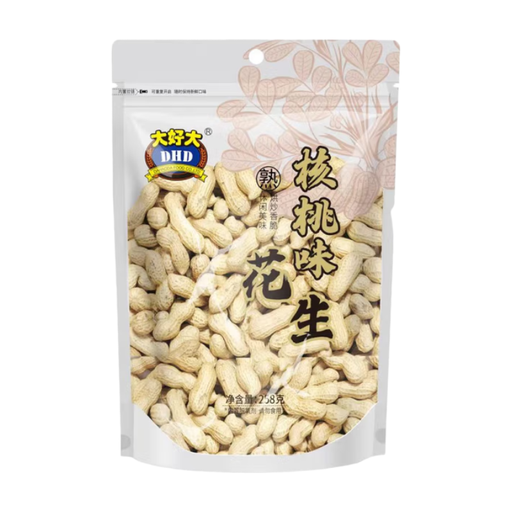 Image unavailable
Dahaoda Walnut Flavour Peanuts, 258 g
For anyone looking for flavoured peanuts: the product information lists walnut flavouring, sugar and salt as ingredients. The nutritional information lists 2420 kJ and 46.2 g fat per 100 g; the product contains peanuts and soya.
View at Joybuy
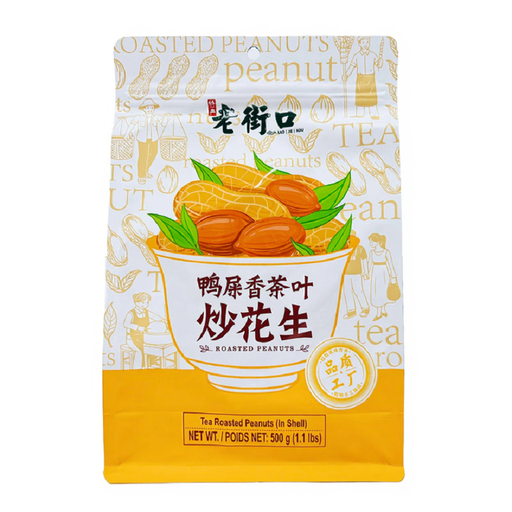 Image unavailable
Lao Jie Kou Yashi Xiang Tea-Infused Roasted Peanuts, 500 g
This roasted variety is for anyone looking for a tea flavour; the product information lists oolong tea and peanuts in their shells. The nutritional information lists 544 kcal, 35.6 g fat and 1.37 g salt per 100 g.
View at Joybuy
 Image unavailable
g'woon Peanuts in Shells, 500 g
For anyone looking for peanuts in their shells as a snack: the product information lists 2515 kJ, 49 g fat and 0.12 g salt per 100 g. Store the pack in a cool, dry place and seal it tightly after opening.
View at Joybuy
Frequently asked questions
How do I calculate the energy in my own portion of peanuts?
Multiply the kcal per 100 g by the weight of your portion in grams, then divide by 100. For 15 g of Jumbo unsalted peanuts, that’s 602 × 15 ÷ 100 = 90.3 kcal. Compare products using the same weight rather than different serving sizes set by manufacturers.
Are 15 g or 25 g set portion sizes for before exercise?
No, these are calculation examples, not set serving sizes. The Netherlands Nutrition Centre gives general advice about eating and drinking around exercise, but doesn’t set a universal portion size for peanuts. Consider when your training session is and your own tolerance.
When can a product be called ‘low energy’?
According to the European Commission, solid foods must contain no more than 40 kcal (170 kJ) per 100 g to carry the ‘low energy’ claim. The peanut labels reviewed here are well above that limit. A small portion or an ‘unsalted’ label doesn’t make the product itself low in energy.
What should I check if I have a peanut or nut allergy?
Check the ingredients and allergen information on the exact pack, and avoid products containing peanuts if you need to because of a diagnosed allergy. Some product information also notes that other nuts or soya may be present. The Netherlands Food and Consumer Product Safety Authority (NVWA) says allergens must be clearly identifiable in the ingredients list.
Which AH peanuts were included in the May 2026 recall?
On 20 May 2026, Albert Heijn announced a recall of AH Extra Large Salted Peanuts in a tub with a best-before date of 04-11-2026 due to the possible presence of metal fragments. The warning applies to that specific variety and date, not all AH peanuts. Check the packaging and follow Albert Heijn’s instructions if you have this product.


