Choose smooth peanut butter with no bits and no added salt or sugar for your baby; don’t offer whole peanuts. GroeiGids recommends this form of peanut butter when introducing peanuts. If you want to buy organic, check the certification of the exact variety separately from its ingredients and texture. If your baby has severe eczema or an existing food allergy, speak to their doctor or dietitian before introducing peanuts, as advised by the Voedingscentrum.
Who is this choice for?
Parents introducing peanuts
You’re looking for a suitable form of peanut for your baby’s first tastes and don’t want to confuse introducing peanuts with offering whole peanuts. GroeiGids recommends smooth peanut butter with no bits and no added salt or sugar. If your baby has severe eczema or an existing food allergy, speak to their doctor or dietitian first, as advised by the Voedingscentrum.
Parents supporting their baby as they eat
You want to choose a way of serving food that suits your baby’s abilities. According to the Voedingscentrum, a child must be able to sit upright and swallow and chew well before you offer larger pieces; whole peanuts aren’t suitable for babies.
Shoppers reading organic labels
You want to combine organic production with a product that’s suitable for your baby. The European Commission explains when the organic logo can be used; also assess the ingredients and texture of the exact variety separately.
What should you look for when buying?
Smooth peanut butter
Choose this form when: you want to use peanuts in baby food; GroeiGids recommends peanut butter with no bits.
Check: the texture, ingredients and organic certification of the exact jar separately.
Whole peanuts
For baby food: don’t choose this form; the Voedingscentrum warns that whole peanuts pose a choking risk.
Bear in mind: organic production doesn’t change the risk associated with serving whole peanuts.
Crunchy peanut butter
For baby food: choose a smooth variety; a label such as 100% doesn’t tell you whether it contains bits.
Bear in mind: check the texture on the packaging, even if the variety is made with organic peanuts.
GroeiGids recommends smooth peanut butter with no bits and no added salt or sugar when introducing peanuts. The percentages below link each buying priority to a specific need.
| Priority |
What to look for |
Who might prioritise this? |
| Texture for your baby |
Check that the peanut butter is smooth and contains no bits. |
If I want to give my baby peanuts, I look for a form with no bits and don’t offer whole peanuts. Around 33% of consumers put texture safety first. |
| When to introduce peanuts |
Keep introducing peanut butter separate from the requirements for offering larger pieces of food. |
I want to be able to introduce peanuts without assuming that my baby can already eat larger pieces. Around 27% of consumers prioritise planning when to introduce them. |
| Organic certification |
Check the certification of the exact variety and read the ingredients list too. |
I want to be able to check on the jar that the organic claim applies to the exact variety, independently of its recipe. Around 27% of consumers put confidence in certification first. |
| Using it at breakfast |
Check the texture and allergen information of the jar you’ve chosen before mixing it into a meal. |
I’m looking for a practical form of peanut butter to use in baby food, without losing sight of the safety requirements. Around 13% of consumers prioritise everyday convenience. |
Common pitfalls
-
Choosing whole organic peanuts for your baby
Organic production doesn’t change the choking risk posed by whole peanuts; the Voedingscentrum warns against this form.
For baby food, choose smooth peanut butter with no bits, and base the introduction of larger pieces of food on your child’s development.
-
Assuming ‘100% organic’ means a suitable texture
A product made with organic peanuts can still contain bits. So its ingredients don’t automatically mean that its texture is suitable for baby food.
Check the packaging to see whether the exact variety is smooth; assess its texture and organic claim separately.
-
Reading a general nut warning as the full label
The Netherlands Food and Consumer Product Safety Authority lists peanuts and nuts separately. For example, a BIO+ natural variety sold at Poiesz lists peanuts as an ingredient and may contain cashews; that isn’t automatically the label for another BIO+ jar.
Read the allergen information on the exact packaging and check for both peanuts and any warnings about other nuts.
Brands to check at product level
Albert Heijn
Albert Heijn lists AH Terra Plantaardig biologisch 100% pindakaas as a product range for anyone looking for organic peanut butter.
- The product name on Albert Heijn’s product page includes ‘organic’ and ‘100%’.
- Check the texture and ingredients of the exact variety; the product name alone doesn’t confirm that it’s smooth.
Jumbo
Jumbo lists 100% Biologische Pindakaas Naturel 350 g as a product option.
- The Jumbo product page confirms the product name and size.
- Check the packaging to see whether the texture is smooth, and read the ingredients and allergen information.
PLUS
PLUS lists BIO+ Pindakaas 100% in a 350 g jar.
- The PLUS listing gives the product name and jar size.
- Don’t assume that ingredients or allergen information for a BIO+ variety with the same name at another retailer apply to this jar without checking.
Lidl
Lidl describes 100% peanut butter with and without bits in its Maribel range.
- The product description distinguishes between varieties with and without bits.
- ‘100%’ doesn’t prove organic certification; for baby food, choose a smooth variety only.
ALDI
ALDI lists HELAES 100% pindakaas in a 600 g jar.
- ALDI’s product information gives the product range and size.
- The product name doesn’t confirm that the variety is certified organic or smooth.
Duyvis
Duyvis describes roasted, marinated and coated peanuts among its snack products.
- The manufacturer distinguishes between different snack types, such as Borrelnootjes and Tijgernootjes.
- These snacks aren’t smooth peanut butter for baby food; whole peanuts also pose a choking risk.
Peanut butter at Joybuy
A Joybuy product option related to peanut butter for this topic. Check that the exact variety is smooth, and that its ingredients and any organic certification suit your needs.
 No image available
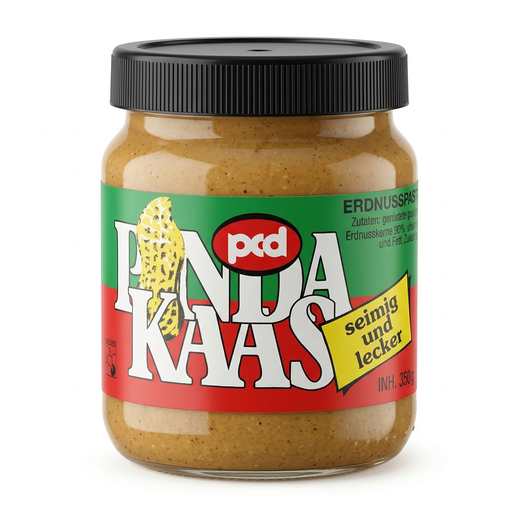
PCD Peanut Butter 350g
This peanut butter is only a candidate for baby food if the packaging confirms that the variety is smooth; the product name doesn’t say whether it contains bits.
The product name states 350g.
View at Joybuy
Frequently asked questions
Should you wait until your baby can eat larger pieces before introducing peanuts?
No. Introducing peanut butter and offering larger pieces are two different choices. According to the Voedingscentrum, your child must be able to sit upright and swallow and chew well before you offer larger pieces; GroeiGids recommends smooth peanut butter with no bits for introducing peanuts.
What should you do if your baby has severe eczema or an existing food allergy?
Speak to your baby’s doctor or dietitian before introducing peanuts. This is the Voedingscentrum’s advice for this at-risk group.
How can you use peanut butter in baby food?
GroeiGids recommends 100% peanut butter with no bits and no added salt or sugar. According to GroeiGids, you can mix it with mashed fruit or cooked vegetables.
Does organic mean that peanut butter contains only peanuts?
No. Organic certification and a recipe made exclusively with peanuts are two different things. Skal Biocontrole states that composite organic products must contain at least 95% organic agricultural ingredients; so read the ingredients list for the exact variety too.
Are peanuts and nuts listed as the same allergen?
No. The Netherlands Food and Consumer Product Safety Authority lists peanuts and nuts separately. Allergen information must appear on the label of pre-packed products; check whether peanuts are listed as an ingredient and look for any warnings about other nuts on the exact packaging.


