Which approach is right for you?

Cooking for a crowd

You want to make enough peanut sauce for several guests and need a jug that suits the quantity in your recipe. The Consumers’ Association says a blender is suitable for larger quantities; the stated jug capacity isn’t automatically the safe filling level for every recipe.

Cooking in the pan

You’re making the sauce on the hob and would rather not pour it from the pan into a blender jug. A hand blender can be used directly in a suitable pan or bowl for appropriate recipes. Follow the instructions for your exact model, especially when blending hot ingredients.

Keeping cleaning and dietary requirements in mind

You want to clean the parts thoroughly after your meal and make sure guests know about peanuts and any other potential allergens before serving. The Netherlands Food and Consumer Product Safety Authority (NVWA) describes an information duty for businesses serving food to consumers; this requirement does not automatically apply to a private meal.

What should you consider when choosing?

Jug blender

Choose this approach: if you want to blend a larger quantity of sufficiently thin sauce.

Bear in mind: the space the jug takes up, the extra washing-up, and the model’s filling and temperature limits.

Hand blender

Choose this approach: if you want to blend the sauce with enough liquid, directly in a suitable pan or bowl.

Bear in mind: according to the Consumers’ Association, hard or very thick ingredients can be more difficult to blend with a hand blender.

No mixer

Choose this approach: if you’re mixing peanut butter with liquid and don’t need to grind whole ingredients.

Bear in mind: this method doesn’t grind whole peanuts; the Netherlands Nutrition Centre explains how to simmer peanut butter and water together in a pan.

What to consider What to look for when buying Which consumers is this important for?
Quantity per batch Compare the quantity in your recipe with the permitted filling level in the manual; don’t assume the stated jug capacity is the usable working volume. When I’m cooking for a group, I want to make enough sauce in as few batches as possible. Around 31% of consumers prioritise batch size.
Desired texture Decide whether you’re mixing peanut butter or processing whole peanuts. Check the model instructions to see whether the appliance and any listed accessories are suitable for your ingredients. When I want a smooth sauce, I need to know whether I only have to mix the ingredients or also grind them. Around 25% of consumers mainly prioritise the desired texture.
Cleaning and allergens Check which parts can be removed and which the manufacturer says are dishwasher-safe. Ask guests about allergies and check the labels on the other ingredients. When I’m cooking for others, I want to be able to clean the parts thoroughly and know exactly what’s in the sauce. Around 25% of consumers prioritise cleaning and ingredient information.
Preparing in or near the pan Decide whether blending is necessary. If using a mixer, check the temperature and usage instructions for the exact model; allow hot ingredients to cool first if necessary. When I make the sauce on the hob, I’d rather not pour it into another container unnecessarily. Around 19% of consumers mainly want to work in or near the pan.

Common mistakes when choosing

  • Buying a blender when the recipe only calls for stirring

    The Netherlands Nutrition Centre describes a basic method using peanut butter and liquid in a pan, without a blender. You don’t need a mixer if you only want to combine these ingredients.

    Before buying, decide whether you want to grind whole ingredients or simply mix peanut butter with liquid.

  • Assuming the jug capacity is suitable for the amount of hot or thick sauce you can blend

    The stated capacity alone doesn’t tell you how much hot or thick sauce you can safely process at once.

    Check the manual for the exact model to find the filling level, temperature limits and suitable ingredients.

  • Choosing based on wattage alone

    The Consumers’ Association describes different uses for a jug blender and a hand blender. Wattage alone won’t tell you which method is right for your recipe.

    First decide how you want to make the sauce, then compare the relevant instructions and parts for each model.

Brands to consider

Bosch

The VitaPower MMB6172S is worth considering if you’re looking for a jug blender for a larger quantity of thin sauce.

  • Bosch lists a 1,5 l glass ThermoSafe jug and dishwasher-safe parts for this model.
  • The jug capacity doesn’t tell you how much hot or thick sauce you can safely process at a time. Check the manual for guidance.

Braun

The MultiQuick hand blenders are worth considering if you’d rather work in a pan or bowl; the MQ7045X is a specific model with a blending shaft.

  • Braun lists variable speed and a 350 ml chopper attachment included with the MQ7045X.
  • The Consumers’ Association notes that hard or very thick ingredients can be more difficult to blend with a hand blender. A brand’s claims about its blades aren’t the same as an independent test of peanut sauce.

Ninja

The Detect TB301EU is a jug blender option if the quantity per batch matters more to you than blending directly in the pan.

  • Joybuy Netherlands’ product information lists a 2,1 l jug and a 1200 W motor for this model.
  • This information doesn’t confirm the safe filling level or permitted temperature for hot sauce. Check the manual for details.

Philips

The 5000 Series may be worth considering if you’re looking for a jug blender; check the exact model variant carefully.

  • Philips describes the HR3030/00R1 as refurbished and lists a 1200 W motor and a cleaning setting for that version.
  • This information doesn’t automatically apply to a new or differently specified HR3030. The stated results don’t demonstrate how well it makes peanut sauce.

Jug blenders on Joybuy

These Joybuy products are jug blenders to compare if you want to make a larger quantity of peanut sauce. Check whether each model’s jug and method are suitable for your recipe.

Cecotec Power Black Titanium 1300Max jug blender

Cecotec Power Black Titanium 1300Max, 1,5 l

Worth comparing if you’re looking for a jug blender for sauces; the product information lists sauces as a suggested use.

1300 W; 1,5 l jug; 2 speeds and a pulse function; crushes ice.

Joybuy

3-in-1 blender with jug and chopper cup

3-in-1 blender, 800 W, 1.500 ml jug

The product information lists sauces as a suggested use and includes a separate chopper cup for ingredients such as nuts and herbs.

300 ml chopper cup; 600 ml travel bottle.

Joybuy
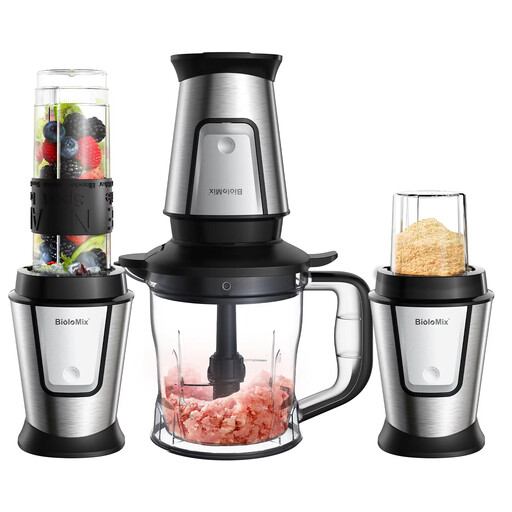
BioloMix TB23M multifunction blender

BioloMix TB23M, multifunction blender

If you want to process nuts as well as make sauce, the product information lists nut butter as a suggested use.

700 W; stated speed of 24.000 rpm; wavy stainless-steel blades.

Joybuy

ochama multifunction blender with 1,5 l jug

ochama multifunction blender, 600 W, 1,5 l

A jug blender to compare for making a larger quantity.

3 speeds; crushes ice.

Joybuy

Philips HR3020/20 blender with 1,5 l jug

Philips HR3020/20, 1.000 W, 1,5 l jug

The product information lists sauces as a suggested use and says the removable parts are dishwasher-safe.

3 speeds; pulse function. Don’t process ingredients hotter than 80 °C, and allow hot liquids to cool first.

Joybuy

Frequently asked questions

Do you need a blender to make peanut sauce from peanut butter?

Not necessarily. The Netherlands Nutrition Centre explains how to mix peanut butter with water in a pan and simmer the sauce. A blender or hand blender may be useful if you want to blend other ingredients or achieve a different texture.

Can you put hot peanut sauce straight into any blender?

Don’t assume you can. Follow the temperature and filling instructions for the exact model, and allow hot ingredients to cool first if necessary. The description ‘temperature-resistant’ doesn’t in itself mean that every temperature or preparation method is permitted.

How can you account for a peanut allergy at a private meal?

Tell your guests that the sauce contains peanuts, ask about allergies and check the labels on the other ingredients. Don’t serve peanut sauce as a suitable option to anyone with a known peanut allergy. The NVWA describes an information duty for businesses serving food to consumers; this doesn’t automatically mean the same legal duty applies to a private meal.

How should you store leftover homemade peanut sauce?

Cool leftovers quickly, store them in a sealed container and don’t leave them out of the fridge for more than two hours. The Netherlands Nutrition Centre recommends keeping general cooked leftovers in the fridge for two days; a separate page gives three days for opened peanut sauce. That guidance doesn’t necessarily apply to every homemade recipe, for example if it contains milk or other ingredients.

Do you need extra cover for a blender?

You don’t need to pay for additional cover to have your statutory guarantee. ACM ConsuWijzer explains that if a product is faulty, you have rights against the seller in addition to any manufacturer’s or seller’s guarantee. The expected lifespan and the circumstances matter; there isn’t automatically one fixed period that applies to every blender.
