What should you look for when choosing?
Start with the product’s form and any allergies. Then consider the amount that suits your family’s consumption and how to store the pack.
For shoppers considering a peanut product as a toddler snack, each row highlights one main purchasing question. Checks on product form and allergens are relevant whichever question comes first.
| What to consider |
What should you check? |
Who is this most relevant to? |
| Product form |
Check whether the product is smooth or contains pieces. The Netherlands Nutrition Centre advises against giving whole peanuts or nuts to children under 4. |
As a parent, I want to know first whether the texture is suitable for a toddler snack. Around 36% of shoppers put product form and food safety first. |
| Pack size |
Compare the net weight with your household’s consumption and follow the storage instructions on the pack. |
When planning supplies for my family, I want to choose an amount that suits our consumption. Around 29% of shoppers prioritise pack size and choosing an amount that suits their needs. |
| Ingredients |
Read the ingredients list and check separately whether the product is smooth and whether salt or sugar has been added. |
As a parent, I want to assess the ingredients for myself, rather than relying solely on the ‘natural’ label. Around 21% of shoppers put ingredients first. |
| Allergens and setting |
Check the ingredients and allergen warnings; ask the childcare setting or school about its policy. |
When a snack is going to childcare or school, I want to take account of any diagnosed allergy and the rules at that setting. Around 14% of shoppers prioritise allergens and the setting’s policy. |
Brands to consider
These brands are useful points of reference for different product ranges. Ingredients, texture and pack size vary by product and variety.
Duyvis
Duyvis describes its product as unsalted whole peanuts. That doesn’t make it suitable as a snack for children under 4.
- Being unsalted doesn’t change the product’s form; consider a different form for a toddler.
Albert Heijn
AH Terra Plant-Based 100% Natural Peanut Butter is available in a 1 kg pack. The product information lists peanuts as the only ingredient.
- The product information states that no salt or sugar is added.
- The pack warns that it may contain several types of tree nuts; check the label if you have a relevant allergy.
Jumbo
Jumbo’s 100% Natural Peanut Butter comes in a 600 g jar, with peanuts as the only ingredient.
- The product information gives the variety and net weight.
- Don’t use the adult reference intake on the product page as advice for toddlers.
Lidl
Lidl describes its 100% Natural Peanut Butter as coming in a 600 g jar, and its Maribel range includes varieties with and without pieces.
- The product page describes the natural variety as having no added ingredients.
- Check the specific pack to see whether the peanut butter is smooth or contains pieces.
ALDI
HELAES 100% Peanut Butter is described as available in 350 g and 600 g packs; the range includes natural and crunchy varieties.
- The product information for the 350g pack lists peanuts as an ingredient.
- Check which variety you’re choosing: the natural and crunchy varieties have different textures.
PLUS
PLUS lists 100% Peanut Butter in a 350 g jar and a 1000 g tub. The ingredients listed for these products include peanuts.
- The product pages include instructions for stirring and storage.
- The 350g pack warns that it may contain cashew nuts; check the specific pack.
Peanut butter at Joybuy
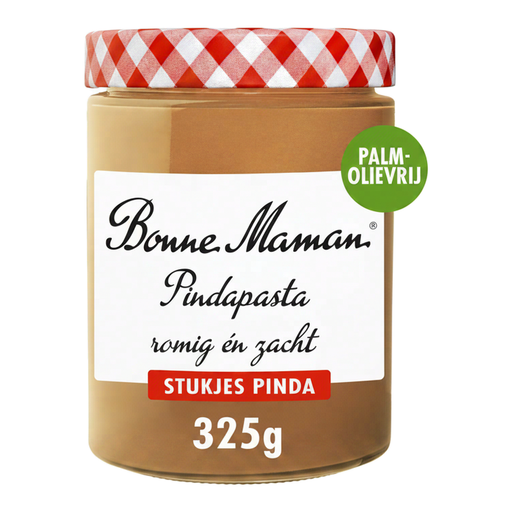
The Joybuy product card below is for crunchy peanut butter. Its texture differs from the smooth peanut butter that is the focus for a toddler snack.
 No image available
Bonne Maman peanut butter with peanut pieces, 325 g
This variety is worth considering if you’re specifically looking at Bonne Maman peanut butter with pieces. For a toddler, its texture differs from the smooth variety used as the starting point here.
The product information lists 79% peanuts, sugar and salt.
View at Joybuy
Frequently asked questions
Which form of peanut product can I consider for a toddler snack?
Consider a smooth product, and don’t give whole peanuts or nuts to children under 4, advises the Netherlands Nutrition Centre. Check the texture of the specific pack; a product with pieces isn’t the same as a smooth variety.
What allergen information must appear on prepacked peanut butter?
According to the Netherlands Food and Consumer Product Safety Authority, allergen information for prepacked foods must appear on the label. Check both the ingredients and any warnings about the possible presence of other allergens.
Can a child with a diagnosed peanut allergy eat peanut butter if it’s smooth or unsalted?
No. Thuisarts advises against giving a child the food they are allergic to. A smooth texture or an unsalted recipe doesn’t make peanut butter peanut-free; follow the advice of your child’s healthcare professional.
Can I pack peanut butter for any childcare setting or school?
Check the policy of the relevant setting. For example, OBS De Venen states that peanuts and nuts are not eaten at that school; this rule applies to that school and doesn’t prove there is a nationwide ban.
How should I choose and store a larger jar of peanut butter?
Choose a net weight that suits how much you use at home, and follow the storage instructions on the pack. The Netherlands Nutrition Centre’s Storage Guide recommends keeping opened peanut butter in a kitchen cupboard for up to a year; also look out for rancidity or an unusual smell or taste.


