If you’re making several glasses at once, a blender with a jug is practical. Compare its usable capacity, not just its maximum capacity. For a single smoothie, a personal blender with a blending or drinking cup is a more compact option. If you’re using frozen peaches or ice, check the instructions for the exact model, as well as the applicable requirements for electrical safety and materials that come into contact with food.
Who are these considerations relevant to?
Making lunch for several people
If you’re making smoothies for others at the table, check the jug’s usable capacity. Consumentenbond highlights capacity as something to consider when choosing; Philips, for example, gives both the maximum and usable capacity for the HR2041/00.
Using frozen fruit
If you want to blend frozen peaches or ice, check that the manual for the exact model allows it. Bosch mentions frozen fruit for the MMB2111S, while Philips says the HR2041/00 can crush ice.
Making a single glass
If you usually make one serving, a smaller blending or drinking cup may suit you better than a large jug. Bosch lists a 0.6 l blending cup for the MMB2111S, while the nutribullet NB603DG comes with a 700 ml cup.
What should you look for when choosing?
First decide how many glasses you want to make at once, then choose based on the ingredients you use and how easy the blender is to clean. This helps ensure a large jug or a frozen-fruit function doesn’t matter more than how you’ll use it every day.
| What to consider |
What should you check? |
Who might this matter more to? |
| Capacity for several glasses |
Compare the usable capacity and fill markings of the exact jug. |
If I’m making smoothies for others at the table, I want to know how much I can prepare in one blending cycle. Around 40% of consumers give making several servings their highest priority. |
| Frozen peaches or ice |
Read the instructions for the exact model to check which ingredients it can handle and how to use it. |
If I use frozen ingredients, I want to know whether the blender I’ve chosen is suitable. Around 30% of consumers prioritise this. |
| Cleaning up after lunch |
Check which parts can be removed and which are dishwasher-safe. |
After preparing a smoothie, I want to be able to clean the jug and its parts without any uncertainty. Around 20% of consumers make ease of cleaning their main purchasing priority. |
| Size for one glass |
Compare the cup capacity, the included lid and the storage space required. |
If I usually make one smoothie, a compact cup may suit me better than a jug designed for several glasses. Around 10% of consumers choose mainly to meet this need for a single-serving option. |
Pitfalls to avoid
-
Assuming the jug’s maximum capacity is its usable blending capacity
For the Philips HR2041/00, Philips gives a maximum capacity of 1.9 l and a usable capacity of 1 l. These figures don’t indicate the same amount.
Compare the usable capacity and fill markings of the exact model with the amount you want to serve.
For a larger lunch group, a smaller usable capacity may mean blending in several batches.
-
Comparing wattages alone when blending frozen ingredients
Wattage alone doesn’t tell you whether a model is suitable for frozen peaches or ice. Consumentenbond treats blending smoothies and crushing ice as separate considerations.
Check the instructions for the exact model. Don’t treat a manufacturer’s claim as a comparative test against other blenders.
-
Assuming a smoothie is the same as whole fruit
A blender is a food-preparation appliance; making a smoothie doesn’t automatically make it nutritionally equivalent to eating unprocessed fruit. Voedingscentrum recommends eating vegetables and fruit rather than drinking them, and doesn’t include smoothies in the Schijf van Vijf.
Choose a blender based on your food-preparation needs, not on unproven health claims about the appliance.
Brands to consider
Philips
The HR2041/00 is a jug blender worth considering if you want to serve several glasses.
- Philips lists a maximum capacity of 1.9 l and a usable capacity of 1 l, along with one speed setting and a pulse setting.
- Philips’ claims about ice and smooth results aren’t based on an independent peach-blending test. Check the usable capacity against the portions you want to make.
Bosch
The VitaPower Serie 2 MMB2111S is a mini blender with a cup for a smaller serving.
- Bosch lists a 0.6 l blending cup, dishwasher-safe parts and suitability for use with frozen fruit.
- The smaller cup is less suited to making several lunch servings in one blending cycle. The description of a creamy texture is a claim made by Bosch.
nutribullet
The Original 600 NB603DG is a personal blender supplied with a 700 ml cup.
- nutribullet lists a 600 W motor base and a cup that can go on the top rack of the dishwasher.
- The cup is designed for a smaller quantity than a large jug. nutribullet’s claims about smooth blends and nutrients aren’t independently verified results.
Tefal
The Blendforce II BL420131 is a jug model with a capacity of 2 l, according to Tefal.
- Tefal describes a removable blade holder and a safety lock.
- The Tefal page consulted also covers spare parts, so check whether the complete appliance is available.
Blenders at Joybuy
These product picks focus on jug blenders for smoothies and lunch servings. Check the applicable requirements for electrical safety and materials that come into contact with food for the exact model.
 Image unavailable
Emerio BL-124816.7 blender, 1.5 l
A jug model to consider if you want to make several portions of smoothie.
The product name lists a 1.5 l jug, two speeds, a pulse function and ice processing. It also mentions a 600 ml travel bottle and dishwasher-safe parts.
View at Joybuy
 Image unavailable
3-in-1 blender, 800 W, with a 1,500 ml jug
The jug capacity makes this an option to consider for making several portions of smoothie.
The product name lists a 600 ml travel bottle, a 300 ml chopping cup, ice processing and six stainless steel blades. It also mentions dishwasher-safe parts.
View at Joybuy
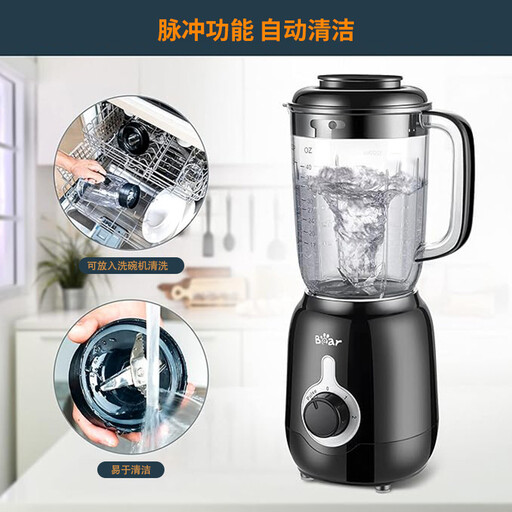 Image unavailable
Bear LLJ-B12K1 countertop blender, 1.2 l
A 1.2 l jug may suit you if you want to make smoothies for more than one person.
The product name lists 500 W, two speeds, a pulse function and four stainless steel blades.
View at Joybuy
 Image unavailable
Philips HR3020/20 blender, 1.5 l
The jug capacity makes this model worth comparing if you’re making smoothies for several lunch servings.
The product name lists a 1,000 W motor and dishwasher-safe parts. The product description mentions three speeds, a pulse function and a working capacity of 1.5 l.
View at Joybuy
 Image unavailable
Ninja Detect Blender Pro & Smoothie Maker TB301EU
The jug capacity makes this an option to compare if you want to prepare several servings at once.
The product description lists a 2.1 l jug, 14 manual speed settings and four automatic programmes. It also mentions functions for ice and frozen ingredients.
View at Joybuy
Frequently asked questions
Is a blender jug’s maximum capacity also the amount I can blend at once?
Not always. Philips lists a maximum capacity of 1.9 l and a usable capacity of 1 l for the HR2041/00. For your lunch, compare the usable capacity and follow the fill markings for the model you choose.
Which blender is better for frozen peaches?
Check the instructions for the exact model to see whether it can handle frozen ingredients. Bosch mentions frozen fruit for the MMB2111S, while Philips says the HR2041/00 can crush ice. These manufacturer claims aren’t a direct performance comparison.
Which blender parts can go in the dishwasher?
It depends on the model and the part. Bosch lists dishwasher-safe parts for the MMB2111S, while nutribullet says the NB603DG cup can go on the top rack. Follow the manual for your model.
What can I do if a blender breaks too soon during normal use?
According to ACM ConsuWijzer, the seller is responsible if a product doesn’t meet what you could reasonably expect from it. Depending on the circumstances, a solution could be a repair, replacement or refund. Any manufacturer’s warranty is separate from your statutory rights.
What product requirements should I consider when buying a blender?
Applicable product safety requirements apply to electrical kitchen appliances; CE marking is required when the rules for that product specify it. Parts that come into contact with food must also meet the applicable requirements for food contact materials. The Netherlands Food and Consumer Product Safety Authority describes these requirements. A CE logo alone doesn’t confirm every feature of an individual model.


