
Cook with limited cupboard space
You make peach purée in a compact kitchen and want to store all the necessary parts easily. The Consumentenbond explains the differences between hand blenders and blenders for this kind of use.


For small batches of peach purée and limited cupboard space, a basic hand blender is a sensible starting point. If you usually make a small, more liquid mixture in a personal blending cup, a personal blender could be a good fit. A jug blender is most useful for larger, liquid-rich batches, but it generally takes up more space. For any appliance, check exactly which parts are included, the cleaning instructions and whether the relevant CE marking is present. The Consumentenbond explains the differences in how these appliances are used, while the Dutch government outlines the CE rules.
You make peach purée in a compact kitchen and want to store all the necessary parts easily. The Consumentenbond explains the differences between hand blenders and blenders for this kind of use.
You care more about the texture you want than about having the smallest appliance to store, so you compare a hand blender with a blender. The Consumentenbond notes that a hand blender may sometimes produce a less even result than a blender.
You want to make a small amount of purée at a time and consider whether a suitable blending cup is included, as well as how much washing up there’ll be afterwards. According to the Consumentenbond, a hand blender is handy for small batches.
A good fit if: you want to purée small batches and put the appliance away after use.
Bear in mind: you have to hold the appliance, and the purée may sometimes be less even than when made with a blender.
A good fit if: you usually make a small, suitably liquid mixture in a personal blending cup.
Bear in mind: you’ll also need to clean and store the cup and blade.
A good fit if: you regularly make several portions at once or want to blend a relatively liquid mixture.
Bear in mind: a jug blender is less practical for a single small, thick batch and usually needs more worktop space.
First decide how thick you want the purée to be and how much you’ll make at a time. Then compare how much storage space the appliance and all its parts need.
| What to consider | What should you check? | Who is this important for? |
|---|---|---|
| Storage space | Check the appliance’s dimensions and everything included in the box. | In a small kitchen, I want to store all the parts without having to clear extra cupboard space. Around 36% of consumers put storage space first. |
| Purée texture | Decide whether you’re making a thick fruit purée or a more liquid one. Look at which preparation method is suitable, not just the wattage. | If a smooth texture matters more to me than compact storage, I compare a hand blender with a blender. Around 29% of consumers prioritise texture above all else. |
| Small batches and washing up | Check whether a blending cup is included, whether the blending foot is detachable and which parts the manual says are dishwasher-safe. | For a small batch, I don’t want to clean an unnecessarily large jug, and I want to know how to clean the separate parts. Around 21% of consumers start by considering portion size and cleaning. |
| Other or larger preparations | Choose a larger jug or chopper only if you expect to use them for those purposes; check which parts are included with the exact version. | If I also make larger quantities or other preparations, extra capacity or an attachment could be useful. Around 14% of consumers prioritise these uses. |
A compact motor unit doesn’t necessarily mean the complete set will fit in a small cupboard.
Compare the dimensions and contents of the whole set with the space you have available.
A cup, blade or chopper also needs space for storage and washing up.
The Consumentenbond says a jug blender is less suitable for small or thick mixtures than for larger, liquid blends.
Before choosing an appliance, think about your usual portion size and how thick your peach purée will be.
A larger jug may take up more worktop space and mean more washing up.
Products listed under similar names may differ in the number of included cups and other parts.
Compare the full model number, cup capacity and included accessories before treating different versions as the same.
This helps you avoid expecting a different cup or bundle from the one included with that version.
A commercial manufacturer’s warranty doesn’t, by itself, determine your legal rights against the retailer. ACM ConsuWijzer explains that the retailer is responsible if a product doesn’t meet what you could reasonably expect.
Keep your proof of purchase and product information, and contact the retailer if the product is faulty.
Braun describes the MultiQuick 1 MQ10.001MWH as a basic hand blender with one speed, a metal blending foot and a blending cup.
Bosch describes the ErgoMixx MSM64110 as a hand blender with a measuring jug, two settings and a detachable metal blending foot.
According to nutribullet, the Original NB603DG is a personal blender with a motor base, blade and 700 ml cup.
The Quickchef HB659838 is a hand blender set for anyone who wants to use a chopper as well as puréeing.
Philips offers the ProMix hand blender HR2653/90, among other options, as part of its range of appliances for use with accessories.
This selection includes hand blenders and compact blenders for preparing small amounts of fruit. For each exact version, check which accessories are included and whether they suit your preferred portion size and available storage space.
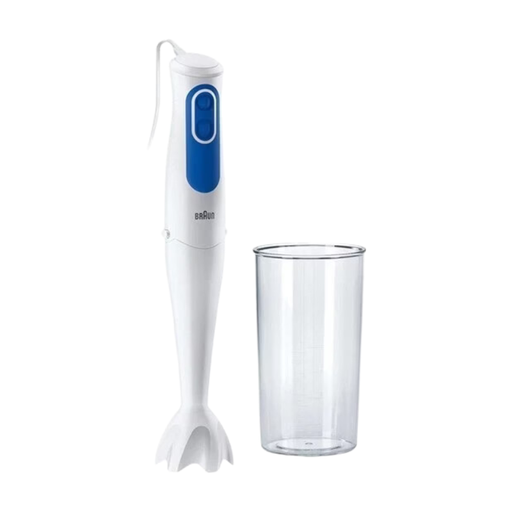 No image available
A hand blender could suit small batches that you want to put away after use.
Two settings and a detachable part; the description lists a 600 ml measuring cup.
 No image available
A mini blender could be a good fit if you want to prepare fruit or sauce in a jug.
0,6 l jug capacity, 350 W power and two speeds. The description lists detachable, dishwasher-safe parts; check the manual for each part.
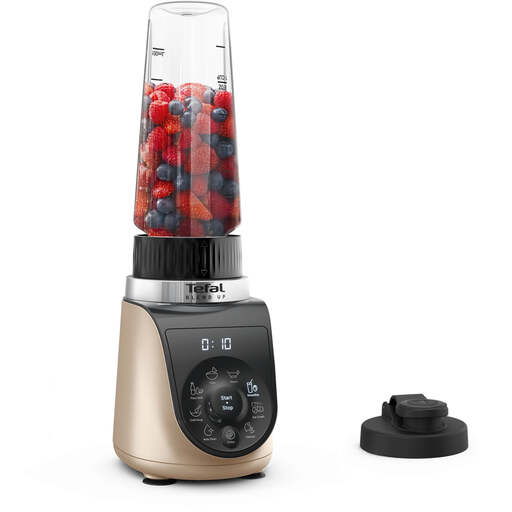 No image available
A personal blender could be a good fit if you want to make a small batch in your own cup.
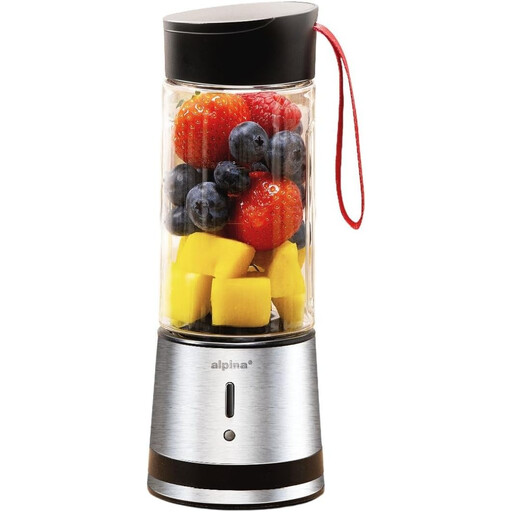 No image available
The stated 300 ml capacity could suit a small portion; check that it’s large enough for what you want to make.
125 W; dimensions 8 × 8 × 23 cm. The description lists a rechargeable battery.
 No image available
A hand blender could suit small batches that you want to put away after use.
The product name lists 800 W, stainless steel and variable speed.
No. According to the Consumentenbond, both a blender and a hand blender can purée fruit. A hand blender is handy for small batches, while a jug blender is best suited to larger quantities or mixtures with plenty of liquid.
Wash peaches under running water and use clean kitchen utensils, as the Voedingscentrum recommends. Follow the manufacturer’s cleaning instructions for the blade, blending foot and cup for the exact version; not every part is dishwasher-safe.
You don’t need a chopper just to purée fruit. For puréeing alone, the Consumentenbond’s buying guide recommends hand blenders without a chopper or whisk; a chopper is for extra chopping tasks.
In the Netherlands, the retailer is responsible if a product doesn’t meet what you could reasonably expect from it, according to ACM ConsuWijzer. A manufacturer’s warranty doesn’t replace this legal right, and there isn’t one fixed statutory warranty period that automatically applies to every blender.
Electrical appliances placed on the market in the EU must carry the applicable CE marking. The Dutch government advises checking the marking on the product; make sure to check the exact version you want to buy.