
Small-batch maker
You make a small amount of peach purée at a time and want a beaker that suits the job, rather than a large jug.


If you usually make small batches of peach purée and want to put the appliance away after use, start with a hand blender and a suitable beaker. A compact blender is worth considering if you also want to make drinks or take a sealed blending cup with you. In either case, check the portion size, storage space and cleaning instructions. Remove the peach stone before blending: the Netherlands Nutrition Centre advises against grinding fruit stones.
You make a small amount of peach purée at a time and want a beaker that suits the job, rather than a large jug.
You want to clear your workspace after blending, so you’re thinking about where to store the base, beaker and any separate accessories.
You want to make drinks as well as purée, and think a sealable cup that you can take with you could be useful.
Best for: blending mostly small portions and putting the appliance away after use.
Bear in mind: you’ll need a suitable beaker; an open beaker may splatter more than a closed blender jug. The Consumers’ Association notes that a closed jug is useful for preventing splashes.
Best for: making drinks too, or sealing and taking a blending cup with you.
Bear in mind: you’ll also need space for the motor base and cup or cups, whether on the worktop or in storage.
First, choose a beaker that suits the portions you usually make. Then check how much space the complete appliance and its separate parts will take up.
| Concern | What to look for | Who is this important for? |
|---|---|---|
| Blending small portions | Check which beaker is included and whether it’s the right size for the amount you usually make. | If I’m only making a small portion, I don’t want to use an unnecessarily large jug. Around 33% of consumers say small portions are their main reason for buying. |
| Worktop space and storage | Check the dimensions of the base and think about where the beakers, cord and accessories will go after use. | I want to clear my workspace after blending, and I don’t have much room for separate parts. Around 33% of consumers put storage space first. |
| Making drinks too | Check whether the model you’re considering includes a sealable cup or lids. | If I want to use the same cup for a drink or take it with me, I look for a secure seal. Around 17% of consumers prioritise this extra use. |
| Cleaning | Check the cleaning instructions for each part; dishwasher suitability can vary from one part to another. | I want cleaning to be straightforward after use, and I follow the instructions in the manual. Around 17% of consumers let their cleaning routine guide their choice. |
Stated power ratings don’t show how smoothly different appliances blend small portions of peach purée.
Compare the beaker, portion size and available space first. Treat wattage as a specification for the exact model, not as a prediction of blending results.
Even a compact blender may come with a motor base and several cups or lids that need to be stored somewhere.
Measure the space available for the complete set-up and decide where the separate parts will go.
Accessories and specifications can vary between versions, even when the models are from the same brand or range.
Before ordering, check the full model code and what’s included in the box.
ErgoMixx hand blenders are worth considering if you want to blend small amounts in a measuring beaker and put the appliance away afterwards.
The compact 3000 Series HR2620/40 is a cup blender for anyone who wants to make drinks as well as purée.
The Blend Up BL19H4F0 is a compact blender with two bottles, for anyone who wants to make more than the occasional batch of purée.
The MultiQuick 3 is a hand blender range to compare if you’d rather use a handheld appliance than a blender base.
The compact MBR06B is a cup blender to consider if small, sealable cups matter more to you than a large jug.
These hand blenders are Joybuy picks for anyone who wants to blend fruit in a beaker and put the appliance away after use.
 No image available
A hand blender for anyone who wants to blend fruit with a handheld appliance and adjust the speed.
The product information lists 25 speeds, a turbo function, splash control and dishwasher-safe parts. The description also mentions a chopper with three texture settings.
 No image available
A hand blender with a beaker for anyone who wants to use the included whisk or chopper attachments as well as blending.
The product name lists up to 1200 W and 15.000 rpm. According to the description, the set includes a 700 ml beaker, a 500 ml chopper and a whisk; the speed is continuously adjustable. The product information says the accessories are dishwasher-safe up to 60 °C.
 No image available
A hand blender to consider if you’re looking for a purée function and adjustable speed.
The product information lists 800 W, 20 speeds, a turbo function and detachable parts. The description says these parts can be cleaned in the dishwasher.
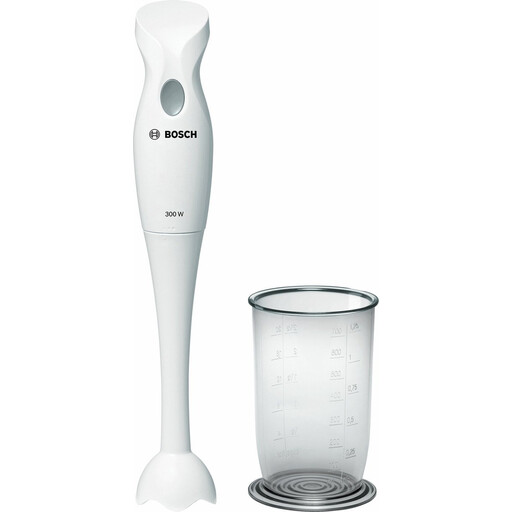 No image available
A hand blender with a measuring beaker for anyone who wants a blending accessory to use with their hand blender.
The product information lists a width of 6,1 cm and a turbo function. According to the description, detachable parts are included and are dishwasher-safe.
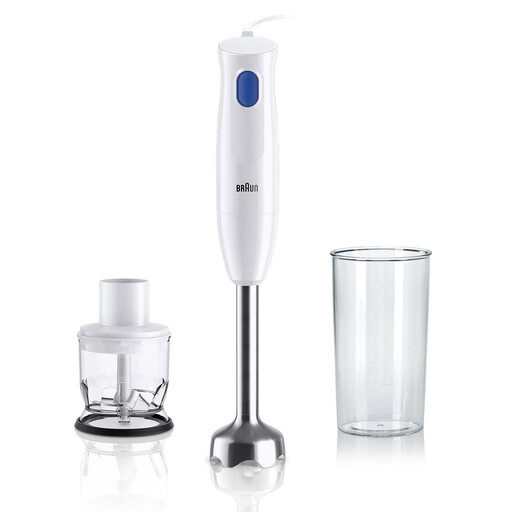 No image available
A hand blender with a measuring beaker for anyone who wants to blend purée in a separate cup.
The product information lists a 600 ml measuring beaker, a 350 ml chopper and a whisk. According to the description, the accessories can be detached for cleaning and storage.
No, remove the stone before blending. The Netherlands Nutrition Centre lists peaches among stone fruits whose stones contain unwanted substances, and advises against grinding fruit stones in a blender or with a hand blender.
Wash the peach under running water, remove the stone and use an amount that fits the beaker. Close a blender jug securely and don’t exceed the stated maximum fill level. Check the manual to see which separate parts are dishwasher-safe.
Yes. According to the Netherlands Food and Consumer Product Safety Authority (NVWA), electrical products must have a CE mark. The NVWA’s guidance says a separate inspection isn’t mandatory for this product category.
Not necessarily. The Dutch Government explains that you’re entitled to a product that works as it should, and that the seller must provide a solution if it doesn’t. There’s no fixed statutory guarantee period in the Netherlands, so check what additional cover actually offers before paying for it.