
Student making small portions
You usually make peach purée just for yourself and want to blend it straight in a bowl or measuring jug.


If you usually make one small portion of peach purée in a bowl or measuring jug, start by considering a hand blender. If you’d also like to take the blending cup with you, compare compact personal blenders. A jug blender is more suited to regularly making purée for several people, but it takes up more space. Check the usable capacity, cleaning instructions and included accessories: wattage alone doesn’t predict how smooth the purée will be.
You usually make peach purée just for yourself and want to blend it straight in a bowl or measuring jug.
You’re looking for an appliance that’s easy to put away after use and has parts that are practical to clean.
You sometimes make more than one portion, so you’re weighing up a jug blender against smaller appliances.
Choose an appliance to suit your usual portion size, the space you have and how often you blend for other people.
Best for: usually one small portion, blended in your own bowl or measuring jug.
Bear in mind: you have to hold the blender. A deep, suitable container helps reduce splashing.
Best for: making one portion in a cup you can take with you.
Bear in mind: the smaller blending cup limits how much you can make at once.
Best for: regularly making several portions, for example for housemates.
Bear in mind: the jug and motor base take up more storage space than a hand blender.
| What to consider | What should you check? | Who should pay particular attention? |
|---|---|---|
| Small portions | Check whether the manual allows you to blend small quantities and whether you have a suitable bowl or blending cup. | If I usually make peach purée just for myself, I want to blend a portion without needing more capacity than necessary. Around 36% of consumers give small portions the highest priority. |
| Storage and cleaning | Check the dimensions, whether the blending foot or cup can be detached, and which parts the manual says are dishwasher-safe. | In a small kitchen, I want to be able to put the appliance away quickly and clean the parts I’ve used without fuss. Around 29% of consumers prioritise space and cleaning. |
| Several portions | Compare the jug capacity and maximum fill level with the quantity you want to make at once. | If I also blend for housemates, the amount I can make in one go matters more than having a cup for a single portion. Around 21% of consumers prioritise capacity for shared use. |
| Other ingredients | Check which ingredients and tasks the manufacturer approves for the exact model. | If I want to blend tougher ingredients regularly as well as peaches, I need to know whether the model is designed for that. Around 14% of consumers give this extra versatility the highest priority. |
The stated power rating alone doesn’t tell you how well a model will blend peach purée. Consumentenbond points out that wattage isn’t the whole story when it comes to blending performance.
Start with your portion size and the type of appliance you need, then compare the features and instructions for the exact model.
Some appliances require you to clean the blade and cup in different ways. Whether each part is dishwasher-safe also varies.
Before buying and using the appliance, read the cleaning instructions for all the included parts.
A blade that needs to be cleaned separately takes extra time after use.
A blender generally takes up more space than a hand blender. A larger capacity can be handy for several people, but it isn’t necessarily more practical for one small portion.
Compare your usual quantity with the model’s instructions, and check that you have room to store the jug and motor base.
According to Bosch’s Dutch product information, the ErgoMixx MSM64110 is a hand blender with a detachable metal blending foot and measuring jug.
Philips offers, among other options, the compact Blend & Go HR2670/01 and the HR2041/00 jug blender. They’re designed for different portion sizes and uses.
According to nutribullet, the Original 600 NB603DG is a compact personal blender for small batches.
The Blend Up Essential BL1EHB is a compact personal blender that comes with extra cups and programmes.
This selection of Joybuy products includes hand blenders for small portions and a compact blender option.
 Image unavailable
This hand blender with measuring jug is an option for blending a small portion.
The set includes a 700 ml measuring jug and a detachable stainless steel blending foot. The instructions recommend washing it with warm, soapy water.
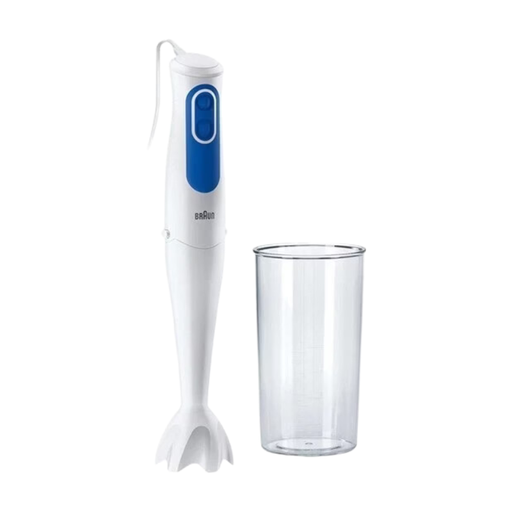 Image unavailable
The included measuring jug makes this hand blender suitable for blending a small batch straight in the jug.
The measuring jug has a capacity of 600 ml. The description lists detachable, dishwasher-safe parts and automatic shut-off after 1 minute of continuous use.
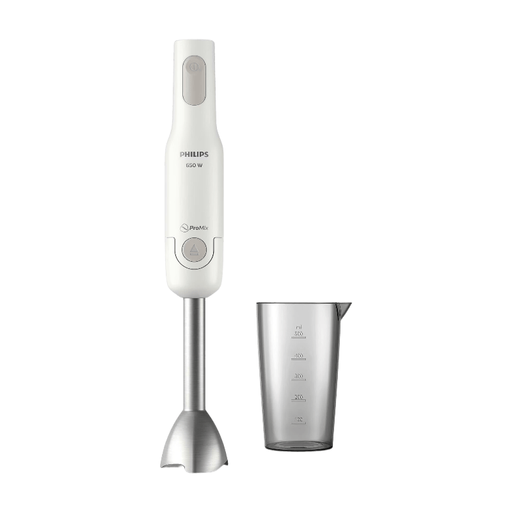 Image unavailable
The included measuring jug makes this model suitable for blending a portion straight in the jug.
The product information lists a power rating of 650 W, a 600 ml measuring jug, a splash guard and a quick-release accessory connection.
 Image unavailable
This mini blender is a cup-style option for preparing a small amount of fruit.
The stated capacity is 0,6 litres and the power rating is 350 W. The product information lists two speeds, a pulse button and detachable, dishwasher-safe parts.
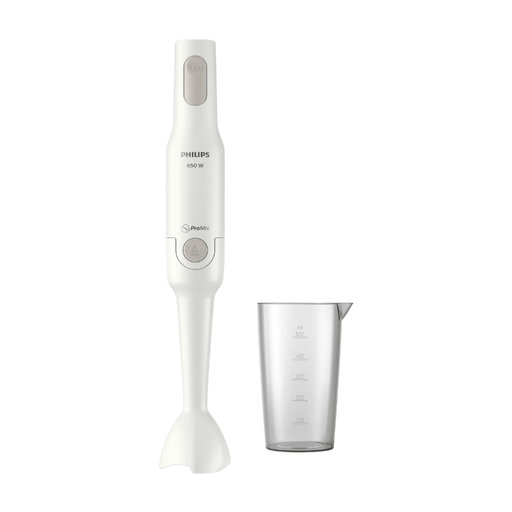 Image unavailable
The included measuring jug gives you the option of blending a small portion straight in the jug.
The product name lists 650 W. The description mentions a splash guard and measuring jug; check the cleaning instructions for the parts included with this version.
Not as a general rule when buying. Consumentenbond points out that wattage alone doesn’t tell you everything about blending performance. First choose the type of appliance and portion size, then check the instructions for the ingredients you want to use.
Wash the fruit and use clean kitchen utensils. Follow the maximum fill level and the instructions for securing the jug lid. Check which parts are dishwasher-safe for your particular model; the motor housing must not go in the dishwasher.
For opened fruit smoothies, Voedingscentrum recommends keeping them in the fridge for 1–2 days. This advice applies to that product category and isn’t a validated storage life for every homemade recipe, such as one containing dairy.
No. According to ACM ConsuWijzer, in addition to any manufacturer’s or retailer’s guarantee, you also have a statutory guarantee: when used normally, the product must meet the standards you could reasonably expect. There is no fixed statutory guarantee period of two years; the retailer is your point of contact.
For electrical equipment covered by the Warenwetbesluit elektrisch materiaal, the Netherlands Food and Consumer Product Safety Authority describes CE marking as compulsory. For these rules, NVWA specifies a rated AC voltage of 50–1000 V and a rated DC voltage of 75–1500 V; which rules apply depends on the model. A CE mark doesn’t tell you how well an appliance will purée peaches.