
Detail inspector
You mainly photograph small components or solder joints and want to know how much detail remains visible at a practical working distance. Dino-Lite lists magnification and a long working distance as features of the AM4115ZTL.


Your choice depends on the smallest details you want to capture and whether you also need to photograph the whole PCB. A compact camera with a macro mode is practical if you often switch between overview shots and close-ups. For local details, you could consider a digital microscope, while a mirrorless camera needs a suitable macro lens. With any setup, check the working distance and lighting on your PCB: reflections from solder can obscure details.
You mainly photograph small components or solder joints and want to know how much detail remains visible at a practical working distance. Dino-Lite lists magnification and a long working distance as features of the AM4115ZTL.
You regularly switch between photographing the whole PCB and taking a close-up, without wanting to set up again for every shot. OM SYSTEM lists a microscope mode for the TG-7; Canon describes a mirrorless camera with interchangeable RF lenses.
You photograph different PCBs under varying workshop lighting and want to manage reflections and differences between shots. Advanced Illumination and KEYENCE explain that lighting depends on the surface and inspection purpose.
Suitable if: you want one portable camera for both overview shots and occasional close-ups.
Trade-off: OM SYSTEM says the TG-7 focuses from 1 cm in microscope mode, but that doesn’t guarantee the lighting will fit around a densely populated PCB. The LG-1 light guide is listed with a separate kit, so check which version you’re buying.
Suitable if: you mainly inspect local details and need room to work above the item.
Trade-off: Dino-Lite specifies 10–140× magnification and a resolution of 1280 × 1024 pixels for the AM4115ZTL. Those features don’t make it a natural replacement for an overview shot. Dino-Lite does not describe this model as ESD-safe.
Suitable if: interchangeable optics are important and you want to choose the camera body and lens separately.
Trade-off: the Canon EOS R50 has an RF mount; Canon states that the RF 35mm F1.8 MACRO IS STM offers up to 0.5× magnification. The body and lens are separate items, and macro photography can have a shallow depth of field.
| What to consider | What should you look for? | Who is this important for? |
|---|---|---|
| Small details | Compare the field of view at your preferred magnification and working distance. Also check whether you need an overview shot. | If I need to capture small components or solder joints, I want to see the details without losing sight of the field of view I need. Around 42% of consumers rank detail visibility as their top purchasing priority. |
| Switching between scales | Check whether the camera can capture both the whole PCB and close-ups, and which lenses or accessories you’ll need. | I want to document a PCB and individual components without having to spend a lot of time changing the setup each time. Around 33% of consumers prioritise switching quickly between an overview and a close-up. |
| Reflections and lighting | Take test shots of the same PCB with the same lighting position. Compare diffuse lighting or lighting from a different direction, and check that there’s room for a stand. | When the workshop lighting varies, I want to assess reflections and make my shots more consistent. Around 25% of consumers prioritise repeatable lighting. |
With the Dino-Lite AM4115ZTL, the field of view and working distance depend on the magnification you choose. A setting for small details won’t automatically show the whole PCB.
Assess both an overview and the smallest detail you need, using the same PCB and setup.
Taking separate overview and detail shots may require a second setup or extra time to adjust the camera.
The direction and spread of the light can determine whether details remain visible on a reflective surface. More magnification won’t automatically solve poor lighting.
Try changing the direction of the light or using diffuse lighting, then compare the shot of the component you want to inspect.
A different lighting setup may require extra lighting equipment or more time to get it right.
Canon’s maximum macro magnification applies to the lens mentioned, while OM SYSTEM lists the LG-1 light guide as part of a specific TG-7 kit. The parts you need can therefore vary by version.
Before buying, check the full model name, compatibility and what’s included in the box.
A suitable lens or the light guide you want may need to be bought separately.
The TG-7 is a compact option if you want to switch between everyday photos and close-ups with one camera.
The AM4115ZTL is a digital microscope for inspecting local PCB details when you need room to work above the item.
The EOS R50 with a compatible RF macro lens is an option if you want interchangeable optics; the body and lens are separate items.
The SEL30M35 is a macro lens to consider if you already have a compatible Sony APS-C camera with an E-mount; the lens isn’t a camera on its own.
This product selection focuses on close-ups with a digital microscope. Check that the working distance, image display and setup suit your PCB and workspace.
 No image available
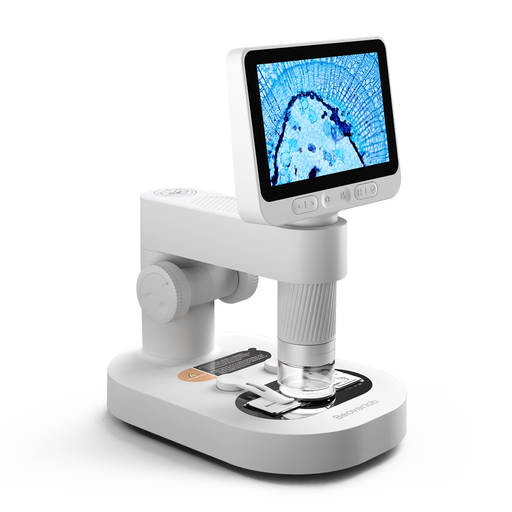
An option for viewing small components under magnification. Check that the setup suits your preferred working distance and how you’ll use it in your workspace.
The product name mentions a detachable screen, specimen slides and accessories. The description says it can be used as a handheld microscope or on a stand, and mentions adjustable lighting and eight adjustable LED lights.
The description advises keeping the microscope and small accessories out of reach of children under 3 and using the product only under direct adult supervision.
Start by adjusting the direction and spread of the light, then compare shots of the component you want to capture. Advanced Illumination describes diffuse dome lighting and coaxial diffuse lighting as possible techniques for reflective PCB surfaces. The right setup depends on the inspection purpose.
Not for every photo of a whole PCB. To achieve the maximum 0.5× macro magnification Canon lists for the RF 35mm F1.8 MACRO IS STM, you’ll need that compatible lens as well as a camera body. Check which items are included in the offer.
Check that there’s room for the stand, computer and cables, and follow the workshop’s PCB protection procedures. Dino-Lite says the AM4115ZTL uses USB 2.0 and that this model is not ESD-safe.
ACM ConsuWijzer says that online purchases generally come with a cooling-off period of up to 14 days after delivery, subject to legal exceptions. Your statutory rights are separate from any manufacturer’s warranty: if a product doesn’t meet what you could reasonably expect under normal use, the seller is responsible for providing an appropriate solution.
A recognisable person in a photo is personal data. The Dutch Data Protection Authority states that a legal basis under the GDPR is required to take and publish such images professionally or for organisational purposes; an exception may apply to images kept solely for private use. Where possible, point the camera only at the PCB. Rules on continuous camera surveillance are a separate matter.