
Vandaag of morgen in huis

Kwaliteit gegarandeerd

Welkomstaanbiedingen ontgrendelen: GRATIS bezorging | Tot 80% korting | Gratis 30 dagen JoyPlus-proefperiode
Download de app
A pastel highlighter set is useful for summaries, diaries, planners and creative projects. The soft colours are less vivid than neon ink, helping pages stay clear and organised. However, the range often looks more similar than it really is. A cheaper set may, for example, have too little colour variation, bleed through thin paper or be awkward to carry around.
As a Joybuy Product Recommendation Officer, I therefore focus mainly on measurable features: the number of colours, tip shape, line width, ink type and ease of use. This helps you avoid paying mainly for the packaging.
Soft colours can be subtle, but some shades offer little contrast on white paper. So check whether a set includes several clearly distinct colour variations, such as pink, yellow, mint, blue and lilac. With a larger set, it is also worth checking how many shades are genuinely different from one another.
For school and the office, you want to be able to find text again without every highlighted area looking the same. For highlighters for bullet journaling or hand lettering, a softer, even colour may be more important.
A round tip is mainly suitable for simple highlighting. A chisel-tip highlighter generally gives you more control: use the broad side for a line of text and the narrow side for underlining or adding small notes.
Pay attention to the stated line widths. STABILO BOSS pastel highlighters, for example, have a chisel tip with 2 and 5 mm, while STABILO swing cool pastel has a tip with 1 and 4 mm. You will notice the difference when making compact study notes and using highlighters for hand lettering.
Water-based ink can be pleasant to write with, but a pen still needs to be properly capped after use. According to STABILO’s own product information, various models can be left uncapped for up to four hours without drying out. This is a product specification under the conditions described by the brand, not a reason to leave the cap off as standard practice.
Preferably store pastel highlighters horizontally or follow the manufacturer’s instructions. Avoid direct sunlight and test new ink on a spare sheet first. Thin school paper in particular can allow ink to show through, even when a product description states “no bleed”.
Choose a broad chisel tip for highlighting and a narrow edge for underlining. A combination such as 1–4 mm is practical for textbooks, planners and an A5 notebook. A range of 2–5 mm works well when you mainly want to emphasise lines of text.
More colours do not automatically mean greater ease of use. A compact set that you use regularly may be more practical than a large box containing shades that barely differ.
Water-based ink is common in pastel highlighters. When using them in an A5 lined notebook, test the ink on a page at the back first. Paper weight also plays a role: the Jubiluu notebook in the selection uses 100 g offset paper, which feels different from thin printer paper.
For students and commuters, size matters. A slim highlighter with a clip fits more easily in a pencil case or bag. A click mechanism also prevents you from losing loose caps, but check that the tip can be fully retracted before putting the highlighter in a book.
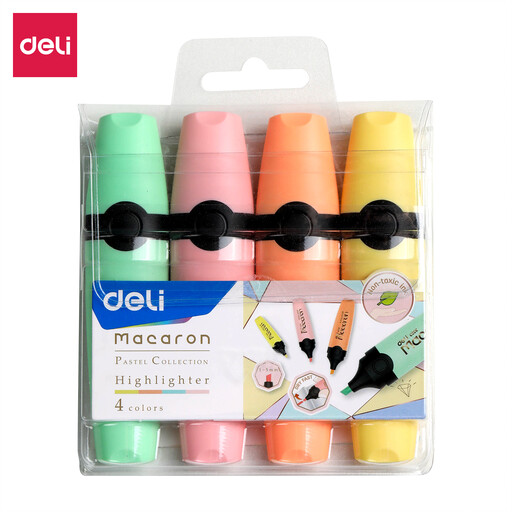
Why it suits this profile: A compact set of four colours is easy to manage for school notes, simple colour codes and your first bullet-journal pages.
The number of pens and the pastel finish are clearly specified. The chisel tip offers more versatility than a simple round tip.
4 pastel colours; chisel tip for broad and narrow highlighting; suitable as a starter set.
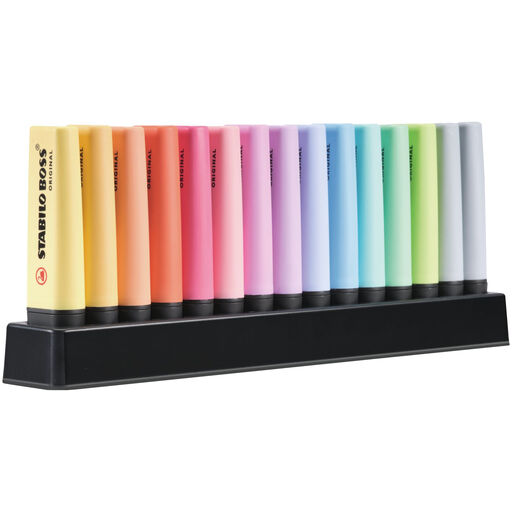
Why it suits this profile: The desk set with 14 pastel colours is suitable for anyone marking lots of categories and wanting to use the same colour system over a longer period.
The product information specifies the number of colours, water-based ink and two line widths of 2 and 5 mm.
14 pastel colours; chisel tip with 2 and 5 mm; according to STABILO’s own information, stays usable for up to four hours without a cap without drying out.
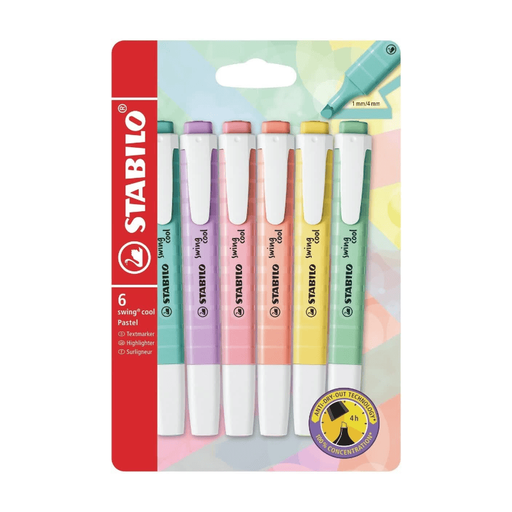
Why it suits this profile: The slim shape with clip is ideal for students, home workers and planners who carry their stationery with them every day.
According to the product information, the tip offers two line widths: 1 mm for underlining and 4 mm for highlighting. The clip reduces the chance of the highlighters coming loose in a bag.
Pocket-sized; clip; water-based ink; 1 and 4 mm in one tip.
A pastel highlighter set works even better when the rest of your stationery supports the same purpose. An A5 lined notebook is practical for lectures, meetings and daily planning. For writing and sketching, a mechanical pencil set with 0.7 mm HB leads can be a useful addition. The WRITECH set contains six pencils, four tubes of HB leads and two extra erasers.
For children and creative hobbyists, pastel coloured pencils are a natural choice. The Faber-Castell Jumbo Grip set contains five pencils with a thicker, triangular shape, a Soft-Grip Zone and a 3 mm lead. According to the product information, they are water-soluble and recommended from the age of six. This makes them suitable for drawing, but not as a replacement for a highlighter in textbooks.
We have put together a complete, up-to-date list of products that fully meet these strict selection criteria and the applicable European safety regulations.
Choose a set with several contrasting colours and a chisel tip. A narrow line width, such as 1 or 2 mm, is useful for underlining. Always test the ink on your paper to check for show-through.
Its lifespan depends on usage, paper and storage. Replace the cap after every session and keep the highlighters out of direct sunlight. If a brand specifies a drying time, such as up to four hours without a cap, treat this as a claim based on its own product information rather than a guarantee for every use.
Yes, provided the tip can create both broad and narrow lines. Also check that the ink does not smudge or show through your bullet-journal paper. For decorative accents, you can combine the highlighters with pastel pens, fineliners and coloured pencils.
