
Busy cook with a full pan of soup
You want to blend the cooked soup without transferring it first. Ease of use, splash control and cleaning all play a part in your choice.


If your parsnip soup is already cooked and you want to blend it without transferring it, a hand blender straight in the pan is the obvious choice. A blender jug is a good option if you also want to use it for other blending jobs, but check the instructions for hot liquids for the exact model. Choose a soup maker if you want the appliance to cook the ingredients too, and its capacity is large enough for your guests.
You want to blend the cooked soup without transferring it first. Ease of use, splash control and cleaning all play a part in your choice.
You want to check whether the usable capacity is enough, or whether blending in the pan is more practical than using a jug in several batches.
You may also want to use the appliance for smoothies, chopping or whisking, so you’re weighing up its design and accessories too.
Choose this when: the soup is already cooked and you want to blend it in the pan just before serving, without transferring it.
The trade-off: you hold the blender yourself and need to watch out for splashes when using it in an uncovered pan.
Choose this when: you want to use it for other blending jobs as well as soup, and the jug’s usable capacity suits your portions.
The trade-off: you’ll need to transfer the soup; you may need several batches, and instructions for hot liquids vary by model.
Choose this when: you want the ingredients to cook in the appliance too.
The trade-off: a cooking programme adds little if the soup is already cooked on the hob. Check that the capacity is right for your guests.
| What to consider | What to look for | Who this matters to |
|---|---|---|
| Blending without transferring | Consider the controls and cord length; also check that you can use it in the pan you have. | If I want to blend cooked soup quickly in the pan, I don’t want an extra jug batch. Around 40% of consumers give blending without transferring the highest priority. |
| Hot soup in a jug | Read the hot-liquid temperature and filling instructions for the exact model. | If you want to transfer soup, you’ll want to know whether the jug and appliance are suitable. Around 30% of consumers prioritise temperature suitability. |
| Quantity for guests | Compare the permitted filling capacity with your recipe and portions; plan batches if needed, or blend in the pan. | If I’m cooking for guests, I want to know whether I can process everything in one go. Around 20% of consumers start by considering the quantity per batch. |
| Use for other dishes | Think about whether you want to chop, whisk or make smoothies, and check which accessories are included with that version. | If you also want to use the appliance for other recipes, it’s worth considering the extra uses. Around 10% of consumers put versatility first. |
Temperature instructions vary by model. Guidance for one jug doesn’t automatically apply to another blender.
Check the manual for the complete model number before transferring hot soup.
If the manual says to let it cool first, you may have to wait longer just before serving.
The permitted quantity can vary depending on whether you’re blending thick or liquid ingredients. So the total capacity doesn’t necessarily tell you how much soup you can process at once.
Check the filling instructions for the complete jug and exact appliance, then compare them with your recipe.
If the soup won’t fit in one batch, you may need to make extra batches just before serving.
A soup maker combines cooking and blending, while a hand blender can blend cooked soup. If the soup is already ready on the hob, you don’t need a cooking function to blend it.
First decide whether you mainly want to blend, or whether you also want the appliance to do the cooking.
Philips offers hand blenders for blending, as well as the SoupMaker for cooking and blending.
The MultiQuick 1 MQ 100 soup is a straightforward hand blender for anyone who mainly wants to blend soup.
The ErgoMixx MSM64110 has a removable metal blending foot and two speeds; the MSM67160 comes with a chopper and whisk.
The Perfectmix+ BL811D38 is a blender with a glass jug for anyone who wants to blend things other than soup.
The Triblade HDP106WG is a hand blender that Kenwood markets for uses including soup.
These Joybuy products suit the in-pan approach to blending cooked soup; some versions also include accessories for other recipes.
 No image available
Suitable if you want to blend cooked soup in the pan without transferring it to a jug first.
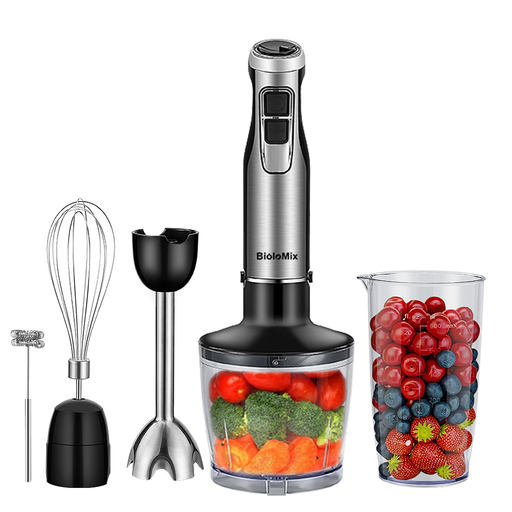
The product name lists six speeds, 1200 W, a stainless steel blade, a splash guard and a detachable design.
 No image available
A good choice if you want to blend soup in the pan and detach the blending foot after use.
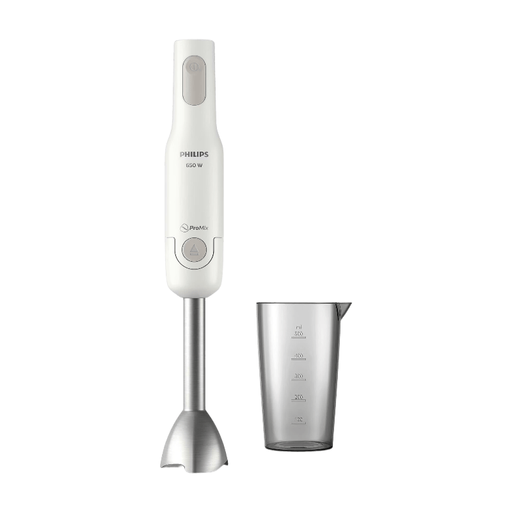
The product name lists 650 W. The product description mentions a splash guard, quick release, measuring beaker and 1.2 m cord. Continuous use for longer than 1 minute is not recommended.
 No image available
Suitable if you want to blend soup and use the listed accessories for other recipes too.
The product description lists 25 speeds, a turbo function, a chopper and a whisk. Do not process boiling liquids.
 No image available
A good choice if you want to blend cooked soup and use the supplied accessories for other recipes too.
The product name lists up to 1200 W, 15,000 rpm, a 700 ml beaker and a 500 ml chopper. The product description states that continuous use should be limited to 1 minute, followed by a 1-minute rest.
 No image available
Suitable if you want to blend soup in the pan and use the included whisk or chopper too.
The product name lists two speeds, a 500 ml chopper bowl and an 800 ml beaker.
Not without checking the instructions for the exact model first. Philips recommends cooling some models to below 60 °C, while the instructions for the Philips vacuum blenders HR3756/00, HR3752/00 and HR3868/00 specify only cold or room-temperature liquids. Don’t automatically apply this guidance to a different model.
No, not if you only want to blend soup. The Consumers’ Association distinguishes between hand blenders for blending only and versions with a chopper or whisk. Choose those extras based on what else you want to make.
According to the Netherlands Nutrition Centre, let leftovers cool quickly, store them in a well-sealed container in the fridge or freezer, and don’t leave them out of the fridge for more than two hours. This is storage advice, not a feature of a blender.
No. The end of the manufacturer’s warranty doesn’t automatically mean you no longer have statutory rights. The Dutch government states that the Netherlands has no fixed statutory guarantee period, and statutory rights may still be relevant after a manufacturer’s warranty expires. If a product is faulty, contact the seller; normal wear and tear or damage caused by misuse isn’t automatically covered.