
Lunch packer keeping an eye on quantity
You’re taking paprika crisps along with sandwiches and want a pack size that suits the number of people eating or lunches you’re preparing.


Choose a large bag if you’re sharing the crisps at lunch; individual bags are better if you want to pack portions for others or divide them up in advance. Even with a supermarket’s own-brand crisps, check the contents and the label for the exact variety: a larger pack won’t necessarily suit your lunches better.
You’re taking paprika crisps along with sandwiches and want a pack size that suits the number of people eating or lunches you’re preparing.
You want one bag for everyone to share, or individual portions to give to several people.
You compare the nutrition information, ingredients or allergens for the exact variety before choosing a pack.
First decide whether you’ll share the crisps or take individual portions with you. Then compare the pack size and the information on the packaging of the varieties that suit your plans.
| What to consider | What should you check? | Who should pay particular attention? |
|---|---|---|
| Pack size | Compare the weight of the bag with the number of people eating and lunches you’re preparing. | If I’m taking crisps for several lunches, I want an amount we can use. Around 36% of consumers put pack size first. |
| Sharing or taking individual portions | Check the number of individual bags and the weight of each one; for a sharing bag, check the storage instructions after opening. | For lunches I prepare separately, individual bags are more convenient than one opened bag. For around 29% of consumers, portioning is the first thing they consider. |
| Nutrition information | Compare the nutritional values of the exact varieties per 100 g and per planned portion. | When I compare varieties, I want to see how the stated amounts of fat and salt relate to my portion. Around 21% of consumers prioritise this comparison. |
| Ingredients and allergens | Read the ingredients list and allergen information on the packaging of the exact bag. | If I need to avoid an ingredient, I want to check the packaging itself before anyone eats the crisps. Around 14% of consumers put checking the label first. |
You’ll need to portion out a sharing bag yourself, while a multipack already contains separate bags. This matters most when the crisps are going into different lunches.
Choose the format that suits how you’ll actually hand out the crisps. For a multipack, check both the number of bags and the contents of each one.
According to the Netherlands Nutrition Centre, nutritional values can vary by brand. So a claim on one variety doesn’t necessarily apply to every bag of paprika crisps.
Compare the nutrition information on the exact packs per 100 g and, if you weigh out portions, per planned portion.
Product information can change. For ingredients and allergens, check the packaging of the variety you’ve bought.
Before eating, read the ingredients list and allergen information on the physical bag.
Lay's sells paprika crisps in different pack formats, including a 300 g bag and a 3-pack.
Jumbo offers both standard 250 g paprika crisps and 335 g ridged paprika crisps under its own label.
Albert Heijn lists both Lay's packs and individually wrapped AH paprika crisps.
One g'woon variety listed is paprika crisps in a 250 g bag.
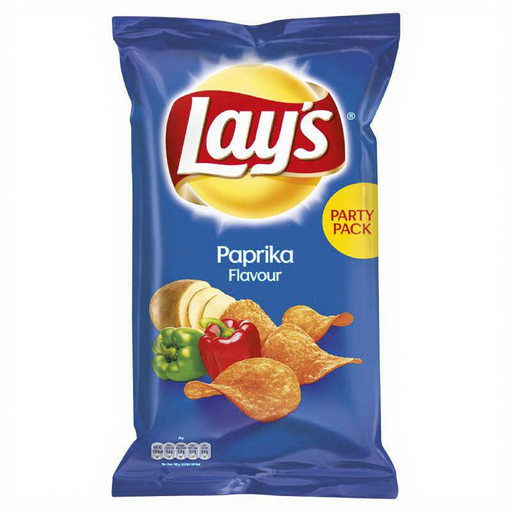
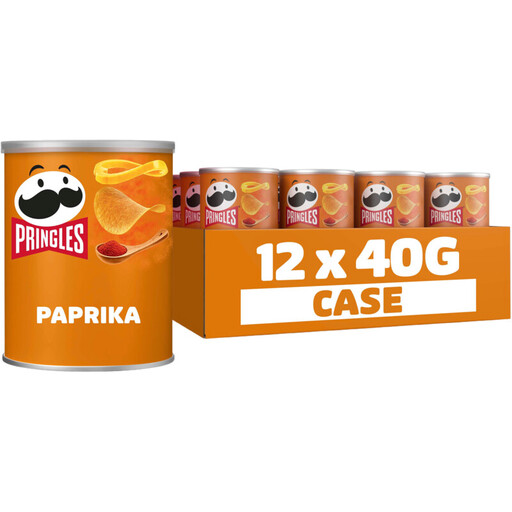
These products show two pack formats: a bag of Lay's Paprika to share and individual portions of Pringles Red Pepper to take with you. If you’re specifically looking for paprika crisps, check the flavour name on the Pringles variety.
 No image available
A 300 g bag of paprika crisps to share at lunch. Check the label on the bag you buy for ingredients and allergen information.
 No image available
Twelve individual 40 g packs for lunches prepared separately. The product name says Red Pepper; check the packaging if you’re specifically looking for a paprika variety, and read the ingredients and allergen information there too.
A large bag is handy when you’re sharing the crisps at one lunch. For lunches you prepare separately, a multipack may be more practical; check how many bags it contains and how many grams are in each one.
Check the pack size, best-before date and storage instructions on the packaging. If you won’t use a large bag all at once, follow the instructions on that bag for storing it after opening.
Compare the values for the exact varieties per 100 g, then check the amount you plan to have as a portion. This lets you compare like with like, without treating an average for crisps as the value for every variety.
Read the allergen information on the physical packaging of the exact bag. The Netherlands Food and Consumer Product Safety Authority explains how allergens are listed on labels. Don’t rely solely on an online product description, as ingredients can change.