
Anyone packing lunchboxes and watching their fat intake
You want to take an individual portion with you and know how much fat it contains. That’s why the weight of each individual pack matters just as much as the nutritional information per 100 g.


For a lunchbox, choose a pack that clearly shows the portion size of each individual pack, then compare the fat content both per 100 g and per portion. If you’re mainly watching your fat intake, oven-baked paprika crisps and lentil crisps are also worth considering. A different cooking method or base ingredient doesn’t, by itself, tell you anything about the salt content or whether the pack is suitable for a lunchbox.
You want to take an individual portion with you and know how much fat it contains. That’s why the weight of each individual pack matters just as much as the nutritional information per 100 g.
You’re open to oven-baked crisps or lentil-based crisps. Compare the nutritional information on the same basis, and don’t overlook salt content or portion size.
Individual packs make it easier to divide up portions and take them with you. However, the number of packs shown on the outer packaging doesn’t tell you how much is in each portion.
First, compare the nutritional information per 100 g, so you can assess packs of different sizes side by side. Then check how much is in each individual pack: that’s the portion you’ll actually put in your lunchbox.
| What to consider | What to check when buying | Who it matters to |
|---|---|---|
| Fat content | Compare the fat and saturated fat per 100 g; use the pack weight to work out how much is in one portion. | If I want to watch my fat intake, I don’t want to rely on the cooking method alone. Around 46% of shoppers prioritise fat content when making this choice. |
| Individual portions | Check whether the multipack contains individual packs and how many grams are in each one. | For a lunchbox, I want to take a clearly defined amount with me. For around 36% of shoppers, portion control is the most important factor. |
| Salt and ingredients | Alongside the fat content, check the salt per 100 g and, where relevant, the ingredients and allergen information. | Anyone considering an alternative to potato crisps will want to know what other differences come with it. Around 18% of shoppers give salt and ingredients the highest priority. |
Small individual packs define a portion, but they don’t change the nutritional value of the crisps. Albert Heijn lists 40 g bags and 30 g of fat per 100 g for AH Ribbelchips paprika 20-pack.
Use the weight of one bag to work out the nutritional information for that portion; don’t choose based on the number of bags alone.
According to Voedingscentrum, light crisps contain less fat than regular crisps, but may contain more carbohydrates. So a claim on the front of a pack doesn’t give you the full picture of its nutritional value.
Compare fat, saturated fat, salt and portion size on the current packaging.
Albert Heijn lists 19 g of fat and 2,71 g of salt per 100 g for Proper Paprika lentil chips. Fat content alone doesn’t tell you about all the differences that might matter when you’re choosing.
Compare the nutritional information per 100 g, then work out how it applies to the portion you want to take with you.
Ingredients and nutritional information can change. If you have a food allergy, the information on the pack you’re buying is what matters.
Each time you buy the product, check the ingredients and allergen information on that pack again.
Lay's offers regular paprika crisps in a 20-pack, as well as a separate Oven Baked Roasted Paprika variant. Compare each range using its own label; one pack doesn’t tell you about the portions in another.
The AH Ribbelchips paprika 20-pack reviewed here combines ridged paprika crisps with individual bags.
Proper Paprika lentil chips are paprika-flavoured crisps made with lentils, so they’re a different type of product from the potato crisps mentioned above.
This option comes in individual packs, making it easy to take a portion with you. They’re tubes rather than bags, so check the nutritional information on the packaging if you’re mainly watching your fat intake.
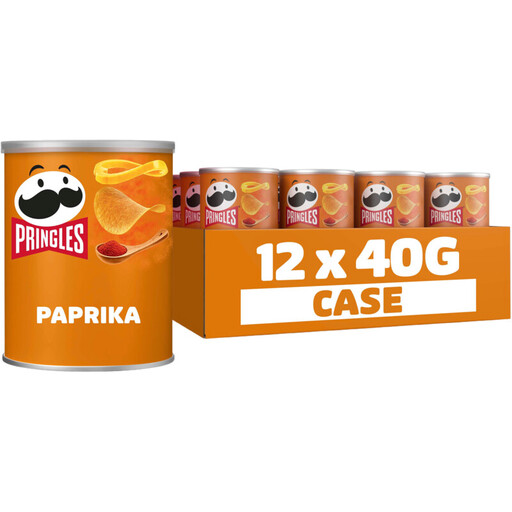 Image unavailable
The individual packs make it easy to take one portion with you. This multipack contains tubes, not bags.
To help you choose, compare the fat content per 100 g and per tube on the current label.
No, check the nutritional information for the specific variant. Lay's describes Oven Baked Roasted Paprika as a variant with less fat than regular potato crisps, but you should also check the portion size and other nutritional information on the pack.
Check whether the individual packs are separate portions and how many grams each one contains. Albert Heijn lists 40 g packs for the Lay's Paprika 20-pack, each labelled as one portion; use the label to work out the nutritional information for a portion like that.
No, compare the specific products and how much you eat. Albert Heijn lists 19 g of fat and 2,71 g of salt per 100 g for Proper Paprika lentil chips. Take both figures into account and check that the pack suits your lunchbox.
Each time you buy the product, read the information on the pack if allergens matter to you. Ingredients can change, and the Netherlands Food and Consumer Product Safety Authority states that allergens must be clearly listed on the label.