
Shoppers with a strict low-calorie requirement
You want to check the label to see whether a snack meets the threshold for the ‘low-calorie’ claim. If paprika crisps don’t meet that threshold, you’d rather choose something else.


If you want to take paprika crisps on your summer holiday, first check the energy per 100 g, then consider how much you open for each snack break. Under European rules, a solid snack can only be labelled ‘low-calorie’ if it contains no more than 40 kcal per 100 g. Regular Lay's Paprika at Albert Heijn contains 507 kcal per 100 g, while Smiths Sticks Paprika at Jumbo contains 491 kcal per 100 g. A small bag can help you stick to a portion, but it doesn’t change the nutritional value per 100 g.
You want to check the label to see whether a snack meets the threshold for the ‘low-calorie’ claim. If paprika crisps don’t meet that threshold, you’d rather choose something else.
You want to take paprika crisps for a set snack break, perhaps in an individual bag, without calling them low-calorie just because they come in a small pack.
You’re looking for a pack with enough crisps for several people or snack breaks, and want to decide in advance how to divide it up.
First decide whether ‘low-calorie’ is an absolute requirement. If you mainly want to take paprika crisps with you, compare the energy per 100 g, then choose an amount that suits your snack breaks.
| What to consider | What to check when buying | Who it matters to |
|---|---|---|
| Low-calorie claim | Check the kcal per 100 g. Under European rules, solid food must contain no more than 40 kcal per 100 g to carry the ‘low-calorie’ claim. ‘Lower fat’ doesn’t answer that question. | If I only want to take a demonstrably low-calorie snack, the value on the label must determine my choice. This is the top priority for around 38% of consumers. |
| Portion for each snack break | Check the weight of each individual bag, and the energy per portion as well as per 100 g. | When I’m out and about, I want to decide how many crisps to open for one snack break. Around 37% of consumers prioritise planning portions. |
| Pack size for a group | Compare the net weight with the number of people and snack breaks, and think about how you’ll share a large bag. | When buying for several holidaymakers, I want to take enough crisps without opening every portion at once. This is the top priority for around 25% of consumers. |
A cooking method or a claim about fat doesn’t, by itself, tell you whether a solid snack meets the European threshold of 40 kcal per 100 g for the ‘low-calorie’ claim.
If that claim is key to your choice, check the energy per 100 g on the label.
Portions vary in weight. The Voedingscentrum gives 215 kcal as the average for a 40 g bowl of crisps; that isn’t the nutritional value of every paprika crisp.
Compare products by kcal per 100 g, then consider how many grams you actually want to open.
A large bag doesn’t give you separate, pre-measured snack portions, so it’s harder to know in advance how much you’ll open each time.
Divide the contents into bowls in advance, or choose individual bags if having a set amount matters to you.
Ingredient and allergen information can change. Jumbo lists milk and sulphur dioxide/sulphites for Smiths Sticks Paprika.
Check the current label every time you buy the product if you need to be mindful of ingredients or allergens.
Paprika crisps are available in standard bags and multipacks with 40 g bags, as listed by Jumbo.
Smiths Sticks Paprika is a paprika-flavoured snack in stick form, not a standard potato crisp.
Lidl lists Snack Day Paprika crisps as paprika-flavoured potato crisps in a 250 g bag.
ALDI lists Sun Snacks Paprika crisps in a 250 g bag.
This Joybuy selection consists of individual bags of paprika crisps for anyone who wants to take a set amount for each snack break. A portion pack doesn’t tell you anything about the energy per 100 g.
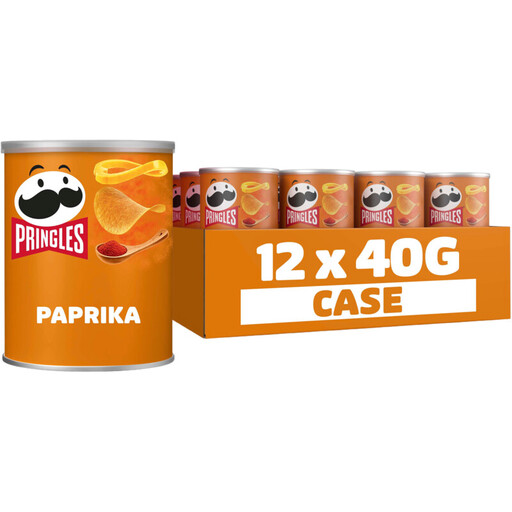 Image unavailable
The individual bags let you take a set amount for a snack break.
Pack: 12 bags of 40 g. Check the current energy per 100 g on the pack if you want to compare it.
Under European rules, this claim can only be used for a solid product containing no more than 40 kcal per 100 g. Albert Heijn lists 507 kcal per 100 g for regular Lay's Paprika, and Jumbo lists 491 kcal per 100 g for Smiths Sticks Paprika; neither variety meets this threshold.
No. A description of how a product is made or a lower fat content doesn’t prove that it meets the threshold for the ‘low-calorie’ claim. Check the energy per 100 g on the current label for the specific variety.
A small bag sets the amount you open, but doesn’t change the energy per 100 g. Compare the bag’s weight and kcal per bag with the amount you want to take for one snack break.
It varies by product: Jumbo lists milk and sulphur dioxide/sulphites for Smiths Sticks Paprika. Always check the current label for the variety you choose, as ingredients and allergen information can change.