
Vandaag of morgen in huis

Kwaliteit gegarandeerd

Welkomstaanbiedingen ontgrendelen: GRATIS bezorging | Tot 80% korting | Gratis 30 dagen JoyPlus-proefperiode
Download de app
A pan that works well on gas is not automatically suitable for induction. The base must be magnetic and make flat contact with the cooking zone. Size, material, coating and care also play an important role. If you focus only on an attractive offer or a familiar term such as “non-stick”, you could end up with a pan that heats unevenly, becomes damaged quickly or is difficult to clean.
This buying guide helps Dutch households, home cooks and cooking enthusiasts compare pans for induction in a focused way. We also look at use on gas, ceramic and electric hobs.
The description pans suitable for all heat sources sounds practical, but always check the product specifications. Induction requires a magnetic base. A pan may be suitable for gas and ceramic cooking, but not for induction if the base does not contain a magnetic layer.
Also pay attention to the base diameter. A large 32 cm wok does not always have a base that covers the entire induction zone. Some models, for example, specify a particular base diameter. Good contact with the cooking zone helps transfer heat more evenly.
A non-stick pan can be ideal for eggs, pancakes and delicate fish, but the coating usually requires careful use. Sharp metal spatulas, heating an empty pan and scouring pads can damage the layer. Also check whether the pan is dishwasher-safe.
With a PFAS-free pan, you should check the exact product description. According to the product information, the Brabantia Onyx models are described as featuring a 100% PFAS-free ceramic coating. This is a product specification provided by the brand or seller; always check the latest information on the product page before buying.
An induction frying pan measuring 20 to 24 cm is suitable for one or two portions. For a family, 26 to 28 cm is often more practical. An induction wok offers more space for stir-fries, but it also requires sufficient storage space and a suitably sized cooking zone.
An induction sauté pan with a lid is useful when you want to sear food first and then simmer it. A saucepan measuring 16 to 18 cm is better suited to sauces, porridge and small amounts of vegetables. Look not only at the diameter, but also at the capacity, height and handle length.
A stainless steel pan is built to withstand intensive everyday use and usually does not have a delicate non-stick coating. With stainless steel, food can stick more easily if the pan is not preheated properly. The Maxcook Tri-Ply wok specifies a 304 stainless steel construction without a non-stick coating. According to the product information, the pan is suitable for stir-frying, searing and everyday cooking, among other uses.
Aluminium generally heats up quickly and keeps the weight down. For induction, it usually needs a magnetic induction disc or a composite base. A multi-layer construction, such as stainless steel-aluminium-stainless steel, is designed to distribute heat more effectively throughout the pan. Check the specified material construction rather than relying solely on terms such as “heats up quickly”.
A ceramic coating may be marketed as PFAS-free, while other pans use a PTFE or titanium-reinforced coating. These terms are not interchangeable. If you are specifically looking for a PFAS-free pan, it is worth reading the product listing and care instructions.
For coated pans, preferably use wooden or silicone utensils. According to the product information for some models, they are dishwasher-safe, but hand washing with a soft sponge is often recommended to help extend the coating’s usable life.
A pan with a lid is useful for simmering, sauces, rice dishes and casseroles. A glass lid allows you to see the contents without lifting it. Check whether the lid can withstand changes in temperature and whether the pan is oven-safe.
Also look for the description dishwasher-safe pan. “Dishwasher-safe” does not mean that hand washing is unnecessary. For some models, frequent cleaning in the dishwasher may affect the finish, handles or coating more quickly. Always follow the manufacturer’s care instructions.
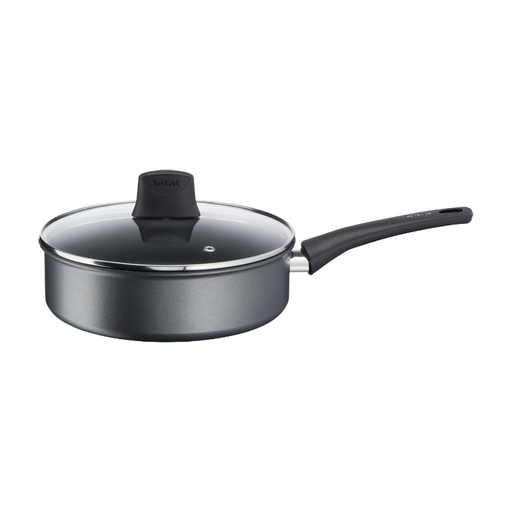
Why it suits this profile: A manageable size for everyday portions, with a glass lid and suitability for induction, gas, electric and ceramic hobs according to the product information.
The stated compatibility makes it easier to check the heat source. However, the coating requires hand washing and suitable utensils.
24 cm, glass lid, oven use up to 175 °C according to the product details, and a titanium-reinforced non-stick coating.
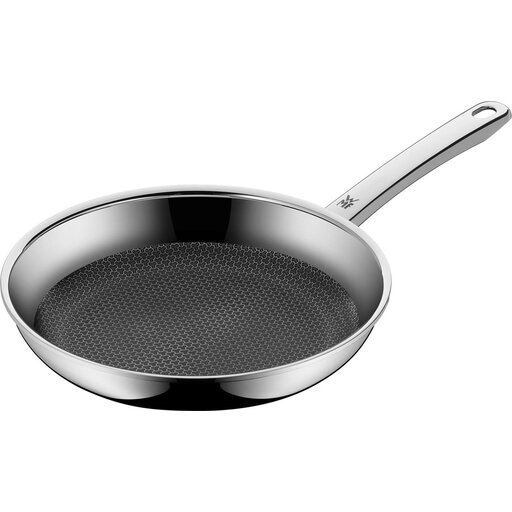
Why it suits this profile: For anyone looking for a combination of stainless steel, an aluminium core and a honeycomb coating structure.
The product specifications explicitly state induction compatibility and a TransTherm base. According to the listing, the pan is not dishwasher-safe.
Suitable for all heat sources, heat-resistant up to 260 °C according to the product information, and fitted with an ergonomic handle.
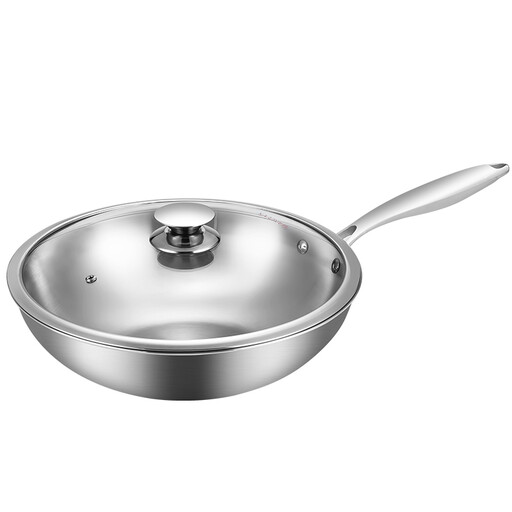
Why it suits this profile: A natural choice for stir-frying, searing and meals where a coating-free stainless steel interior is preferred.
The product description clearly states that there is no non-stick coating. This means you need to preheat the pan correctly and use oil to help prevent food from sticking.
304 stainless steel, composite base, 28 cm size, glass lid and, according to the product information, suitability for induction, gas, electric and ceramic cooking.
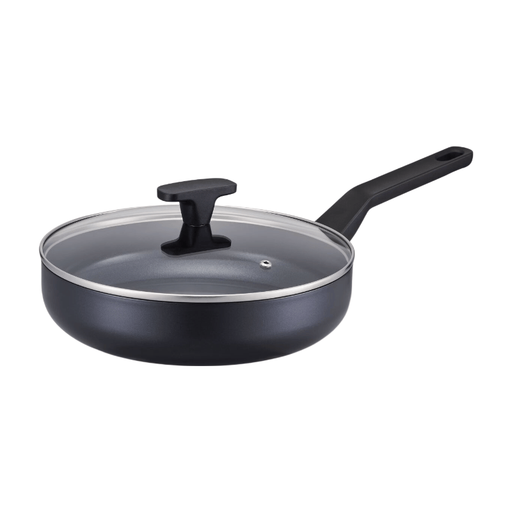
Why it suits this profile: A spacious induction sauté pan for sauces, vegetables and casseroles, with a focus on a PFAS-free ceramic coating according to the product information.
The product details specify both induction compatibility and the type of coating. According to the description, the pan is dishwasher-safe, but hand washing is recommended.
26 cm, glass lid, recycled aluminium and, according to the product description, suitability for induction, gas, electric, ceramic and halogen cooking.
We have put together a complete, up-to-date list of products that fully meet these strict selection criteria and the applicable European safety regulations.
A pan works on induction if its base is magnetic and flat. Look for the description “suitable for induction” and, if in doubt, check whether a magnet remains attached to the base. An induction frying pan, induction wok and saucepan can all be suitable, provided the base is designed for induction.
No. A pan can be PFAS-free and have a ceramic coating, but the terms do not mean the same thing. Check the stated coating type. With a coating-free stainless steel frying pan, you also need to use a different cooking technique to help prevent food from sticking.
Only when the manufacturer explicitly states that it can. Even with a dishwasher-safe pan, hand washing may help keep the finish or coating in good condition for longer. Always read the latest care instructions on the product page before buying a pan.
