
Canteen manager serving a lunch to share
Plans how many pancakes, toppings and staff are needed for a group of diners. The stated yield per pack helps determine the size of the lunch batch.


For a university lunch to share, choose a standard 400 g pack if the kitchen can prepare the milk and eggs. Choose a complete mix if you want to minimise the number of separate ingredients, but base your calculations on the yield stated on the exact pack. A gluten-free option requires a suitable separate mix, as well as separate preparation and serving arrangements. Don’t make a limited-edition flavour the basis of a recurring lunch menu.
Plans how many pancakes, toppings and staff are needed for a group of diners. The stated yield per pack helps determine the size of the lunch batch.
Wants to measure out fewer separate ingredients just before the lunchtime rush. A complete mix may be a good fit, provided its ingredients and allergens suit the menu.
Needs to be able to provide allergen information for each prepared pancake and topping. A gluten-free option also requires separate preparation and serving arrangements.
First, work out how many pancakes the lunch service needs and how much preparation the kitchen can manage. Then check the ingredients of each option and what information guests will receive when food is served.
| What to consider | What should you check? | Who is this important for? |
|---|---|---|
| Allergens and menu options | Read the ingredients and allergen information for the exact variant, and include your chosen toppings in the information provided when serving. | If I’m cooking for guests with different dietary requirements, I want to know before lunch which prepared options I can clearly offer. Allergen management is the top priority for around 31% of consumers. |
| Yield per pack | Compare the number of pancakes stated in the preparation instructions on the pack, not just the pack weight. | For a lunch shared by several guests, I want to work out how many packs I’ll need for the batch. Around 25% of consumers give predictable yields top priority. |
| Preparation during the lunchtime rush | Check which ingredients you need to add and whether you’ll be using a bag of mix or a shaker bottle. | When the kitchen team has little time just before serving, I want to have fewer separate ingredients ready. Minimising preparation is the top priority for around 25% of consumers. |
| Stock and pack format | Check the shelf-life information, storage instructions after opening and availability of your preferred variant before finalising the menu. | For a recurring lunch, I want to be able to store an opened mix and avoid relying on a single limited-edition flavour. Stock planning is the main concern for around 19% of consumers. |
For unpackaged pancakes, allergen information must be available to guests before they buy, according to the Netherlands Food and Consumer Product Safety Authority. Keeping the information behind the counter doesn’t automatically make it accessible.
Record the allergens for each prepared option and topping, and make sure guests can access the information when food is served.
Yield varies by recipe and pack. For example, Koopmans states a yield of 11–13 pancakes for Origineel and 8–10 for Compleet.
Work out how many packs you need using the yield for your chosen variant, and allow for test pancakes and fluctuating demand when planning.
A lower-than-expected yield can mean you need extra packs or preparation time during lunch.
The fact that you only need to add water says nothing about the allergens in the dry mix. The complete mixes from Koopmans, Jumbo and PLUS that were reviewed also contain milk and egg.
Use ‘complete’ to describe how the mix is prepared, and check whether it meets dietary requirements separately on the pack of the exact variant.
Flavoured variants can be discontinued: Jumbo states that the Koopmans Speculoos mix reviewed is no longer part of its online range.
For a recurring lunch, choose a standard variant and check its availability in advance. Use limited-edition flavours as an extra option only.
If a planned flavour is no longer available, you may need to change the menu shortly before lunch.
Offers standard, complete and gluten-free pancake mixes that were reviewed. Compare the variants by preparation method and yield, not just by brand name.
The plain and wholemeal mixes reviewed offer two different menu options.
Offers plain and complete 400 g mixes that were reviewed, allowing you to compare a recipe with added ingredients against one that only needs water.
The plain and complete mixes reviewed both come in 400 g packs, but require different preparation methods.
ALDI lists a 400 g ALBONA multigrain mix as a possible option for a different menu choice.
This Joybuy selection includes packs for a planned batch and shaker bottles for smaller batches or top-ups. For a lunch to share, work out how much you’ll need based on the yield per pack; don’t assume the multigrain mix shown is gluten-free without checking first.
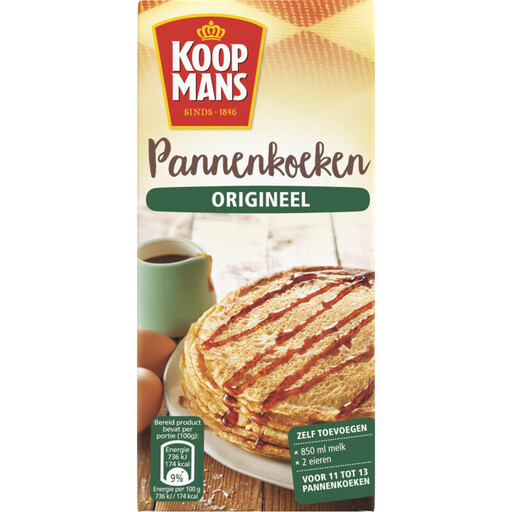 Image unavailable
A standard mix for a planned lunch batch, when the kitchen can prepare the additional ingredients.
400 g pack. Koopmans states a yield of 11–13 pancakes per pack for Pannenkoeken Origineel. For your prepared lunch, check the allergens on the exact pack and on your toppings.
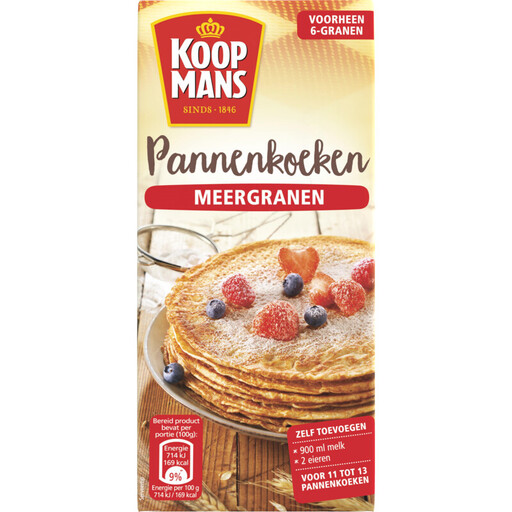 Image unavailable
An option if the canteen wants to offer a multigrain alternative alongside its standard mix.
400 g pack. Check the preparation method, stated yield and allergens on the exact pack before planning your lunch batch.
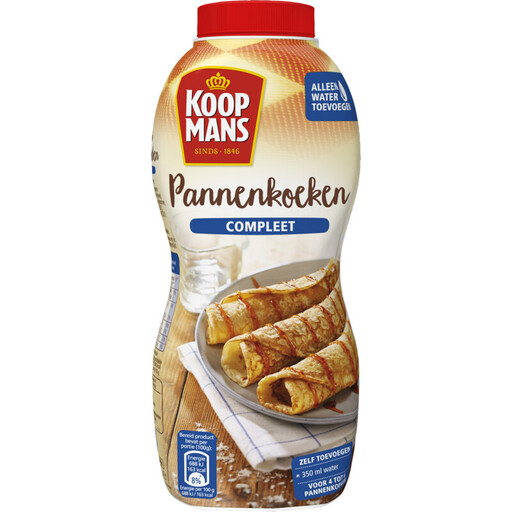 Image unavailable
A shaker bottle for a smaller batch when you have few separate ingredients ready to hand.
210 g bottle. Joybuy states a yield of 4–6 pancakes per bottle. For a larger lunch, work out how many bottles you’ll need and check the allergens for this variant.
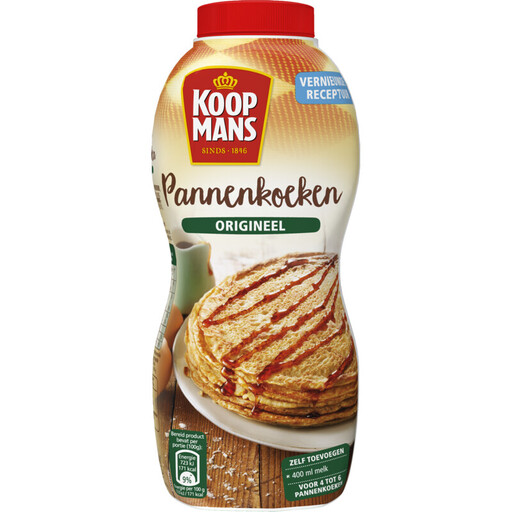 Image unavailable
A shaker bottle to consider for a small batch or as an extra for the lunch service.
175 g bottle. Check which ingredients are needed and how many pancakes the exact pack states it makes; don’t assume it has the same yield as another shaker bottle.
Start with the number of pancakes you want to make, then use the yield for the exact variant to work out how many packs you need. Koopmans states a yield of 11–13 pancakes for Origineel and 8–10 for Compleet; Albert Heijn states around 12 for AH Naturel and around 10 for AH Volkoren. Allow for test pancakes and fluctuating demand when planning.
Yes, as long as guests can clearly see that they can ask for the information and receive it before buying. The Netherlands Food and Consumer Product Safety Authority explains that allergen information for unpackaged food can be provided in ways other than on a label. Make sure staff can give guests the information about the prepared option and toppings straight away.
No. ‘Complete’ describes what you need to add during preparation, not which diets the mix is suitable for. The complete mixes from Koopmans, Jumbo and PLUS that were reviewed contain ingredients including wheat, milk and egg. Check the ingredients and allergens for the exact product when assessing each menu option.
Don’t leave cooked pancakes out of the fridge for too long: the Netherlands Nutrition Centre advises that leftovers should not be left out for more than two hours. Cool them quickly, seal them well and then store them according to the relevant storage instructions.
Only if you check in advance that it will be available for your planned lunches. For example, Jumbo states that the Koopmans Speculoos mix reviewed is no longer part of its online range. It’s best to use a limited-edition flavour as an extra alongside a standard mix you’ve chosen in advance.