
Big breakfast tables
Families and brunch hosts who want to work out in advance how many packs they need. The yield per pack and the total ingredients required for all the packs matter more than the pack weight alone.


For a big weekend breakfast, you can work out how many standard packs you need based on the yield per pack. A multipack may simply bundle individual packs together, rather than being a larger-format pack. A complete mix means you need fewer additional ingredients to prepare it, while with wholemeal and multigrain mixes you should check the ingredients and allergens for the specific variety.
Families and brunch hosts who want to work out in advance how many packs they need. The yield per pack and the total ingredients required for all the packs matter more than the pack weight alone.
If you want to get fewer separate ingredients ready on a busy weekend morning, compare the preparation instructions for a standard mix and a complete mix.
If you’re looking for a particular grain composition or need to take guests’ allergies into account, read the label for the exact variety before buying a larger quantity.
First, decide how many pancakes you want to make. Then compare the yield and recipe for each pack so that you buy enough mix and the other ingredients for the number of people you’re serving.
| What to consider | What to check | Who it matters to |
|---|---|---|
| Enough batter | Compare the stated yield per pack and check whether a multipack contains separate standard packs. Koopmans says its Original mix makes 11 to 13 pancakes per pack. | When I’m cooking for a large group, I want to make sure I have enough packs in the house beforehand. Around 33% of consumers put getting the right quantity first. |
| Preparing everything on the morning | Check which liquid and other ingredients the recipe for your chosen variety calls for. The PLUS Complete mix reviewed requires water and cooking fat; PLUS Naturel requires milk, eggs and cooking fat. | On a busy morning, I want to get as few separate ingredients ready as possible. Around 27% of consumers say this preparation is their top priority. |
| Ingredients for all the packs | Add up the quantities of milk, eggs and cooking fat in the recipe for the number of packs you plan to use. | When I’m making several packs at once, I don’t want to run out of a required ingredient halfway through. Around 20% of consumers prioritise having a complete shopping list. |
| Ingredients and allergens | Check the ingredients and allergen information for each variety. If you’re serving unpackaged pancakes to customers, also find out what allergen information you need to provide. | If guests have specific dietary requirements, I want to know which mix and preparation method are suitable before I start cooking. Around 20% of consumers put this check first. |
The Koopmans 3-pack sold by Albert Heijn is supplied as separate items. You can use it to plan for three standard packs, but you’ll still be working with individual packs and recipes.
Calculate the yield for the pack you’ve chosen and round the number of packs you need up.
A standard mix and a complete mix may require different ingredients for preparation, even if they have the same pack weight.
Read the recipe for each pack before working out the shopping list for the whole group.
The ingredients and preparation method don’t, by themselves, tell you which allergens a mix contains. According to the Netherlands Food and Consumer Product Safety Authority, customers must be given information about relevant allergens when unpackaged food is served.
Read the current label for the variety you’ve chosen. If you’re serving customers, make sure allergen information is available for the prepared pancakes.
You may have some mix left after a big breakfast. Moisture and heat make it important to keep an eye on storage conditions once a pack has been opened.
According to the Netherlands Nutrition Centre, store the mix in a cool, dry, dark place and keep it tightly sealed.
Koopmans offers several types of pancake mix, including standard, complete, wholemeal and shaker-bottle varieties.
Albert Heijn’s own brand offers a 300 g wholemeal pancake mix, among other products.
Jumbo sells its own pancake mixes as well as mixes from other brands.
PLUS sells Naturel, Complete and wholemeal pancake mixes in 400 g packs.
Albona is an ALDI own brand that includes pancake mix in a 400 g pack.
Belbake is a Lidl own brand, with a 400 g Original pancake mix.
These two packs are a good fit for a breakfast where you want to scale up the number of standard packs yourself. Choose between the Wholegrains and Original varieties based on the grain composition you’re looking for. Check the yield, recipe and allergens on each pack.
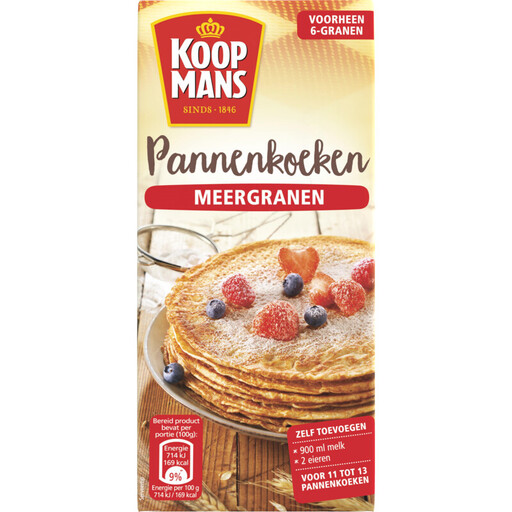 Image unavailable
A good option if you specifically want to compare a Wholegrains variety when planning a big breakfast. This is one 400 g pack. If you’re buying several, read the label and preparation instructions for this variety, and check the allergens if necessary.
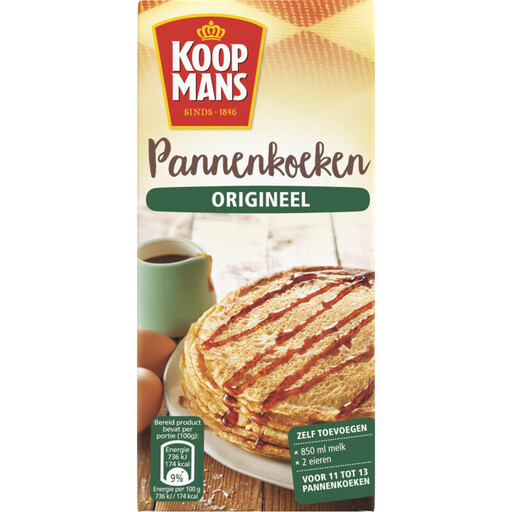 Image unavailable
A good option if you want to buy standard pancake mix in separate packs for a bigger breakfast table. This is one 400 g pack. Work out how many you need based on the yield on the pack, then add up the recipe ingredients for all the packs.
Use the stated yield for the mix you’ve chosen and round the number of packs you calculate up. Koopmans says its Original mix makes 11 to 13 pancakes per pack; Lidl says its 400 g Belbake pack makes around twelve pancakes. Then add up the additional ingredients required by the recipes for all the packs.
A complete mix is useful if you want to get fewer separate ingredients ready for preparation. PLUS lists water and cooking fat for its Complete mix, compared with milk, eggs and cooking fat for Naturel. Check the ingredients of the complete mix itself: the preparation method doesn’t determine whether a product is free from particular allergens.
No. Wholemeal on its own doesn’t mean a product is suitable for a gluten-free diet. The AH and PLUS wholemeal mixes reviewed contain wheat. According to the Netherlands Food and Consumer Product Safety Authority, the term ‘gluten-free’ may only be used when a product meets the relevant requirements, so check the label on the exact pack.
Store leftover mix in a cool, dry, dark place and keep it tightly sealed, as advised by the Netherlands Nutrition Centre. Also follow the storage instructions on the pack. If it has been opened, look out for any unusual smells or signs of insects.
Make sure customers can get information about the allergens in the prepared pancakes. The Netherlands Food and Consumer Product Safety Authority says information must be provided about 14 allergens in unpackaged food. For catering from home, the Chamber of Commerce also advises using an HACCP food safety plan or hygiene code. Check which requirements apply to the way you sell.