Who should consider buying in bulk?
The right pack size depends mainly on how much batter you make at once and whether everyone can eat the same mix.
Organisers of a pancake get-together
If you’re cooking for a club, children’s party or large family group, plan not only how much mix you need but also the time and space required to cook and serve all the pancakes. If you’re making different batters or serving different toppings, keep track of the allergens in each.
Large families stocking up
If you’re making pancakes on several days, consider whether separate 400 g packs suit the way you cook better than one large bag that has been opened. Check what you need to add to the batter for each variety and how to store any leftovers.
Cooks catering for dietary needs or allergies
Check the ingredients and allergens on the specific pack before cooking for others. According to the Voedingscentrum, people with coeliac disease must also avoid contact with gluten from other products during preparation.
What should you look for when choosing?
Several 400 g packs
When to choose them: opt for separate packs if you want to spread the cooking over several occasions or need different varieties.
The trade-off: you’ll need to factor in the yield and preparation instructions for each pack you choose.
1 kg bag
When to choose it: when you want to make a larger, consistent batch without opening a 5 kg bag.
The trade-off: you’ll need to weigh out part of the bag. If your guests have different allergen requirements, one recipe may not suit everyone.
5 kg bag
When to choose it: for regular or large-scale cooking when you can store and use the mix properly.
The trade-off: a larger bag won’t give you more cooking space, and you’ll have more mix left over if you use less than planned.
First, work out how many pancakes you need for each cooking session. Then choose a recipe that suits the people you’re cooking for and the way you want to store any leftovers.
| What to consider |
What to check |
Who it matters to |
| Yield per batch |
Check the stated yield for the exact mix and work out how much batter you can cook at once. |
If I’m cooking for a whole group, I want to know how many rounds I’ll need before everyone can eat. A sufficient yield is the top priority for around 33% of consumers. |
| Extra ingredients |
Check whether water is enough or whether you’ll also need milk, eggs and cooking fat. |
When I shop for everything for a cooking session in one go, I don’t want to forget anything for the batter. Around 27% of consumers give this preparation the highest priority. |
| Allergens and preparation |
Read the current label for each variety and, where necessary, prevent different batters and utensils from coming into contact. |
If I’m cooking for guests with allergen requirements, I need to know which mix and preparation method will suit them. This is the main consideration for around 20% of consumers. |
| Choice of varieties |
Check that the ingredients and preparation method you want are suitable for the mix you’ve chosen. |
If not everyone wants the same batter, I prefer to have the flexibility to choose a different variety for each round. This freedom of choice matters most to around 20% of consumers. |
Brands to start with
Preparation methods, pack sizes and allergens can vary between varieties from the same brand. Use the product name and current label to compare the mixes and find the right one.
Koopmans
Koopmans offers both packs for home use and larger-format professional pancake mixes.
- Albert Heijn gives an approximate yield of 10 pancakes for 400 g of Koopmans Compleet; you add water to prepare it. Koopmans Professioneel also offers 1 kg and 5 kg mixes.
- The varieties aren’t interchangeable when it comes to allergen or dietary requirements. Check the ingredients and preparation instructions on the specific pack.
AH
AH Naturel is a 400 g basic mix for anyone who wants to add their own ingredients to the batter.
- Albert Heijn states an approximate yield of 12 pancakes per pack and gives instructions for both the standard and a plant-based preparation method.
- The standard preparation requires milk and eggs. Using a different preparation method doesn’t change the ingredients in the dry mix, so check the label for dietary or allergen requirements.
PLUS
PLUS Complete is a 400 g mix which, according to PLUS, is prepared with water and cooking fat.
- According to the product information, you don’t need to add milk or eggs separately to the batter.
- PLUS lists wheat, milk and egg as allergens. Don’t rely on the preparation method instead of checking the label.
Albona
ALDI offers Albona pancake mix and Albona Naturel in 400 g packs.
- The two varieties give you the option of choosing separate packs for different cooking sessions.
- Check the specific pack to see which ingredients you need to add and which allergens are listed for that variety.
Joybuy: 400 g mixes
These packs are suited to cooking in separate rounds for a larger group. Compare their preparation methods and stated yields before deciding how many packs you need. A 1 kg or 5 kg bag calls for different storage and batch-size considerations.
 No image available
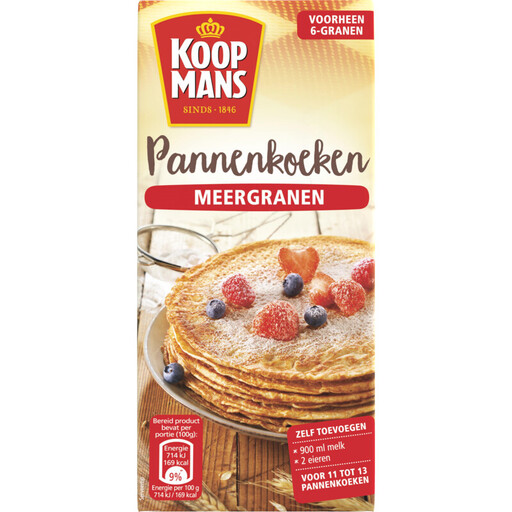
Koopmans Wholegrains Pancake Mix 400 g
This 400 g pack is an option if you’re cooking for a larger group in separate rounds. Before deciding how many packs to buy, check the yield, the ingredients you need to add and the allergens listed on the pack.
View at Joybuy
No image available
Koopmans Original Pancake Mix 400 g
This 400 g pack is a good fit if you’re planning several rounds of cooking. Joybuy gives an approximate yield of 11 to 13 pancakes per pack for this Original mix; before you start, also check the preparation instructions and current label.
View at Joybuy
Frequently asked questions
How many 400 g packs do I need for a large group?
Divide the number of pancakes you want by the stated yield of your chosen mix, and allow for differences in size. Albert Heijn gives an approximate yield of 10 pancakes for 400 g of Koopmans Compleet and around 12 for 400 g of AH Naturel, so don’t assume every mix has the same yield.
Is a complete mix more convenient if I’m making lots of pancakes?
A complete mix can make preparation easier if you don’t want to add milk and eggs separately. According to Albert Heijn, Koopmans Compleet requires water, while AH Naturel is normally prepared with milk and eggs. Check the label for both varieties if allergies or dietary requirements are a consideration.
How should I store mix left over in a large bag?
Store opened pancake mix in a cool, dry, dark place in a tightly sealed container, as recommended by the Voedingscentrum. Also check the storage advice and best-before date on the pack.
Can I use regular pancake mix if someone with coeliac disease is eating with us?
For that guest, only choose a mix whose current label confirms it meets the required gluten-free standard, and prevent contact with gluten during preparation. The Voedingscentrum points out that even small amounts of gluten from other products can cause symptoms in people with coeliac disease.
When do I need to provide allergen information at an event?
If you’re a business or caterer offering non-prepacked pancakes to consumers, information about any allergens must be available before purchase. The Netherlands Food and Consumer Product Safety Authority says this information requirement also applies to catering; include both the batter and toppings in your records.


