
Holidaymakers with limited supplies
If milk and eggs aren’t on your shopping list, look for a complete mix that, according to the instructions, only needs water added to the batter. Also check what you’ll need to cook the pancakes.


For your holiday cottage, choose a complete pancake mix if you don’t want to bring milk and eggs, but check whether you’ll need cooking fat as well as water. If you already have milk and eggs, a plain mix gives you a base for sweet and savoury toppings; a shaker bottle may suit a smaller batch. If you prefer wholemeal or need to avoid allergens, always check the labelling and ingredients on the pack you choose.
If milk and eggs aren’t on your shopping list, look for a complete mix that, according to the instructions, only needs water added to the batter. Also check what you’ll need to cook the pancakes.
A plain mix lets you choose a topping for each pancake, from syrup or apple to cheese or bacon. Before buying, check how many pancakes the pack makes and which ingredients you’ll need to add yourself.
First decide whether you’re looking for a product explicitly labelled wholemeal or need to avoid a particular ingredient or allergen. Multigrain, buckwheat and gluten-free don’t mean the same thing; read the labelling, ingredients and allergen information on the pack you choose.
Start with what’s available at your holiday cottage: a complete mix means fewer fresh ingredients to add, while a plain mix needs milk and eggs. Then compare the yield with the size of your group and check for any grain or allergen requirements.
| What to consider | What to check before buying | Who it matters to |
|---|---|---|
| Fewer extra ingredients | Check what you need to add to the batter and whether you’ll need cooking fat. | If the cupboard is nearly bare, I don’t want to buy milk and eggs just for one batch. Around 40% of consumers prioritise keeping extra ingredients to a minimum. |
| One base for different toppings | Choose a plain or original version and compare the stated yield with the number of people you’re catering for. | When one person wants something sweet and another wants something savoury, I look for a batter that I can top differently for each pancake. This flexibility is the main concern for around 30% of consumers. |
| Grain preferences | Check whether it explicitly says ‘wholemeal’; for multigrain or buckwheat mixes, also read the ingredients and preparation instructions. | If I’m choosing a wholemeal product or a particular type of grain, I want to know what’s actually in the mix. This grain preference is a priority for around 20% of consumers. |
| Allergen or gluten-free requirements | Check the current ingredients, allergen and ‘may contain’ information; look for an explicit gluten-free label if needed. | If someone at the table needs to avoid an allergen, the packaging will show whether the mix meets that requirement, whatever the preparation benefits. This is the main purchasing concern for around 10% of consumers. |
With the complete mixes described here, you add water to the batter, but you’ll still need a pan and cooking fat to make the pancakes.
Read the instructions before you set off and check what equipment and ingredients are available at your holiday cottage.
The name ‘multigrain’ doesn’t tell you whether all the grains used are wholemeal. According to the Netherlands Nutrition Centre, a product can only be called wholemeal if it’s made from 100% wholemeal flour.
If wholemeal is one of your criteria, look for an explicit wholemeal label and also read the ingredients and nutritional information.
A mix labelled gluten-free may contain other allergens. The name buckwheat or multigrain doesn’t, on its own, tell you whether a product is suitable for someone who needs to avoid gluten.
Check the current packaging for both the gluten-free label and the ingredients, highlighted allergens and any ‘may contain’ warnings.
Koopmans states that its Schudfles Pannenkoeken Origineel makes around 5 pancakes, compared with 11 to 13 for Pannenkoeken Origineel in a pack.
Compare the stated yield of the specific version with the number of people and how many pancakes you want to make.
You may need several bottles for a larger group.
Koopmans offers the options discussed here: a classic mix in a pack, a complete mix in a pack and a shaker bottle.
Albert Heijn’s category listing includes complete, multigrain and spelt mixes, as well as products from other brands.
Jumbo has the own-brand Naturel and Compleet versions, both in 400 g packs, which were reviewed for this article.
PLUS has reviewed plain and complete pancake mixes in 400 g packs, as well as a 200 g plain shaker bottle.
Albona is the ALDI own brand behind the 400 g multigrain pancake mix described here.
Belbake is the Lidl own brand behind the 400 g original pancake mix described here.
These products show four options for your holiday cottage: a complete shaker bottle to which you add water, a shaker bottle that needs milk, a mix containing several grains and a classic mix in a pack. Above all, compare the additions required and the stated yield for the specific pack.
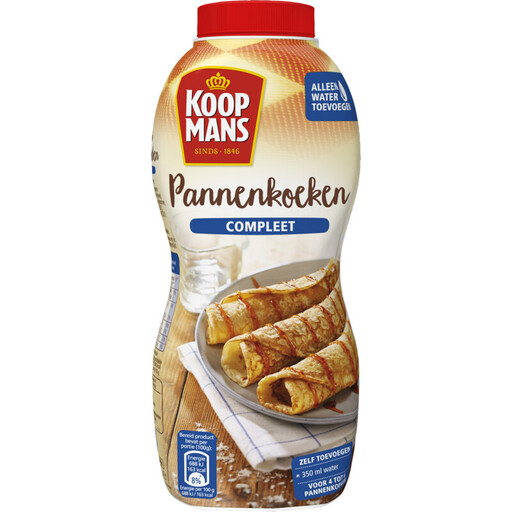 No image available
For a small batch when you don’t want to add milk or eggs to the batter.
According to the product information, add 350 ml of water; the shaker bottle makes 4 to 6 pancakes. Check that this is enough for your group and read the label for allergen information.
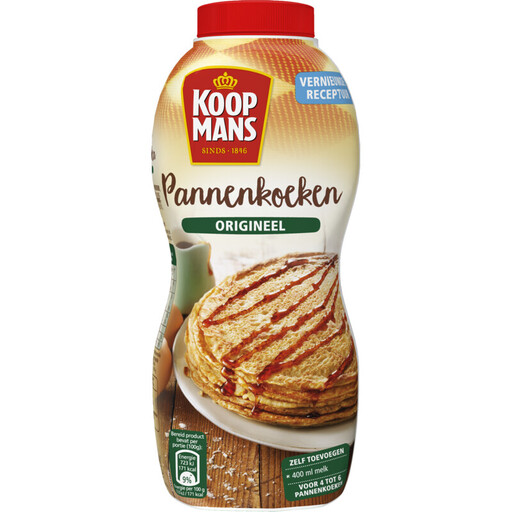 No image available
For a small batch when you have milk available and want to mix the batter in the bottle.
According to the product information, add 400 ml of milk; the bottle makes 4 to 6 pancakes. Check the current packaging for allergen information.
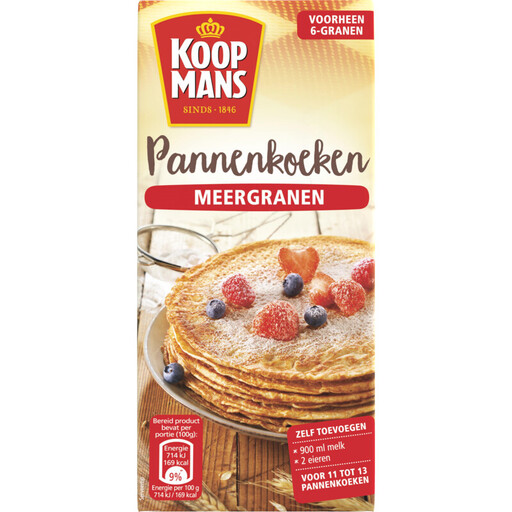 No image available
For anyone looking for a mix containing different types of grain and able to add milk and eggs.
According to the product information, you’ll need 900 ml of milk, 2 eggs and cooking fat or oil; the stated yield is 11 to 13 pancakes. The name Wholegrains doesn’t make this a fully wholemeal mix. Read the ingredients and allergen information on the pack.
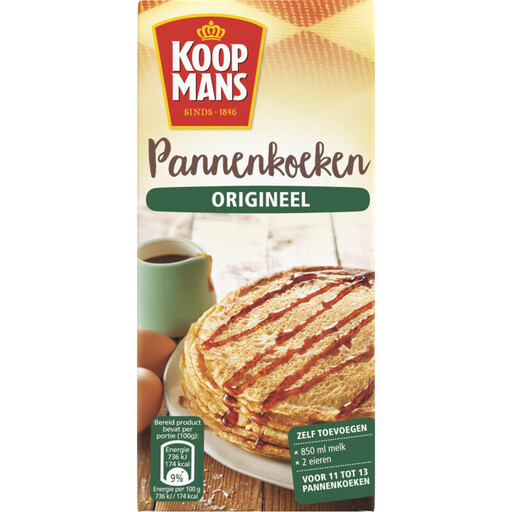 No image available
For a larger batch when you already have milk and eggs and want to choose a different topping for each pancake.
According to the product information, add 850 ml of milk, 2 eggs and butter or oil; the stated yield is 11 to 13 pancakes. Check the current packaging for allergen information.
Choose a version whose instructions say that you only need to add water to the batter. Koopmans says this applies to Pannenkoeken Compleet; PLUS Complete also needs cooking butter or oil. Check whether there’s a suitable pan too.
No, ‘multigrain’ doesn’t automatically mean a mix is entirely wholemeal. According to the Netherlands Nutrition Centre, a product can only be called wholemeal if it’s made from 100% wholemeal flour, so check the explicit labelling and the ingredients in the mix you choose.
Don’t assume so: if someone needs to eat gluten-free, choose a product with an explicit gluten-free label on the current packaging. Also check the other ingredients and allergens, as gluten-free doesn’t mean free from milk or egg, for example.
Follow the instructions for the bottle you’ve chosen. PLUS says that batter from its plain shaker bottle must be used straight away after mixing with milk and must not be stored.