
Family cook making lots of pancakes at once
You want to work out in advance how many packs you need and which ingredients to buy. For the mixes we looked at, Koopmans and Lidl state the yield per pack, which gives you a useful starting point.


For a large family, choose pancake mix based on the stated yield per pack and what else you need to add, not the word ‘premium’. With the complete mixes we looked at, you only need to add water to make the batter; wholemeal flour and an organic certification are other features you might want to look for. If you have dietary requirements or allergies, always check the label on the exact variant.
You want to work out in advance how many packs you need and which ingredients to buy. For the mixes we looked at, Koopmans and Lidl state the yield per pack, which gives you a useful starting point.
You want to make batter without having to add milk and eggs separately. The complete mixes from Koopmans and PLUS that we looked at use water to make the batter; you’ll still need butter or oil for frying.
You might be comparing wholemeal flour, an organic certification or a gluten-free variant. Also check the ingredients and allergen information on the pack you buy: these vary between mixes and may include milk, egg or a ‘may contain’ statement.
First, decide how many pancakes you want to make. Then compare the extra ingredients needed for each pack and the ingredients that matter to your household.
| What to consider | What to check when buying | Who it matters most to |
|---|---|---|
| Yield per pack | Compare the stated number of pancakes and work out how many packs you need. | If I’m cooking for lots of people, I want to know in advance whether I’ve got enough mix in the cupboard. Yield is the top priority for around 36% of consumers. |
| Preparation | Check whether you need to add water, or milk and eggs as well, to make the batter; remember to allow for cooking fat. | When things are busy, I want to be able to make batter with as few extra ingredients as possible. Simple preparation is the main priority for around 29% of consumers. |
| Grain choice | Check whether the variant states that it contains wholemeal flour or carries an organic certification; compare nutritional values on the same basis, such as per 100 g of prepared product. | I want to base my choice on a stated ingredient or certification, not the word ‘premium’. Grain choice matters most to around 21% of consumers. |
| Diet and allergens | Check the ingredients and ‘contains’ and ‘may contain’ statements on the exact pack; also check what you’ll be adding yourself. | If I have dietary requirements or allergies, I want to know what’s in the mix and the finished batter. This check is the top priority for around 14% of consumers. |
The word doesn’t tell you how many pancakes a pack makes, whether the mix contains wholemeal flour or how to prepare the batter.
Decide which feature matters for your family meal, then compare the relevant information on the packs.
In the examples we looked at, PLUS Naturel requires milk and eggs, while PLUS Complete is made up with water, according to PLUS. This affects your shopping list, even though both packs contain 400 g.
Read the preparation instructions and check the yield for each variant before deciding how many packs to buy.
The Koopmans Glutenvrij mix we looked at is sold as gluten-free, but the product information states that it may contain egg and milk.
Check the current allergen information on the exact pack you’re buying, along with the ingredients you’ll add to the batter.
Compare variants within each brand individually: the yield, preparation and ingredients of one mix don’t necessarily apply to another.
Koopmans offers, among other options, a classic mix, a complete mix and an organic multigrain mix.
The AH wholemeal mix we looked at is an option to compare based on its stated ingredients and nutritional value.
The PLUS Naturel and Complete mixes we looked at show why the preparation instructions matter for each variant.
ALDI lists a 400 g Albona multigrain baking mix for pancakes.
Lidl lists a 400 g pack of Belbake Pannenkoekenmix origineel.
These two 400 g Koopmans mixes are worth considering if you want to compare a Wholegrains variant with a classic Original variant for a family meal. To work out how much you need, always check the yield and preparation instructions on the pack.
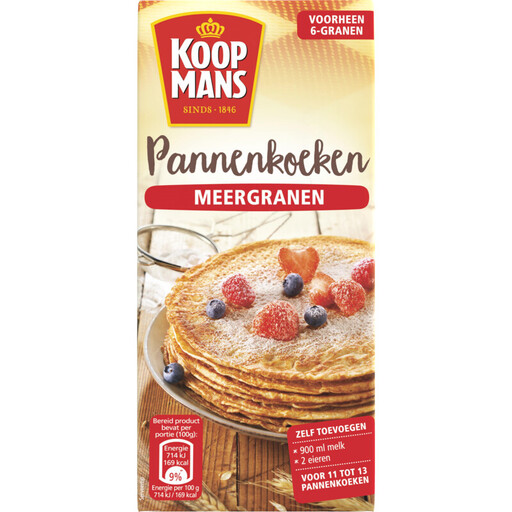 Image unavailable
If you want to take grain choice into account when planning a family meal, this Wholegrains variant is one to compare on the label.
Pack size: 400 g. Check the yield, preparation instructions and ingredients on the pack before deciding how much you need.
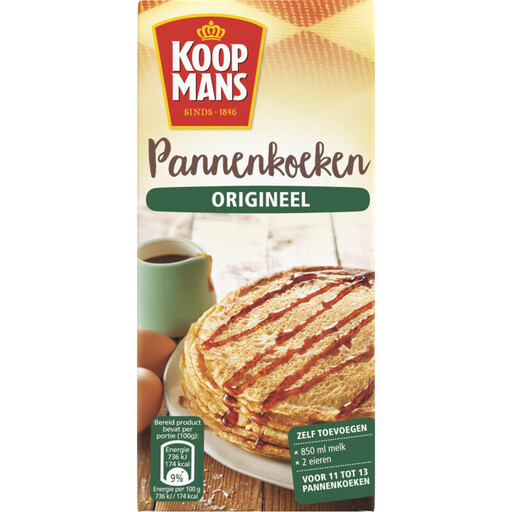 Image unavailable
This classic mix is a good choice when planning a big stack of pancakes and you want to add the batter ingredients yourself.
Pack size: 400 g. Koopmans states that Pannenkoeken Origineel makes 11–13 pancakes per pack; check the preparation instructions on the variant you buy to see what else you need to add.
Divide the number of pancakes you want to make by the stated yield per pack, then round up to the next whole pack. Koopmans states that Compleet makes 8–10 pancakes and the organic multigrain mix makes 13–15 per pack, so the yield of the mix you choose will determine how many packs you need.
Choose a complete mix if you want to make the batter with water instead of adding milk and eggs yourself. The complete variants from Koopmans and PLUS that we looked at call for 700 ml of water, but check their allergen information too, and have butter or oil to hand for frying.
No. Wholemeal and organic describe different product features and don’t, by themselves, tell you anything about the yield or how easy the mix is to prepare. Think about which feature you’re looking for, check it on the pack and only compare nutritional values on the same basis, such as per 100 g of prepared product.
Read the ingredients and allergen information on the pack of the exact mix, and check what you’ll be adding yourself too. According to the Netherlands Food and Consumer Product Safety Authority, allergens must be listed in the ingredients; a gluten-free mix may still contain egg or milk, or carry a ‘may contain’ statement.