
Planner of a shared canteen lunch
You want to match the number of packs to the expected turnout, while also allowing for the ingredients and time needed to cook the pancakes.


If you’re planning pancakes for a shared canteen lunch, start by checking how many pancakes each pack makes and what you have available to prepare them. A standard mix usually needs several additional ingredients; a complete mix that only needs water makes preparing the batter easier, but you’ll still need to cook the pancakes. If you need a gluten-free option, choose a mix explicitly labelled gluten-free, and check the other allergens and how the pancakes will be served.
You want to match the number of packs to the expected turnout, while also allowing for the ingredients and time needed to cook the pancakes.
You’re looking for a batter that doesn’t require you to measure out or store milk and eggs separately. A mix that only needs water can be a practical option.
You need to check which allergens are present in each mix and topping, and make that information available to guests when serving unpackaged food. A gluten-free label doesn’t tell you everything about egg or milk.
First, decide how many pancakes you want to cook and which ingredients and facilities are available. Then check the allergens for each product you choose, and plan what to do with any leftover mix or pancakes.
| What to consider | What to check before buying | Who it matters to |
|---|---|---|
| Yield and ingredients | Check how many pancakes each pack makes and read the preparation instructions. Albert Heijn states that Koopmans Original 400 g makes 11–13 pancakes and requires 850 ml of milk and 2 eggs, as well as cooking fat. | When I’m cooking for several colleagues, I want to know how many packs and additional ingredients to have ready. For around 33% of consumers, planning the yield is a priority. |
| Preparation | Check whether the batter needs water, milk or eggs, and whether you have enough time and cooking space. Even a complete mix that only needs water still requires cooking fat or oil. | With little space to store and measure ingredients, I want to make the batter using as few separate products as possible; around 27% of consumers prioritise this when preparing. |
| Dietary requirements and allergens | Check the latest allergen information for the mix and toppings. If you choose a gluten-free option, also consider egg, milk and possible cross-contamination during preparation. | When a guest has a dietary requirement or allergen concern, I want to be able to check what’s in the pancakes being served. For around 20% of consumers, this is the most important consideration. |
| Stock and leftovers | Consider how many packs you can store and plan to cook the pancakes in batches. The Netherlands Nutrition Centre advises storing opened mix in a cool, dry, dark place in a tightly sealed container. | For a regular lunch, I want to be able to manage opened packs and leftover cooked pancakes properly; an estimated 20% of consumers prioritise this. |
Needing to add only water doesn’t tell you anything about the allergens in the mix. The complete mixes described list allergens including gluten, egg and milk.
Check the current packaging for the product you’ve chosen before deciding whether it meets a dietary requirement.
According to the Netherlands Food and Consumer Product Safety Authority, businesses offering unpackaged food must inform customers about the allergens it contains. This also includes any toppings and ingredients used in preparation.
Before lunch, record the information for each pancake being served and make sure guests know how to access it.
The Netherlands Nutrition Centre advises not leaving leftovers out of the fridge for more than 2 hours.
Where possible, cook in batches, cool any leftover pancakes quickly and store them in a tightly sealed container.
The Koopmans product ranges described include a standard mix, a complete mix that only needs water, and a gluten-free option. Check which one you choose, as the preparation ingredients differ.
The PLUS 400 g options described let you compare a standard preparation method with a complete mix that only needs water.
ALBONA is ALDI’s own brand, with a plain and a multigrain baking mix described, both in 400 g packs.
Belbake Original is a 400 g Lidl pancake mix described here.
The Albert Heijn own-brand range described includes plain, wholemeal and multigrain mixes in 400 g packs.
These products include dry mixes for a shared lunch and smaller shaker bottles for a short cooking session. Choose the number of packs to suit the stated yield of your chosen variant; a small bottle won’t necessarily replace a larger pack.
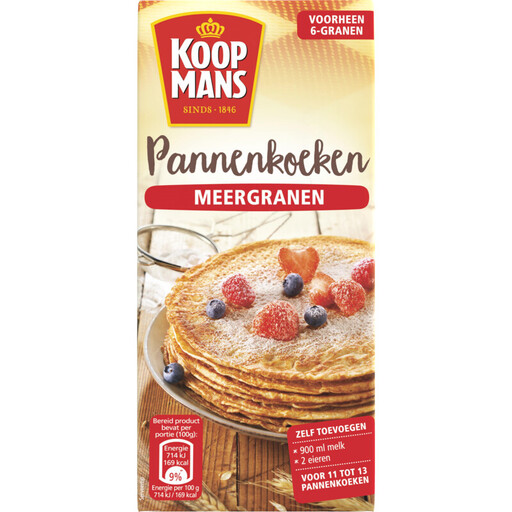 Image unavailable
A 400 g dry mix for anyone planning a shared lunch. Before cooking, check which ingredients you’ll need and the latest allergen information for the mix and toppings.
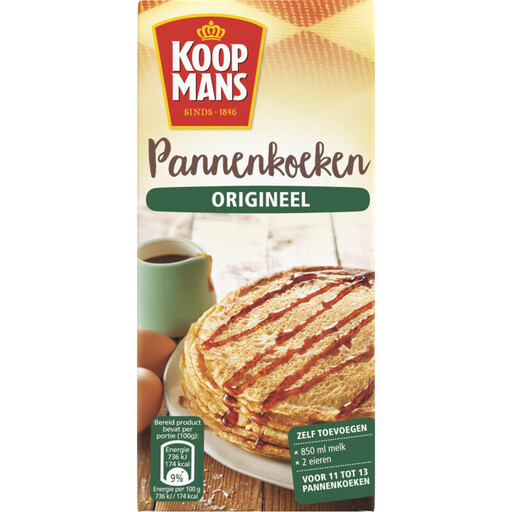 Image unavailable
For a shared lunch where you want to plan how many pancakes each pack will make. Joybuy’s product information says that the 400 g pack makes 11–13 pancakes and requires 850 ml of milk, 2 eggs and butter or oil; also check the latest allergen information.
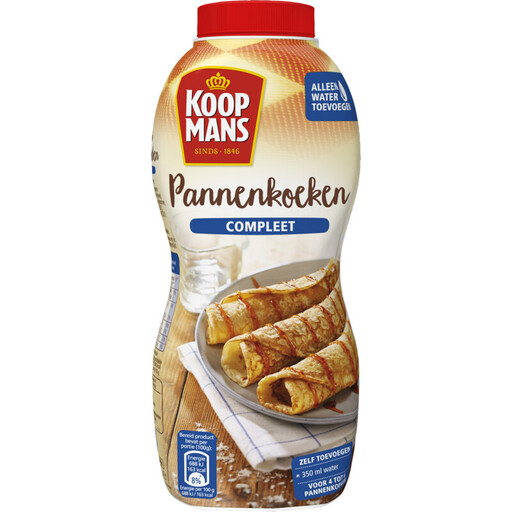 Image unavailable
A complete shaker bottle for a small batch of pancakes. Joybuy says that the 210 g bottle makes 4–6 pancakes and is prepared with 350 ml of water; even though you only need water, check the allergens on the packaging.
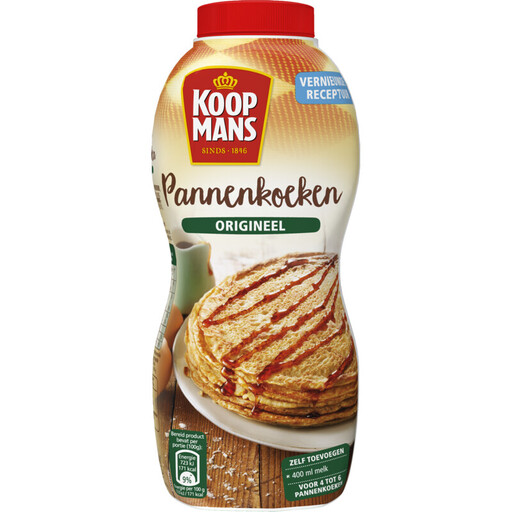 Image unavailable
A 175 g shaker bottle to consider when planning a small batch of pancakes. Check the packaging to see how many pancakes it makes, how much milk you’ll need and which allergens are listed.
Use the yield on the packaging of your chosen mix and the number of pancakes you want to serve as a guide. Albert Heijn says that a pack of Koopmans Original 400 g makes 11–13 pancakes; you’ll also need 850 ml of milk, 2 eggs and cooking fat.
A complete mix that only needs water is practical if you don’t want to buy and measure out separate milk and eggs for the batter. The complete Koopmans and PLUS mixes described are made with water, but you’ll still need cooking fat or oil, pans and time to cook the pancakes.
A gluten-free label doesn’t tell you that. According to the product information, the Koopmans Gluten Free mix described may contain egg and milk, and it needs milk and eggs for preparation. Check the current packaging, toppings and preparation method separately.
When serving unpackaged pancakes to customers or guests, a canteen must provide information about the allergens they contain, according to the Netherlands Food and Consumer Product Safety Authority. Make sure the information covers the ingredients used for preparation and any toppings, and that guests know how to ask for it.
Store opened pancake mix in a cool, dry, dark place in a tightly sealed container. The Netherlands Nutrition Centre advises not leaving cooked leftovers out of the fridge for more than 2 hours; its Storage Guide says cooked pancakes can be kept in the fridge for 2 days.