
Vandaag of morgen in huis

Kwaliteit gegarandeerd

Welkomstaanbiedingen ontgrendelen: GRATIS bezorging | Tot 80% korting | Gratis 30 dagen JoyPlus-proefperiode
Download de app
A Pampers monthly nappy box may seem like a straightforward purchase: choose a size, order a large box and you’ll have enough in stock for a while. However, choosing the wrong option can quickly become expensive. Babies sometimes outgrow a size within a few weeks, and not every nappy fits every body shape in the same way. Brands also regularly make broad claims about dryness, comfort and leak protection. So focus mainly on verifiable details such as size, quantity, fastening, certification and material information.
A box containing lots of Pampers nappies may seem like good value, but the number of items means little without knowing the price per nappy. A monthly box with 240 nappies may be appealing for a smaller size, while larger sizes often contain fewer nappies per box. So calculate:
total price ÷ number of nappies = price per nappy
Also consider usage. A newborn will generally use more nappies per day than a toddler who is beginning to make progress with potty training.
Age indications are only a guideline. Your child’s weight and the fit around their tummy, back and legs are more important. A nappy that is too small may feel tight and leak more quickly. A nappy that is too loose will not fit as securely.
Always check the size indication on the packaging. Pampers offers nappies from size 1 to size 8, but the applicable weight range varies between product lines. After putting the nappy on, check for red marks, gaps around the legs or a sagging middle section.
Pampers nappy pants are practical for active babies and toddlers who move around a lot. You pull them on like underwear and tear open the sides when changing them. For a newborn or a child who spends most of their time lying down, traditional nappies with adhesive tabs may be easier.
So choose based on mobility and where you will be changing your child, rather than on the product name alone.
Compare your child’s weight with the size chart for the specific product. Also look for:
A good fit reduces the risk of leaks, but no nappy can guarantee a leak-free night in all circumstances.
Product descriptions often mention a super-absorbent core, an extra absorbent layer or a Stop & Protect pocket at the back. According to Pampers’ product information, these features are designed to absorb moisture and help reduce leaks around the back or legs.
Treat “up to 12 hours’ protection” as a product claim made by the brand, not as a fixed usage time for every baby. Change a nappy when it is wet or soiled and follow the instructions on the packaging.
For parents who pay close attention to material information, terms such as dermatologically tested and OEKO-TEX Standard 100 are relevant. These statements describe a test or certification; they do not mean that every skin reaction is ruled out.
The supplied product information lists the following for various Pampers lines:
Always check the label when your order arrives. Ingredients, certification information and packaging details may vary by size or product variant.

Why it suits this profile: A large supply of 222 nappies can be useful when you are buying a frequently used size and want to compare the price per nappy. The traditional adhesive fastening is suitable for everyday changes.
The size and fixed quantity are clearly stated. However, check your child’s current weight before ordering a large box.
222 nappies, an extra absorbent layer according to the product description, elasticated sides and an OEKO-TEX Standard 100 listing.
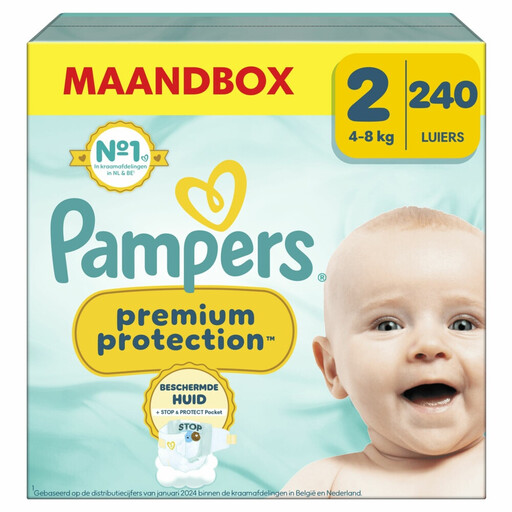
Why it suits this profile: This version is designed for the early months, with soft materials, an umbilical-friendly notch and a product description that mentions rapid absorption.
You are not simply paying for a large box: the product information lists specific features such as micropores, a Stop & Protect pocket and OEKO-TEX certification.
240 nappies, no EU fragrance allergens according to the product information, dermatologically tested and fitted with an umbilical-friendly notch.

Why it suits this profile: For children who crawl, walk or are difficult to change. The pants have a 360° flexible waistband and can be pulled on in one movement.
You are deliberately choosing pants instead of an adhesive nappy. The sides can be torn open, making changes easier when you are out and about.
160 pants, protective leg cuffs, an absorbent core and OEKO-TEX Standard 100 certification according to the product information.
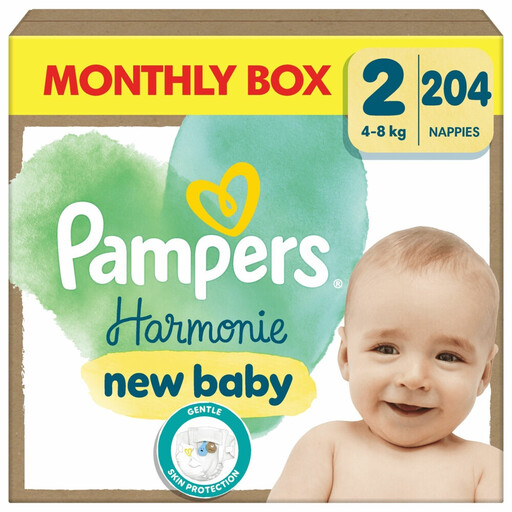
Why it suits this profile: The product description states 0% perfume and lotion, hypoallergenic properties and a wetness indicator. This can be useful if you carefully compare labels and material choices.
The relevant features are described clearly. Even so, check the packaging if your child has previously reacted to certain materials.
204 nappies, 0% perfume and lotion according to the product information, a Stop & Protect pocket and OEKO-TEX certification.
We’ve put together a complete, up-to-date list of products that fully meet these strict selection criteria and the applicable European safety regulations.
Store a monthly box in a dry, clean place, out of children’s reach. When it is delivered, check that the box is undamaged and read the usage and disposal instructions on the packaging. Nappies are disposable products; put used nappies in a suitable bin.
Do not automatically order several boxes in a new size. If you are unsure, buy a smaller pack first or compare it with a size you already know. A supply that turns out to be too small can lead to extra costs and possible leaks. Also check the expiry date or any other date information on the packaging.
This varies by size and product line. The range includes boxes with, for example, 152, 174, 204, 222 or 240 nappies. Nappy pants often contain a different quantity, such as 160 items in size 5. So always compare the total number of items and the price per nappy.
For active children, Pampers Baby-Dry Pants can be practical thanks to their elasticated waistband and pull-on design. A traditional Pampers Baby-Dry nappy with adhesive tabs may be more convenient for a child who still spends a lot of time lying down. The fit and size remain decisive.
Change a nappy when it is wet or soiled and follow the manufacturer’s instructions. A statement such as “up to 12 hours” in a product description is a claim about maximum protection in certain conditions, not a fixed rule for every child. Check your child’s skin regularly and stop using the product if irritation occurs.
