
Vandaag of morgen in huis

Kwaliteit gegarandeerd

Welkomstaanbiedingen ontgrendelen: GRATIS bezorging | Tot 80% korting | Gratis 30 dagen JoyPlus-proefperiode
Download de app
A Pampers monthly nappy pack seems straightforward: choose a size, order a multipack and you’ll have a supply to hand for a while. Yet parents often buy too many nappies in the wrong size, overlook the type of nappy or compare only the price of the pack. This can make a month’s supply less cost-effective than expected, especially for babies who grow quickly.
This practical guide will help you know what to look for when choosing Pampers nappies, nappy pants and baby wipes.
A box of 240 nappies may look appealing, but the number alone doesn’t tell you much unless you also consider the size and how you’ll use them. A newborn usually needs more nappies per day than a toddler. Your child may also move from size 2 to size 3 during the month.
So always check:
A monthly pack won’t necessarily last exactly one month.
Terms such as hypoallergenic, dermatologically tested and fragrance-free only tell you so much, so check the full product information. According to the product descriptions, some Pampers varieties contain no EU fragrance allergens, while others are described as scented.
If your baby has sensitive skin, it’s worth checking for:
A dermatologically tested nappy won’t automatically prevent skin irritation in every child. Stop using it if redness or irritation occurs, and follow the instructions on the pack.
Nappies with fastening tabs are often practical for young babies. Pampers nappy pants can be easier to put on an active child. So your choice depends not only on age, but also on how much your child moves, how you change them and how the nappy fits.
Pampers nappies are available in various sizes, including size 2, size 3, size 4, size 5, size 6 and size 7. Some product ranges also offer larger sizes, such as size 8 in nappy pants.
A good fit means:
Leaks aren’t always caused by a lack of absorbency. A nappy that’s too big or too small, leg cuffs that haven’t been positioned properly and infrequent changing can all play a part.
According to the product descriptions, many Pampers Baby-Dry nappies and Pampers Premium Protection nappies have an absorbent core and a Stop & Protect Pocket at the back. Baby-Dry Pants are also described as having a flexible waistband and protective leg cuffs.
In particular, consider the difference between:
Claims such as “up to 12 hours of protection” come from the brand’s product information. Don’t treat this as a set changing interval: change a nappy when it’s soiled or when the instructions say it’s time to do so.
When buying a bulk pack of baby nappies, it’s important to look beyond the price per nappy. Check the product features too. The product information provided mentions OEKO-TEX Standard 100, dermatological testing and the absence of EU fragrance allergens for various Pampers products.
These labels describe specific features or checks; they don’t guarantee that every baby will react in the same way. Store unopened packs in a cool, dry place, and keep plastic packaging out of children’s reach.

Why it suits this need: A large box of 198 nappies for families who want to stock up and already know that size 4+ is a good fit.
The number of nappies is clearly stated. Check your child’s weight first, though, so the large pack doesn’t go unused.
198 disposable nappies, an extra absorbent layer according to the product description, and a Stop & Protect Pocket.

Why it suits this need: A good choice for parents who value soft materials, a good fit and features designed with sensitive baby skin in mind.
The product description mentions no EU fragrance allergens, dermatological testing and OEKO-TEX certification. Always check the current packaging.
204 size 3 nappies, soft outer materials and an umbilical cord cut-out, according to the product information.
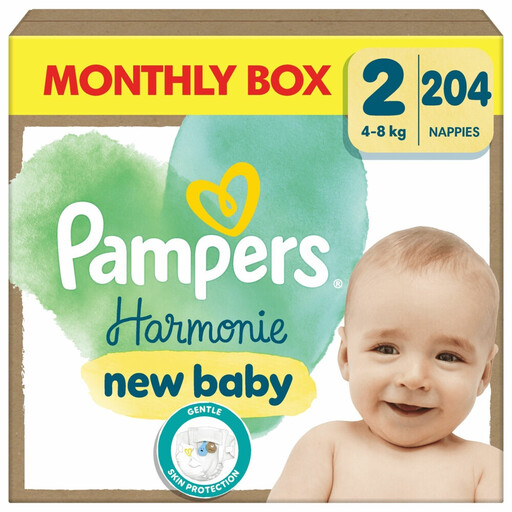
Why it suits this need: An option for parents of a small baby who look for fragrance-free materials, a wetness indicator and a generous monthly supply.
The product description states that it contains 0% perfume and lotion. If you’re not sure how your baby will react, try a smaller pack first.
204 nappies, a wetness indicator and cellulose from FSC-certified forests managed responsibly, along with other controlled sources, according to the product description.
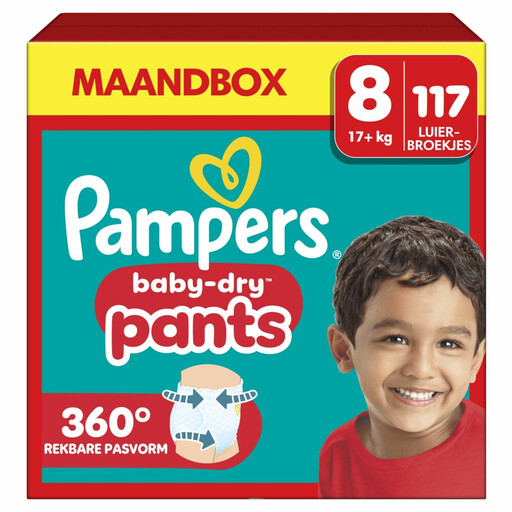
Why it suits this need: Nappy pants are practical for a child who moves around a lot, stands up or wants to help when it’s time for a change.
The stretchy waistband and tear-away sides make them easier to put on and take off than nappies with separate fastening tabs.
117 size 8 pants, a 360° flexible waistband and 0% EU fragrance allergens, according to the product description.
If you’re ordering a monthly supply of nappies, you can add baby wipes too. Check the differences between Pampers Fresh Clean, Pampers Sensitive and Pampers 99% Water baby wipes.
Seal the pack carefully after use to help prevent the wipes from drying out. Use wipes externally only, don’t flush them down the toilet, and stop using them if irritation occurs.
We’ve put together a complete, up-to-date list of products that meet these strict selection criteria and the applicable European safety regulations.
That depends on your child’s age, how often you change them each day and how many nappies are in the box. Divide the number of nappies by your average daily use. Allow for growth spurts and the possibility that your child may need a different size before you’ve used up the pack.
Use your child’s weight as a starting point, then check the fit. Pampers sizes 2 and 3 are often suitable for younger babies, while sizes 4 to 7 are widely used as children grow. Size 8 is available in Baby-Dry Pants in the range provided.
Not necessarily. Compare the price per nappy, the pack size and how easy they are to use. Nappy pants can be particularly practical for active children, while standard nappies with fastening tabs can sometimes be easier when changing a child lying down.
