
Vandaag of morgen in huis

Kwaliteit gegarandeerd

Welkomstaanbiedingen ontgrendelen: GRATIS bezorging | Tot 80% korting | Gratis 30 dagen JoyPlus-proefperiode
Download de app
A Pampers monthly nappy box is a practical choice for families who use several nappies every day. You’ll need fewer individual packs and can easily compare the price per nappy. However, a larger pack isn’t automatically better value. The wrong size, a poor fit or a product range that doesn’t suit your needs can all lead to waste.
In this buying guide, you’ll find out what to look for in Pampers Baby-Dry nappies, Pampers Premium Protection nappies, Pampers Harmonie nappies and Pampers nappy pants.
A monthly box with lots of nappies might seem appealing, but how long it lasts depends on your child’s age and how often you change them. A newborn typically uses more nappies a day than a toddler. So work out the price per nappy rather than looking only at the total price.
Also consider when your baby might move up a size. If you buy several boxes in the same size, your baby could outgrow them sooner than you expect.
Size numbers are only a starting point. Always check the weight range on the pack and make sure the nappy fits snugly around the legs and waist. A nappy that’s too small can dig in; one that’s too large can leave gaps and let moisture leak out.
This applies to Pampers size 1, size 2, size 3, size 4, size 5+ and Pampers size 6 or size 8 nappies too. The exact fit also varies between product ranges.
Terms such as ‘leak-proof nappies’ and ‘12-hour protection’ usually describe the manufacturer’s claims under certain conditions. According to Pampers product descriptions, various models have absorbent cores and leak guards that are designed to provide up to 12 hours of protection. This isn’t a guarantee for every child, body shape or changing routine.
Nappies still need to be checked and changed regularly. If your baby has soiled their nappy or it’s full, you shouldn’t wait longer to change it.
Use your baby’s weight as a starting point, then check how the nappy fits in practice:
A navel-friendly cut-out can be useful for newborns. According to the product description, Pampers Premium Protection nappies in sizes 1, 2 and 3 have this feature. For active babies, Pampers Baby-Dry Pants in size 4, 6 or 8 may be more convenient than a traditional nappy with fastening tabs.
A standard nappy is often practical when changing your baby on a changing table. Nappy pants can be pulled on in one go and are especially handy when your child is very wriggly or already standing.
According to the product information, Pampers Baby-Dry Pants have a 360° flexible waistband, wider leak guards and a fastening strip for disposing of the rolled-up pants. The sides can be torn open when changing. Make sure your child is within the stated size range.
Parents looking for nappies for sensitive baby skin often check for perfume, lotion and skin testing. Look for verifiable information on the pack, such as:
‘Hypoallergenic’ doesn’t mean that every skin reaction is ruled out. Stop using the product if irritation occurs and follow the instructions on the pack. If symptoms persist, contact a healthcare professional.

Why it suits this profile: A large pack for families who want to stock up and compare the price per nappy.
The size information and pack of 198 nappies make it easy to assess how much stock you’ll have and the price per nappy. Check the weight range before buying.
According to the product description: an extra absorbent layer, a Stop & Protect pocket and stretchy sides.

Why it suits this profile: Designed for parents of newborns who pay extra attention to soft materials, fit and the product information available.
The navel-friendly cut-out is useful in the early weeks. You’ll still need to choose a size that suits your baby’s weight and build.
According to Pampers: more than 1,000 absorbent micropores, soft materials, dermatologically tested and OEKO-TEX certified.
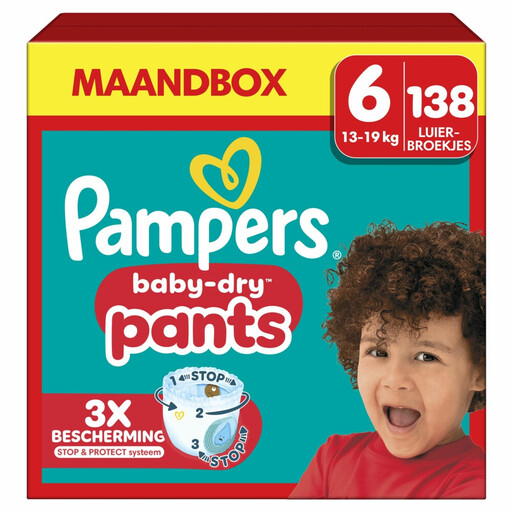
Why it suits this profile: A good choice for active babies and toddlers who’ll benefit from pants that are quick to pull on.
The flexible waistband and leak guards are designed to move with your child. Check that the pants aren’t too loose around the legs.
According to the product description: a 360° flexible waistband, Stop & Protect system and up to 12 hours of protection, according to the manufacturer.
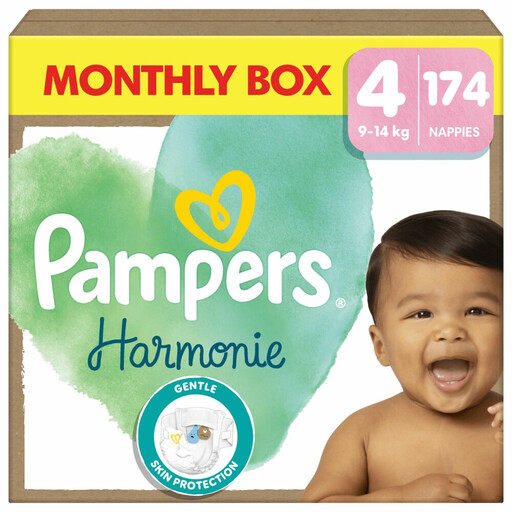
Why it suits this profile: An option for parents who look for perfume-free materials and information about the absorbent core.
The product description states that the nappies contain 0% perfume and lotion and have a wetness indicator. This makes it easy to check the product’s features before buying.
According to Pampers: hypoallergenic, dermatologically tested, OEKO-TEX Standard 100 certified and made with cellulose from FSC-certified sources.
It depends on your child’s age, how often you change them and the size you choose. A monthly box is best if you already know the size you need. For a newborn, it may be wiser to order a smaller pack, as size 1 or size 2 can be replaced by a larger size relatively quickly.
For older children, you can choose from Pampers Baby-Dry nappies in sizes 4, 5+ and 6, or Pampers Baby-Dry Pants in sizes 4, 6 and 8. Compare not only the number of nappies, but also the price per nappy, the fastening style and how much storage space you have at home.
We’ve put together a complete, up-to-date list of products that meet these strict selection criteria and the applicable European safety regulations.
It varies depending on your child’s age and how many changes they need each day. Divide the number of nappies in the box by your average daily usage. Also check regularly that the size still fits well.
Not always. Work out the price per nappy and check that the pack contains the same size and product range you usually use. A cheaper box that doesn’t fit will ultimately lead to more waste.
Store unopened nappies somewhere dry and clean, and out of children’s reach. Check the pack before use and follow the storage, shelf-life and safety information on the label.
