Who is this choice relevant to?

Artists with bound sketchbooks

If you want to capture pages without forcing a stiff binding flat, consider book support, the scanning area and the results near the spine. CZUR and Ricoh describe book-scanning features; check what the scans look like with your own work.

Artists creating detailed drawings

If you want to assess fine lines and differences in colour, it’s worth testing a scan of your own work. Canon, Epson and IRIS publish product specifications, but these aren’t a comparative test of colour reproduction.

People using a shared desk

If you need to put away the scanner and drawings regularly, measure the space you’ll need for scanning and storage in advance. Also check whether you can use the required software on the computer at the shared desk.

What should you look for when choosing?

Overhead scanner with book correction

Suitable for: a bound sketchbook you want to scan from above without pressing it against a glass plate.

Bear in mind: the open book must fit within the scanning area and setup. Check with your own work whether the correction reproduces lines and colours as you’d like.

A4 flatbed scanner

Suitable for: loose drawings or sketchbooks that can lie sufficiently flat, with the area you want to scan fitting within A4.

Bear in mind: an original larger than A4 won’t fit in a single scan; check for yourself whether a bound book can lie flat enough.

Flatbed scanner with book-edge design

Suitable for: loose pages close to the spine, if you want to use a flatbed scanner.

Bear in mind: the stated scanning area of the Plustek OpticBook 4800 is A4; also check the exact model and software.

Foldable overhead scanner

Suitable for: mainly loose, flat drawings up to A3, when you need to put the scanner away after use.

Bear in mind: a foldable design doesn’t eliminate the need for space while scanning, and doesn’t prove that the scanner is suitable for a thick, bound book.

What to consider What should you check? Who should consider this?
Binding and book pages Compare a test scan near the spine and check whether the open book fits within the scanning area. If I don’t want to press the spine flat, I want to know how the pages and lines near the binding will be captured; around 37% of consumers prioritise preserving the binding.
Lines and colour If possible, test pencil, ink and coloured work, then compare the scan with the original. For fine details, I want to compare the scan with my drawing, because a stated resolution alone doesn’t describe colour reproduction; around 27% of consumers prioritise detail.
Workspace and storage Measure the desk with the book open, and check the connections and software for the shared computer. If the desk needs to be clear again after scanning, I want to consider both the setup and where to store the scanner; around 18% of consumers prioritise a workspace that can be cleared quickly.
Size of the drawing Measure the largest loose sheet and the open book separately, then compare both with the model’s scanning area. If I want to capture larger sketches in a single scan, the maximum size is key; around 18% of consumers prioritise the largest sketch size.

Things to consider before buying

  • Comparing only the size of one closed page

    With an overhead scanner, the area you want to photograph must also fit in the practical setup. The size of a single page doesn’t tell you whether the entire open book can be captured.

    Measure both the page and the open book, and decide which area you want to include in a single scan.

  • Assuming book correction or resolution guarantees an accurate scan

    Manufacturer information describes features and specifications, but doesn’t show how your lines, colours and details will be reproduced.

    If possible, test a representative page with lines, colour and details near the spine.

  • Assuming a foldable device needs little space while scanning

    Even with a foldable overhead scanner, the book needs to fit under the camera while you use it.

    Measure the space you’ll need while scanning separately from the space where you plan to store the device.

  • Assuming the software will work on any shared computer

    Software and support may depend on the exact model code and version.

    Before buying, check the model code, software package and current support for the shared computer’s operating system.

Brands and models to consider

CZUR

According to CZUR, the ET series is designed for books and includes flattening correction; the Shine 800 A3 Pro is positioned for flat sheets and design drawings.

  • CZUR describes the Shine 800 A3 Pro as foldable, with an A3 scanning area for flat sheets.
  • The Shine series’ features don’t prove that this model corrects bound pages in the same way as ET series models.

IRIS

IRIS describes the IRIScan Desk 6 Pro as an A3 document camera for books and documents.

  • IRIS lists automatic flattening and output in JPG and PDF formats.
  • The manufacturer’s information doesn’t prove how the details and colours in your drawing will be reproduced; assess this with a test scan.

Ricoh ScanSnap

Ricoh describes the ScanSnap SV600 as a contactless overhead scanner for books, drawings and documents up to A3, among other things.

  • Ricoh lists book correction and automatic page-turn detection.
  • These features don’t guarantee that every sketch will be captured without distortion.

Plustek

The OpticBook 4800 uses a flatbed design with a book edge for bound material.

  • Plustek lists a 2 mm book edge and an A4 scanning area.
  • Check the version on offer, the software and whether it’s supported by the computer you use.

Canon

The CanoScan LiDE 400 is an A4 flatbed scanner for originals that can be positioned to fit and lie sufficiently flat.

  • Canon lists an optical resolution of 4.800 × 4.800 dpi and a maximum document size of 216 × 297 mm.
  • These specifications don’t mean that a larger or stiffly bound sketchbook will fit on the device.

Epson

The Perfection V39II is an A4 flatbed scanner with an integrated stand.

  • Epson lists USB power and a stand that lets you position the scanner flat or on its side.
  • The stand doesn’t prove that a bound book can be scanned flat or that colours will be reproduced accurately.

Joybuy products for these scanning needs

The models below suit two different types of work: A4 originals for a flatbed scanner, and loose, flat drawings up to A3 for an overhead scanner.
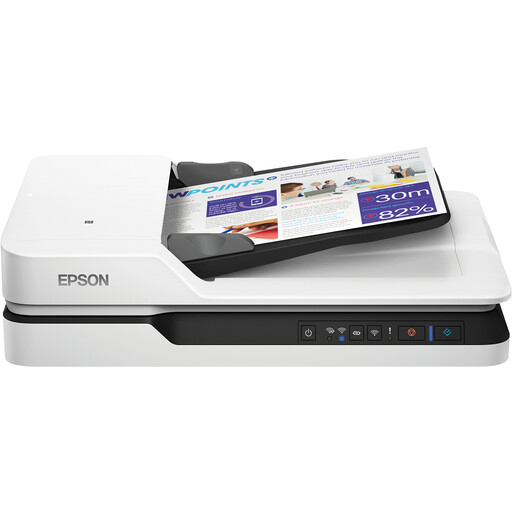
Epson WorkForce DS-1660W A4 flatbed scanner

Epson WorkForce DS-1660W A4 flatbed scanner

An option for loose or sufficiently flat originals up to A4; check for yourself whether a bound sketchbook can lie flat.

The product name specifies A4 and a resolution of 1200 × 1200 dpi. Originals larger than A4 won’t fit in a single scan.

View at Joybuy

CZUR Shine 800 A3 Pro document camera

CZUR Shine 800 A3 Pro document camera

Suitable for loose, flat drawings up to A3 if you want to fold the scanner away and store it after use.

The product name specifies A3 sheets and compatibility with Windows and macOS. CZUR describes this model as foldable; glossy materials aren’t recommended.

View at Joybuy

Frequently asked questions

How can you prevent distorted lines in a bound sketchbook?

An overhead model with book correction can use software to adjust a curved page; CZUR, IRIS and Ricoh list features like these for their book scanners. Check the result with a test page that has straight lines and details near the spine, rather than assuming automatic correction will always be accurate.

What should you check before scanning at a shared desk?

Place the book in the position you plan to use and check that it fits within the scanning area, with enough room for the setup. Also check whether you can install the required software on the computer. If scans contain personal data and an organisation processes that data, it must be properly protected in accordance with the Dutch Data Protection Authority’s guidance.

What are your return rights when buying online in the Netherlands?

According to the Dutch government, when you buy online from a business, you’ll often have 14 days to change your mind, although there are exceptions. Before buying, check who the seller is and which terms and conditions apply to your order.

Can you share scans of someone else’s sketchbook with colleagues or online?

According to the Dutch government, a private copy of copyright-protected work is for personal use and can’t simply be distributed or made public. Permission may be needed to copy and share copyright-protected publications digitally within a business or institution. Don’t assume sharing is allowed just because the scanner is at a shared desk.

When does the GDPR apply to scanned sketchbooks?

If an organisation processes personal data shown in scans, it must protect that data properly in accordance with the Dutch Data Protection Authority’s guidance. The appropriate measures depend on the processing and the risks; using a shared desk doesn’t in itself require a particular scanner setting.
