For a fragile, bound family scrapbook, a contactless overhead scanner is a good choice if you want to capture the pages, photos and captions without pressing the album against a glass plate. A flatbed scanner is mainly an option for loose photos or a page that can safely lie flat without putting strain on the binding. Check the scanning area, reflections on glossy photos and software compatibility; stated features do not prove that old photos will be reproduced faithfully.
Who is this buying guide for?
Family with a fragile scrapbook
You want to capture a whole page of photos and captions without putting strain on brittle pages or an old binding. The Library of Congress points out that albums can be fragile and that careful handling is important when digitising them.
Student creating a visual school project
You need usable images of photos, colours and decorations, and want to match the scanning area and lighting to the album. Manufacturers such as IRIS and Epson describe models for scanning documents and photos; assess the results using your own material.
Student with lots of album pages
You want to process several pages, so you need to consider the capture and software workflow without compromising safe handling of the album. Compare the features of the exact model with the computer you’ll use for your school project.
What should you consider when choosing?
Contactless overhead book scanner
A good fit if: you want to capture a bound page with photos and captions without pressing it against a glass plate.
Bear in mind: the scanning area, book correction and lighting vary by model; test it on an actual album page.
Flatbed scanner
A good fit if: the photos are loose or a page can safely lie flat and fits within the scanning area.
Bear in mind: don’t press a thick or fragile bound album down onto the glass.
Put off scanning
A good fit if: pages are coming loose, the photos look fragile or the binding won’t open safely enough.
Bear in mind: this takes time to prepare, but a school deadline is no reason to force a fragile original.
| What to consider |
What to look for |
Who should pay particular attention? |
| Keeping the album intact |
Check how far the album can safely open and whether the page can be supported without pressure. |
I want to protect the binding and brittle pages while still capturing the whole page. Around 36% of consumers put preserving the album first. |
| Capturing photos and page context |
Compare the scanning area with the largest page, and test glossy photos, handwriting and edges. |
If I need the photos and their position on the page, I first check that nothing is cropped or lost to reflections. Around 29% of consumers prioritise images and page context. |
| Processing pages on time |
Check the controls, any page-turn detection and the export workflow; review a short test batch for missing pages. |
With lots of pages and a school deadline, I also need to allow time for turning pages and checking them. Around 21% of consumers prioritise processing speed. |
| Purchase and software |
Check that the exact model and its software work with your computer; choose a scanner type that suits loose or bound pages. |
For a one-off project, I want to avoid choosing an unsuitable scanner or being unable to use the software. Around 14% of consumers prioritise choosing a suitable scanner and software. |
Common buying mistakes
-
Treating a fragile album like a stack of loose documents
Scrapbooks may contain brittle pages, fragile bindings and items that stick out above the page. A flatbed scanner is no reason to force the album open.
First, check the condition of the album and how far it can safely open. Choose a method that supports the page, and don’t force the binding.
Forcing it can damage pages, photos or the binding.
-
Assuming megapixels or text recognition guarantee photo quality
A stated resolution or OCR feature alone doesn’t tell you how well a scanner captures old, glossy or faded photos.
Test-scan a representative page and check the photos, handwriting, edges and lighting before processing the whole album.
Reflections or details that are hard to make out can mean extra time spent rescanning.
-
Choosing an A4 flatbed scanner without measuring the page
The page or any protruding items may fall outside the scanning area. A bound album may also be unsuitable for laying flat safely.
Measure the largest page, including anything that sticks out, and compare it with the scanning area of the exact model. Don’t flatten the album to make it fit.
A scanning area that’s too small may mean you need to take extra scans.
Brands and models to consider
ScanSnap
The ScanSnap SV600 is a contactless overhead model for bound and fragile material, among other uses. These features apply to this model, not to every ScanSnap scanner.
- ScanSnap Netherlands lists capture sizes up to A3 and curvature correction for bound documents for the SV600.
- These features don’t prove that old album photos will be reproduced with accurate colours; assess the results with a test scan.
IRIS
The IRIScan Desk 7 Pro is an overhead book scanner for capturing album pages and other documents.
- For this model, IRIS lists an 18 MP sensor, lighting designed to reduce reflections and page-turn detection; IRIS’s comparison lists A3 as the maximum scanning size.
- These are manufacturer specifications, not an independent assessment of how it handles glossy family photos. Check the results with a test scan.
CZUR
The ET24 Pro is an overhead option for bound material, with manufacturer features for correcting curved pages.
- CZUR lists A3 support, side lighting and 24 MP for the ET24 Pro.
- Check that the software is compatible with your computer. These specifications aren’t an independent test of how it performs on album photos.
Epson
The Perfection V39II is a flatbed alternative for loose photos or A4 documents that can safely lie flat.
- Epson Netherlands lists A4 and 4800 dpi for this model.
- A flatbed format doesn’t automatically make it suitable for a large or fragile bound scrapbook.
Joybuy product picks
These product picks are intended for flat pages and pages that can safely lie flat; check the limitations for glossy material and bound albums.
 Image unavailable
CZUR Shine 800 A3 Pro Document Camera
The product description lists flat A3 and A4 documents as suitable uses; this isn’t a contactless overhead book scanner for curved album pages.
The description lists an 8 MP sensor and a maximum flat scanning size of A3.
The product description advises against scanning high-gloss material, including glossy photos.
View at Joybuy
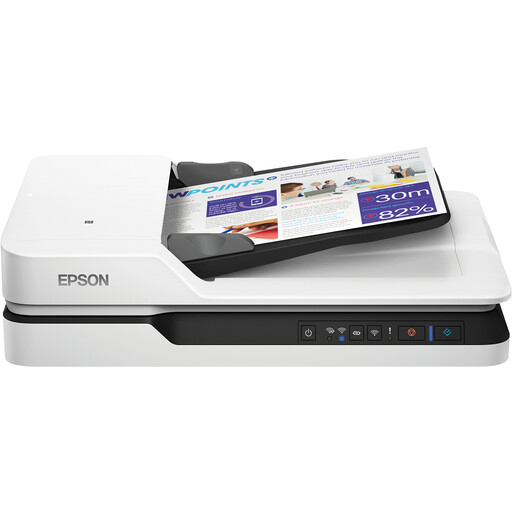 Image unavailable
Epson WorkForce DS-1660W A4 flatbed scanner, 1200 × 1200 dpi, black and white
This flatbed model is suitable only if the album page can lie flat safely, without forcing the binding.
The product name lists A4 and 1200 × 1200 dpi.
The product description lists automatic cropping and skew correction, as well as USB and wireless connectivity.
View at Joybuy
Frequently asked questions
Do I need to open the scrapbook flat or remove photos for a sharp scan?
No. Don’t remove photos just to make them fit on a scanner. First, check the condition of the binding and how the photos are attached; if the pages are fragile or the album has a limited opening angle, careful handling matters more than getting a completely flat image. An overhead scan may be a suitable option in that case.
How can I avoid missing pages or distracting glare?
Take test scans of a glossy page and a curved page, keep track of the page order and check the files after exporting. The National Archives lists checking image quality and looking for skipped pages as part of digitisation. IRIS describes lighting designed to reduce reflections as a feature of the IRIScan Desk 7 Pro; test for yourself to see how it works with your album.
What should I check about returns and the guarantee when buying online?
According to the Dutch Government, many online purchases by consumers in the Netherlands come with a 14-day cooling-off period. You’re also entitled to a product that works as it should; the Dutch Government states that there’s no fixed statutory guarantee period. Check the terms that apply to your purchase, and distinguish between the cooling-off period and a remedy for a faulty product.
Can I include all my family photos in a public school project?
Not automatically. The Dutch Government distinguishes between a private copy for personal use and sharing or publishing copyright-protected work. If a school takes and publishes images in which pupils or staff can be identified, the Dutch Data Protection Authority sets out specific consent requirements. So check who took the photos, who can be recognised in them and how the project will be shared.


