Which camera is right for you?

Creator of detail-focused lessons

You mainly film from above and want to show both small pen movements and the entire writing area clearly. Lens distance and a stable mount are important considerations. Sony Netherlands explains that the minimum focus distance varies by lens; DJI lists a minimum object distance of 20 cm for the Osmo Pocket 3.

Teacher working at a computer

You teach at a single desk and want to record demonstrations on your computer. Control over the desk view and the software workflow are important factors. Logitech describes Show Mode as a way to display sketches and notes on your desk.

Creator of spoken demonstrations

You explain techniques as you write, so you’ll want to consider the camera alongside the positioning and connection of a microphone. The Dutch Consumers’ Association lists an external microphone as a useful video feature, while Canon specifies a microphone input for the EOS R50 V.

What should you look for when choosing?

Consideration What to look for Who should prioritise it?
Focus and pen tip Measure the distance from the camera to the paper and check the minimum focus distance of the specific camera or lens. Test both the full page and a small letter. If I want to show the pen tip and fine ink strokes clearly, I prioritise focus at my working distance. Around 29% of consumers put detail and sharpness first.
Lighting and ink colour Record a test using your own paper and ink while moving your hand across the page. Look out for shadows, reflections and white balance. If you want the paper and ink to remain easy to distinguish while you write, pay particular attention to the lighting. Around 24% of consumers make visibility and colour reproduction their top priority.
Recording at your desk Decide whether you’ll be streaming live or editing later, then check the computer connection, software and field of view you’ll need. If I mainly teach from one desk using a computer, I want recording to fit into my workflow as easily as possible. Around 18% of consumers prioritise this desk-based workflow.
Spoken explanations Record a test lesson in your usual writing position. Check the microphone connection and listen back to make sure your explanation is clear. If you explain techniques aloud while the camera is above the paper, you’ll want your voice to be recorded clearly. Around 17% of consumers put clear instruction first.
Recording in different locations Check the weight, mounting options, storage and the distance at which the camera can focus. If I also want to film short demonstrations away from my usual writing desk, easy portability matters. Around 12% of consumers say mobile filming is their top priority.

Common pitfalls

  • Focusing only on resolution

    A resolution label doesn’t tell you whether the lens can focus at the distance used in your overhead setup. Fine pen strokes could therefore fall outside the focus range.

    Measure the distance from the lens to the paper and record a test showing both the entire writing area and a small letter.

    Depending on the camera you choose, you may need a different lens or an adjusted overhead setup.

  • Assuming every camera needs the same mounting setup

    The load capacity depends on the complete combination of camera, lens, arm, clamp and mounting points. A lightweight camera and a mirrorless camera won’t necessarily need the same mounting arrangement.

    Before mounting, check the load capacity of the entire setup and make sure the camera is secure above the paper.

    You may need to buy a suitable arm, clamp or tripod separately.

  • Assuming a desk-view feature will show small letters clearly

    Logitech describes Show Mode as a way to display notes and sketches on your desk. This doesn’t confirm that fine pen tips will show enough detail in every setup.

    Test the field of view and sharpness using a sample letter on the paper you normally use.

  • Showing identifiable people without checking first

    According to the Dutch Data Protection Authority, identifiable people in images count as personal data. You need a valid GDPR legal basis to record and publish this kind of footage for business purposes.

    Where possible, frame your shot to avoid including identifiable third parties. Otherwise, check which legal basis applies before recording and publishing.

Camera brands to consider

Canon

The EOS R50 V is a mirrorless camera option for a fixed overhead setup, with interchangeable RF lenses and a webcam function.

  • Canon lists a microphone input, headphone output and USB-C webcam function for this model.
  • How well it captures fine pen strokes also depends on the lens, distance, mounting and lighting. The listed connections don’t prove its close-up performance.

Sony

The ZV-E10 II is a mirrorless camera option with interchangeable E-mount lenses for a fixed teaching setup.

  • Sony lists an APS-C sensor and compatibility with E-mount lenses for this model.
  • Sony states that the minimum focus distance varies by lens, so check the specific lens and the intended distance from the paper.

Logitech

The MX Brio is a webcam option for teaching at a fixed desk using a computer.

  • Logitech says Show Mode can display notes and sketches on your desk. It also lists adjustable white balance and exposure.
  • These features don’t independently confirm that fine calligraphy strokes will look sharp in your setup. Test the framing with your own writing area.

DJI

The Osmo Pocket 3 is a portable camera with a fixed lens, for creators who also film away from their usual writing desk.

  • DJI lists a weight of 179 g and microSD storage, with a minimum object distance of 20 cm.
  • The fixed lens gives you less flexibility for close-ups. The available recording distance also affects how well the writing area fits in the frame.

Cameras and webcams for a desk setup

This selection focuses on computer-based recording at a desk, as well as a portable camera for demonstrations in different locations.

AOC 4K PRO webcam with Sony IMX363 sensor

AOC 4K PRO webcam

An option for computer-based recording at a desk. Record a test to check whether the field of view suits your writing area.

The product name lists a Sony IMX363 sensor, PDAF autofocus, dual microphones, a lens cover, a 75° field of view and USB-A/USB-C connections.

View at Joybuy
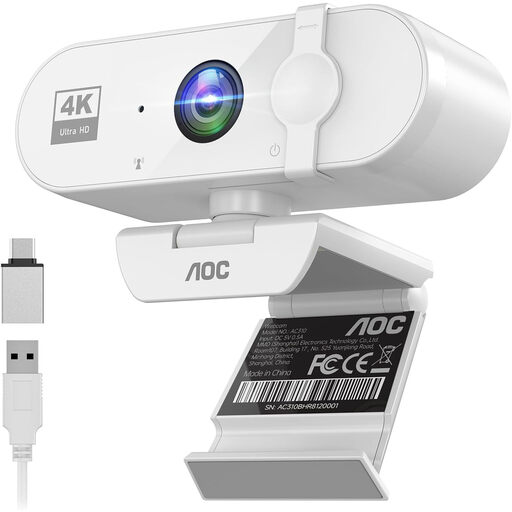
AOC webcam for PC with microphone

AOC 4K webcam for PC

This webcam is designed for computer use at a desk. Test it with a sample letter to check whether the field of view shows enough detail.

The product name lists a 99° field of view, a privacy shutter and noise reduction. The product description mentions a built-in microphone and tilting the camera to show your desk.

View at Joybuy

Logitech HD Pro Webcam C920e

Logitech HD Pro Webcam C920e

A webcam option for a computer at a desk. Check that the mount and field of view suit the position of your paper.

The product description lists a 78° field of view, autofocus, an adjustable clip, automatic light correction and dual microphones.

View at Joybuy

Philips 4000 Series 4K UHD webcam, model SPL6408BT/00

Philips 4000 Series 4K UHD webcam SPL6408BT/00

This webcam is designed for desktop use. Test the focus on your paper and check how it sits above your desk.

The product name lists autofocus, dual microphones, a privacy shutter and the black EU version. The product description mentions mounting on a laptop, desktop monitor or tripod, and a USB-A connection.

View at Joybuy

DJI Osmo Pocket 3 camera

DJI Osmo Pocket 3

A portable option for short demonstrations in different locations. The fixed lens gives you less flexibility for close-ups.

DJI lists a minimum object distance of 20 cm for this model. The product information also mentions a weight of 179 g, a rotating touchscreen and mechanical 3-axis stabilisation.

View at Joybuy

Frequently asked questions

How can you tell whether a camera can sit close enough above a calligraphy sheet?

Measure the distance between the lens and paper in your intended setup, then compare it with the minimum focus distance of that specific camera or lens. Next, test both the entire page and the smallest letter. DJI lists a minimum object distance of 20 cm for the Osmo Pocket 3, while the focus distance of interchangeable lenses can vary from one lens to another.

What should you check before mounting a camera above the paper?

Check that the arm, clamp, connection and supporting surface are suitable for the weight of the complete setup. Manfrotto lists load capacity for each specific arm and tripod model, so don’t assume the same figure applies to a different mount.

What extra equipment might you need for your recording setup?

It depends on the option you choose. You might need a suitable overhead mount, lighting, a microphone and storage. The Osmo Pocket 3 saves recordings to microSD; with a mirrorless camera, the lens you choose also affects the components you’ll need. Check what’s included with each version.

Does consumer protection automatically apply if you buy the camera for your online shop?

No. A business purchase isn’t automatically covered by the same consumer protection. According to the Netherlands Chamber of Commerce, business owners generally have less protection than consumers, although a small business may sometimes be able to rely on consumer law in certain circumstances. Before ordering, check which contract and warranty terms apply to your purchase.

Can you publish identifiable students or employees in an online shop video without checking first?

Not without a valid GDPR legal basis. The Dutch Data Protection Authority treats identifiable people in images as personal data, and you need a legal basis to record and publish this kind of footage for business purposes. Consent is one possible legal basis, but it isn’t the only one. If you don’t film any other identifiable people, the same question doesn’t automatically apply in the same way.
