
Bakers with a favourite baking tin
You mainly want to know whether your tin and the quantity of bars you want to make will fit in the oven in one batch. Recipes may call for different tin sizes.


Start by checking the internal dimensions of your baking tin: the capacity in litres alone won’t tell you whether it will fit in the oven. Then choose a compact model for smaller batches and limited worktop space, or a larger model if you need to use bigger tins and have a permanent place for it. Also check the recommended oven setting, positioning instructions and power connection in your shared kitchen.
You mainly want to know whether your tin and the quantity of bars you want to make will fit in the oven in one batch. Recipes may call for different tin sizes.
You share a worktop and want an oven that fits there and can potentially be put away, with enough room to use it safely.
You follow different recipes and want to be able to select the recommended oven setting. In a shared kitchen, it also matters how easy the appliance is to clean after use.
Recipes from Uit Paulines Keuken and Leuke Recepten, for example, call for tins measuring around 15 × 20 cm and 20 × 20 cm. The Consumers' Association recommends comparing an oven’s internal dimensions with the largest tin you want to use.
| What to consider | What to look for when buying | Who is this important for? |
|---|---|---|
| Baking tin and batch size | Compare the external dimensions of your tin with the usable internal dimensions and shelf space of the exact model. | If I want to use my usual tin in one go, the internal space is what matters most. Around 36% of consumers prioritise their baking tin and batch size. |
| Positioning and power connection | Measure the space available, read the positioning instructions and check that there’s a suitable socket within reach. | In a shared kitchen, I want to know where the oven can be placed safely and how I can connect it. Around 29% of consumers make positioning and connection their main consideration. |
| Recipe setting | Check which setting and temperature the recipe calls for, then compare these with the model’s settings. | If I bake a range of recipes, I want to be able to select the recommended setting. Around 21% of consumers prioritise the required oven setting. |
| Cleaning and running costs | Check which parts can be removed, and only compare energy-use figures if they were measured on the same basis. | In a shared kitchen, I want to be able to leave the oven clean and weigh up its energy use. Around 14% of consumers prioritise maintenance and running costs. |
The capacity in litres won’t tell you whether your baking tin will fit on the rack. Recipes for oat bars use tins in different sizes.
Measure your own tin and compare it with the usable internal dimensions of the exact model.
You may need to use a smaller tin or bake in several batches if yours doesn’t fit.
The oven must be positioned according to the instructions for that model; a shared worktop won’t necessarily have enough space.
Measure the space and check the manual and power connection before choosing a model. The Fire Service recommends plugging high-powered appliances directly into a socket rather than using a cable reel or multi-socket adaptor.
The stated power rating isn’t the same as the energy used per cooking session. Milieu Centraal recommends comparing ovens by their electricity use per cooking session or per year.
Compare energy-use figures measured on the same basis, and choose a size that suits what you actually bake.
The OV-3610 is a small freestanding oven for limited space and smaller baking tins.
The OV207B is a freestanding option with a larger capacity and several oven settings.
The TO 2058 is a larger freestanding oven for those with enough permanent space.
The Optimo OF444810 is a freestanding oven with a capacity of around 19 litres and several cooking settings.
This selection of Joybuy products covers ovens for baking, with a range of sizes and heating settings. For the model you’re considering, check that your tin will fit and that the oven setting suits your recipe.
 No image available
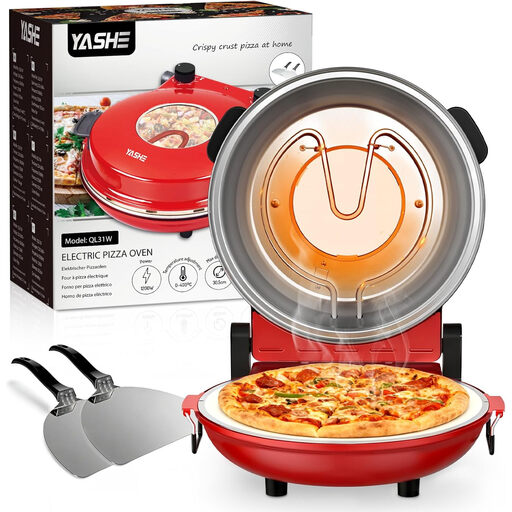
The product title lists top and bottom heat; check whether this setting matches the recipe you want to follow.
The title mentions a built-in timer and viewing window. The product description specifies a 30 cm ceramic stone.
 No image available
The product title mentions fan-assisted cooking and a four-level baking rack; check the product specifications to see which settings suit your recipe.
The title mentions a thermometer, LED display and 35-litre oven capacity. Check the internal dimensions for your baking tin.
 No image available
The product description lists top and bottom heat, fan-assisted cooking and a grill; check which setting your recipe calls for.
The product title lists a power rating of 2000 W. The description specifies a capacity of 45 litres; measure the space available and check the internal dimensions for your tin.
 No image available
The product description lists top heat, bottom heat and a combination of the two. Choose the setting that suits your recipe.
The description mentions a baking tray, rack and four rack positions. Check that the internal space is suitable for your baking tin.
 No image available
The product description lists top and bottom heat for recipes that call for these settings. Check whether your tin will fit in the oven.
The description lists a temperature range of 80–230 °C, a baking tray up to 20 cm and a crumb tray. Its stated external dimensions are 38,5 × 27 × 23 cm.
That depends on the dimensions of your baking tin. Recipes may call for tins measuring around 15 × 20 cm and 20 × 20 cm, for example. Measure your own tin and compare it with the usable internal dimensions. A capacity of 10 litres doesn’t, by itself, guarantee that the tin will fit.
Use the setting and temperature in your recipe as a starting point, and don’t assume they’ll automatically be the same for fan-assisted cooking. For example, a recipe for carrot cake oat bars calls for 175 °C using top and bottom heat.
Follow the positioning and cleaning instructions for the exact model, and let the oven cool down safely before cleaning it. Inventum states that the OV207B has a removable baking tray and crumb tray. The Fire Service recommends plugging high-powered appliances directly into a socket rather than using a cable reel or multi-socket adaptor.
If a product is faulty, the seller must offer an appropriate solution under Dutch statutory guarantee rules. The Dutch Government explains that there is no fixed statutory guarantee period; the circumstances and the product’s expected lifespan are taken into account. Online purchases also generally come with a 14-day cooling-off period after delivery, subject to exceptions, as explained by ACM ConsuWijzer.
Electrical appliances placed on the market under the relevant European rules must carry a CE marking. For the specific product listing, check the product identity, marking and instructions for use; a model being mentioned in this buying guide doesn’t confirm that an individual item has been checked. The Dutch Government and the European Commission explain the relevant product rules.