
Baker with limited worktop space
You have limited worktop space and want to check first whether a freestanding oven will fit where you plan to put it, with enough clearance around it.


First, measure your baking tin and the space available for the appliance. Then compare the usable interior dimensions with the clearance required around the oven. A small freestanding oven may be suitable for one modest-sized nut loaf, while a larger model offers more room but also takes up more worktop space. The Netherlands Nutrition Centre gives a baking time of 45–60 minutes at 180 °C for one nut loaf recipe, so check that the temperature settings and timer will work for your recipe too.
You have limited worktop space and want to check first whether a freestanding oven will fit where you plan to put it, with enough clearance around it.
You want to use a tin you already own, so you’re checking the usable interior height and the space around the tin. The Netherlands Nutrition Centre uses a small baking tin as an example in one of its nut loaf recipes.
You cook other dishes too, and are weighing up the extra oven space against the room the appliance will take up. Milieu Centraal recommends choosing an oven size to suit how you’ll use it.
The Netherlands Nutrition Centre gives a temperature of 180 °C and a baking time of 45–60 minutes for one nut loaf recipe. Use this as a guide when comparing ovens, and always check the instructions for your recipe and chosen model.
| What to consider | What to look for | Who is it important for? |
|---|---|---|
| Fit and positioning | Measure the tin, including its handles and height, and compare it with the model’s internal dimensions and positioning instructions. | If I want to use my baking tin in a small kitchen, I need to know whether both the tin and oven will fit in the space I’ve chosen; around 36% of consumers put fit and positioning first. |
| Baking controls | Check that the temperature range includes 180 °C and see which heating settings the model offers. | For my nut loaf, I want to be able to match the temperature and heating settings to the recipe; around 29% of consumers give baking controls the greatest weight. |
| Cooking time | Compare the timer duration and any continuous setting with your recipe’s baking time, and check how you can keep an eye on the baking process. | If a recipe takes 45–60 minutes, I want to be able to keep a close eye on it; around 21% of consumers prioritise cooking time and supervision. |
| Space and energy use | Compare the usable capacity and, where available, the electricity used per cooking session, making sure the figures are measured on the same basis. | I want enough room for my dishes without choosing an oven that’s bigger than my kitchen or needs require; around 14% of consumers give the most weight to usable space and energy use. |
The capacity in litres won’t tell you whether your tin will fit in the oven; the usable height and width can be crucial.
Measure your tin and compare it with the internal dimensions, shelf positions and positioning instructions for the exact model you’re considering.
The Netherlands Nutrition Centre’s example recipe takes 45–60 minutes. According to the manufacturer, the Rommelsbacher BG 950 has a 30-minute timer with a continuous setting.
Check how the timer and continuous setting work, and keep track of the cooking time yourself if a single timer setting isn’t long enough.
Wattage or oven size alone won’t give you a comparable figure for the electricity used during a cooking session.
Milieu Centraal recommends choosing an oven size to suit your needs and comparing energy use per session or per year. Only compare figures when they’re based on the same measurements.
For the Severin TO 2052, the title and product description give different figures for capacity and power; the manufacturer states 9 litres and 800 W.
Check the full model number and key specifications with the manufacturer and retailer before choosing a version.
The 112713 is a 20-litre freestanding oven with separately or jointly adjustable top and bottom heat.
According to Severin, the TO 2067 is a freestanding oven with a capacity of around 20 litres and separately or jointly adjustable top and bottom heat.
The OV307B is a larger freestanding option; Inventum lists a capacity of 30 litres, fan-assisted cooking and top and bottom heat.
The BG 950 is a 10-litre freestanding oven for anyone short on space who uses a suitably sized, shallow tin.
According to Tristar, the OV-3610 is a 10-litre freestanding oven for smaller spaces.
These models range from compact freestanding ovens to larger options. Measure your baking tin and the space available before comparing capacity or features with your needs.
 No image available
A freestanding oven for anyone looking for more cooking space; bear in mind how much room the appliance will take up.
45 L; 2000 W; white.
 No image available
A freestanding oven for anyone looking for space to cook a larger dish; also measure the ventilation clearance needed where you plan to put it.
35 L; 1800 W; stainless steel.
According to the product information, leave at least 10 cm of clearance on all sides and 30 cm above the oven; placing it in an enclosed cupboard is not recommended.
 No image available
A mini oven to consider if you’re looking for a smaller cooking space; compare your tin’s dimensions with the internal dimensions of this version.
Also check the temperature options and heating settings in the product information for the exact model.
 No image available
This very small oven may suit you if your tin is shallow enough and you’ve checked the limited interior space.
Rommelsbacher lists a capacity of 10 litres and usable interior dimensions of 25,4 × 21 × 12 cm. The timer runs for 30 minutes and has a continuous setting; the Netherlands Nutrition Centre’s example recipe takes 45–60 minutes.
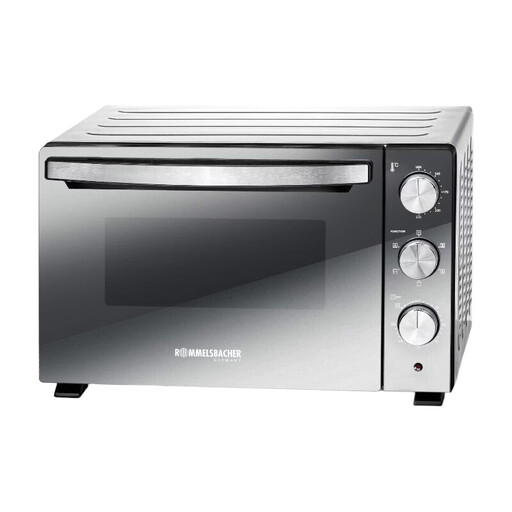 No image available
A freestanding baking and grilling oven for anyone considering a larger model; compare the internal dimensions with your baking tin and the external dimensions with your worktop space.
Check the product information to see whether the temperature settings suit the recipe you want to make.
Measure your tin, including its handles and height, the usable oven space and the area where you plan to put the appliance. Follow the instructions for the exact model regarding the required clearance and connection; the capacity in litres is no substitute for these checks.
Follow your recipe and the oven instructions. The Netherlands Nutrition Centre’s example recipe says to preheat the oven to 180 °C; Rommelsbacher recommends preheating the BG 950 to avoid strong direct heat while the oven is warming up.
The Netherlands Food and Consumer Product Safety Authority states that CE marking is mandatory for electrical products. Check the marking on the appliance you’re considering; a product description alone doesn’t prove that a specific item meets all applicable requirements.
No. According to the Dutch government, there’s no fixed statutory warranty period in the Netherlands; what matters is what you can reasonably expect from the product. If there’s a problem, contact the seller.