
Home baker with a regular cake tin
You want your tin to fit in the oven and to be able to select a suitable setting for the cake you’re serving before lunch. The BBC Good Food recipe and oven information from Inventum and Bosch can help you decide.


First, choose an oven with a suitable baking function and check that your cake tin fits on the shelf. Then decide whether a freestanding model or a built-in oven suits the space and connections in your kitchen. A combination microwave is worth considering if you also want to reheat food, but check the oven function and space for your tin separately: the microwave function does not replace the baking setting in the recipe.
You want your tin to fit in the oven and to be able to select a suitable setting for the cake you’re serving before lunch. The BBC Good Food recipe and oven information from Inventum and Bosch can help you decide.
You’re choosing between worktop space and a suitable built-in space; the connection and heat clearance matter too. The Fire Service advises taking the heat given off by electrical appliances into account.
You’re considering a combination microwave because you want a microwave function as well as an oven, without assuming that the microwave function replaces the right oven setting for the recipe. Samsung describes the MC32DB7746KCE1 as suitable for both oven and microwave use.
The BBC Good Food recipe uses a tin measuring approximately 14 × 24 cm and gives separate settings for a conventional oven and a fan oven. So check both the baking function and whether the tin fits, as well as where the appliance will go.
| What to consider | What to look for when buying | Who is this important for? |
|---|---|---|
| Baking function for the recipe | Check whether the exact model has conventional heat and/or a fan oven setting; follow the temperature for the setting you choose. | If I want to bake the cake using the recipe’s settings, I’ll look for an oven with the corresponding function. Around 33% of consumers put the baking function first. |
| Space for the cake tin | Measure your tin and compare it with the usable interior, door opening and shelf height. | If I have a regular cake tin, I want to know in advance whether it will actually fit inside and sit properly on the shelf. For around 27% of consumers, whether it fits is the deciding factor. |
| Position and connection | Compare the dimensions and connection details of the exact model with your kitchen, and follow the ventilation requirements. | If space is limited in my kitchen, I want to know which type of oven can be installed and connected there. Around 27% of consumers put this question first. |
| Reheating too | Check whether the model has a separate oven function and whether your tin and accessories are suitable for it. | If you’re looking for one appliance for both baking and reheating, you’ll want to use both functions without overlooking the baking space needed for your cake. Around 13% of consumers make combined use their main priority. |
The capacity in litres doesn’t tell you directly whether the width, depth, door opening and clearance will suit your cake tin.
Measure your tin and compare its dimensions with the usable interior and shelf position of the exact model before you choose.
If your existing tin doesn’t fit, you may need to buy a different one.
The BBC Good Food recipe specifies 180 °C for a conventional oven and 160 °C for a fan oven, so the right setting depends on which function you choose.
Follow the recipe temperature for the oven setting you’re using and check whether the cake is cooked as instructed.
Built-in dimensions vary by model, and an appliance needs room to release heat.
Compare the dimensions and connection details of the exact model with your kitchen, and follow the connection and ventilation instructions.
Depending on your kitchen, you may need to make changes to the space or installation.
The freestanding OV307B is an option if you’re not looking for a built-in oven.
The freestanding TEO4500B is an option if you’re looking for a worktop oven with a larger stated capacity.
The HBA534BB3 is a built-in oven to consider if your kitchen has a suitable space for one.
The OS6AB50AK is a built-in oven with conventional and fan settings.
The MC32DB7746KCE1 is a combination microwave for anyone who wants to reheat food as well as bake.
This selection includes freestanding ovens and combination microwaves with an oven function. For each model, check separately whether your cake tin will fit and whether the available settings suit the recipe.
 Image unavailable
A freestanding oven to consider if you’re looking for an appliance for your worktop; check that your cake tin fits in the usable space.
The product title lists a 35-litre capacity and a four-tier baking rack.
Place the appliance on a stable, heat-resistant surface and keep the air inlet and outlet clear.
 Image unavailable
A combination microwave to consider if you want a microwave function as well as an oven; check the cooking space and suitable accessories for your tin.
The product title lists a 25-litre capacity, a grill and convection.
Don’t put metal or aluminium foil in the microwave unless the manual expressly allows it.
 Image unavailable
A freestanding oven to consider if you’re looking for a larger model and have a suitable space; measure your tin and check the available room.
The product title lists a 65-litre capacity and 2000 W.
Use the oven indoors in a dry environment and keep the ventilation openings clear.
 Image unavailable
A combination microwave to consider if you want to bake and reheat with one appliance; check that the oven space suits your cake tin.
The product title lists a 20-litre capacity, a grill and convection.
If you place it in a cupboard, follow the ventilation requirements and don’t put metal in the microwave.
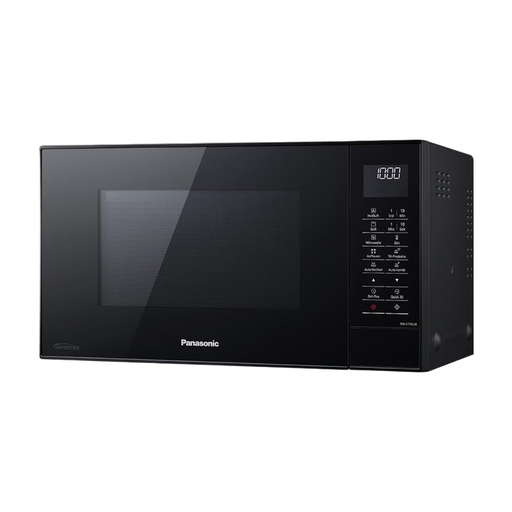 Image unavailable
A combination microwave to consider if you want to reheat food as well as bake; check that your cake tin fits in the oven space.
The product title lists a 27-litre capacity and a microwave power rating of 1000 W.
Don’t use metal objects in microwave mode, and leave enough ventilation space around the appliance.
The BBC Good Food recipe calls for 180 °C in a conventional oven or 160 °C in a fan oven, for 45–50 minutes. Insert a skewer into the centre; according to the recipe, the cake is ready when it comes out clean. These are recipe timings and temperatures, not fixed settings for every oven or cake.
Measure the tin you actually use and compare it with the usable interior, door opening and shelf position. The BBC Good Food recipe uses a tin measuring approximately 14 × 24 cm; the capacity in litres alone isn’t enough to tell whether it will fit.
Follow the positioning and connection instructions for the exact model. The Fire Service advises allowing heat from ovens and microwaves to escape, and recommends plugging high-power appliances directly into a socket rather than using a multi-socket adaptor or cable reel.
No. According to the Government of the Netherlands, there is no fixed statutory guarantee period in the Netherlands; you’re entitled to a product that works properly for as long as you could reasonably expect it to. If a product is faulty, the retailer is your point of contact; a manufacturer’s guarantee may give you additional rights.
No. The European Commission describes energy labelling rules for household ovens and lists small and portable ovens, among others, as exceptions to the scope. So don’t automatically compare a portable oven without a label with the label of a built-in oven.