
Workshop baker making one cake
Wants to set the recipe’s oven setting easily and check in advance that the cake tin will fit. Measure the tin and compare it with the internal dimensions.


Start by checking the internal dimensions: your cake tin needs to fit with room around it. Then choose an oven with the setting specified in your recipe; 24Kitchen recommends 160 °C with conventional top and bottom heat for lemon drizzle cake. A built-in oven needs a suitable housing unit, while a freestanding model is for a standalone setup. A mini oven is only suitable if your tin fits and you can position it correctly.
Wants to set the recipe’s oven setting easily and check in advance that the cake tin will fit. Measure the tin and compare it with the internal dimensions.
Needs usable internal space, suitable shelf positions and straightforward controls. Check whether you can bake several items at once on the relevant setting and model.
Is looking for a freestanding oven and needs to check there’s enough worktop space, room for heat to escape and a suitable electrical connection.
24Kitchen recommends 160 °C with conventional top and bottom heat for lemon drizzle cake. The Consumentenbond advises checking the internal dimensions rather than relying on the capacity in litres alone.
| What to consider | What to look for | Who this matters to |
|---|---|---|
| Recipe setting | Check whether the model has conventional top and bottom heat and the temperature setting you need. | If you want to bake the cake according to your chosen recipe, look for an oven with the right setting and an easy-to-adjust temperature. Around 33% of consumers say recipe settings are their main consideration. |
| Room for baking tins | Measure your largest tin and compare it with the internal dimensions and available shelf positions. | If you use different tins during a workshop, you’ll want to know in advance what will actually fit in the oven. Around 27% of consumers prioritise suitable baking tins and usable space. |
| Positioning and connection | For built-in ovens, check the housing unit dimensions; for freestanding ovens, follow the positioning and ventilation instructions. | If there’s no suitable housing unit or the workspace is a deciding factor, the oven needs to suit the space and connection available. Around 27% of consumers give positioning top priority. |
| Energy use | Where available, compare the electricity used for each baking programme; don’t judge it by the energy rating letter alone. | If you use the oven regularly, you’ll want to know how much energy the chosen setting uses. Around 13% of consumers prioritise energy use and running costs. |
The usable internal space may be smaller than the stated capacity, so your cake tin might not fit after all.
Measure your largest tin and check the internal dimensions, shelf and clearance around it.
According to the Consumentenbond, some combination microwaves may not have bottom heat or several shelf positions.
Check the settings and available space of the exact model against your recipe and baking tin.
Electrical appliances need room to release heat. You may also be using several appliances at once during a workshop.
Follow the instructions and check the workspace and connection in advance. If you’ll be using the oven commercially, also check the terms of use for your chosen model.
You may need to adapt the workspace or connection before the oven can be used safely.
Milieu Centraal also recommends comparing ovens by how much electricity they use per use; a larger oven may use more energy.
Compare the stated energy use for a suitable baking programme and choose a size that works with the tins you use.
The Bosch HBA534BB3 is a built-in oven with conventional top and bottom heat, 3D hot air and a stated capacity of 71 litres.
According to Inventum, the freestanding Inventum OV607B has a capacity of 60 litres, conventional top and bottom heat and hot air.
According to the manufacturer, the compact freestanding Severin TO 2068 has a capacity of 20 litres, with conventional top and bottom heat and hot air that can be used separately.
According to Siemens, the built-in Siemens HB534AER3 has conventional top and bottom heat, 3D hot air, a stated capacity of 71 litres and one telescopic rail.
According to the manufacturer, the built-in Whirlpool WOI78HT1SBA has a stated capacity of 73 litres and automatic recipes.
This selection includes freestanding and built-in ovens for baking cakes. Check that each model’s settings, internal dimensions and positioning suit your recipe and baking tin.
 No image available
A freestanding model for anyone without a built-in housing unit; follow the positioning instructions and keep the ventilation openings clear.
The product information lists convection heating, adjustable time and temperature, and a four-level baking rack. The stated capacity differs between the product title and the additional information, so check the internal dimensions to make sure your baking tin will fit.
 No image available
A built-in option for anyone with a suitable housing unit who wants to take the available shelf positions into account.
The product information lists a capacity of 71 litres, conventional top and bottom heat, 3D hot air, telescopic rails and baking on up to three levels. Check the housing unit dimensions before installation.
 No image available
A built-in option for anyone with a suitable housing unit who wants to use both conventional top and bottom heat and hot air.
The product information lists a capacity of 66 litres, baking on up to three levels and a temperature range of 50 °C to 275 °C. Check the dimensions before installation.
 No image available
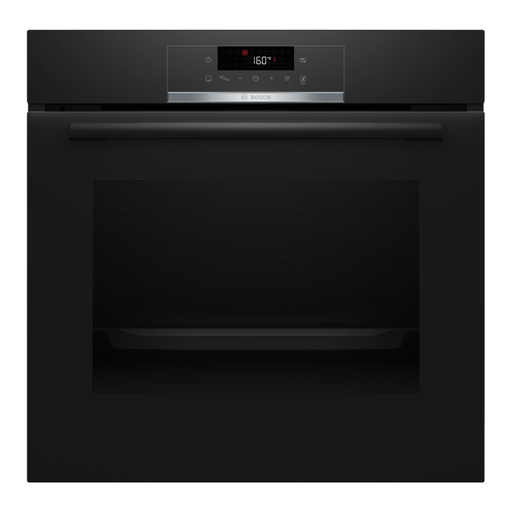
A built-in oven for anyone with a suitable housing unit who wants a recipe setting with conventional top and bottom heat.
The product information lists a capacity of 71 litres, conventional top and bottom heat, 3D hot air and baking on up to three levels. Check the housing unit dimensions before installation.
 No image available
A built-in option for anyone with a suitable housing unit who wants to compare the available heating settings with their recipe.
The product information lists a capacity of 71 litres, conventional top and bottom heat, 3D hot air and a temperature range of 30 °C to 275 °C. Check the housing unit dimensions before installation.
Follow the recipe you’re using. The 24Kitchen recipe consulted recommends preheating the oven to 160 °C with conventional top and bottom heat, then baking for around 60 minutes. Don’t use that time and temperature without adjustment for a different recipe or oven setting.
Only if the oven setting, model and tins are suitable. The Consumentenbond describes hot air as a setting for cooking dishes on different levels, but that doesn’t confirm that the ovens mentioned here will deliver even results.
Follow the instructions on positioning and heat clearance, and check the connection in advance. The Dutch Fire Service advises plugging high-power appliances directly into a socket where possible, rather than using a multi-socket adaptor or cable reel. This is safety advice, not a general legal installation requirement established here.
No. A two-year manufacturer’s warranty is not automatically the limit. ACM ConsuWijzer explains that statutory consumer rights apply alongside any seller’s or manufacturer’s warranty. If a product breaks sooner than you could reasonably expect under normal use, the seller is responsible for providing an appropriate solution. What’s appropriate depends on the circumstances.